A bargain mini skid steer can work, but the buyer inherits the dealership
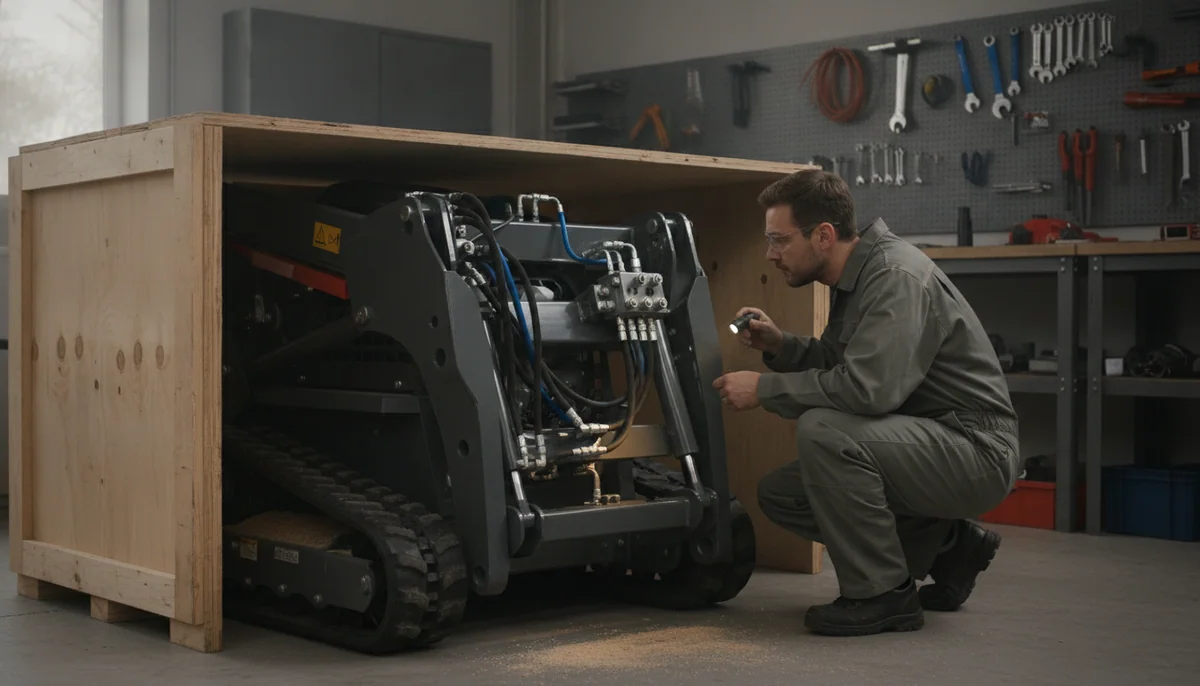
Cheap does not mean useless. Exact owners have moved road rock, dirt, logs, stall bedding, firewood, concrete bags and landscaping material with the machines covered here. A compact loader can replace an astonishing amount of shoveling and wheelbarrow work when the route is short, the ground is suitable and the job begins with a bucket.
Good does not mean proven, either. The strongest exact-model record on this page reaches only 36 hours, while several otherwise favorable records stop at 10, 15 or 16 hours. Those reports establish early utility, not track life, pump life, wiring durability, seasonal reliability or the speed of a serious parts claim.
The fast answer
Buy the job, not the badge
The HUAYEE HY480C has the strongest conditional case
It has the deepest exact-owner record in this group, visible three-section hydraulics and reported work with buckets, forks, a grapple, mixer, cutter, power rake and trencher. Its honest drawbacks are serious: one machine leaked fuel from the low filler while pointed uphill with a full tank, another owner stopped after the hydraulic-temperature display climbed beyond 71 °C on the factory fluid, and the longest disclosed exact-model account still ends at 36 hours.
Several bucket-first machines earn a narrower yes
The HUAYEE HY360C and wheeled MMS MS360L or MS380L make sense for light material work on firm ground, while the MACHPRO MP-380-YE adds an unusually useful 4-in-1 bucket and a seller-claimed three-pump system. Their shared limitation is immaturity: the relevant owner records end between 10 and 16 hours, the MMS machines are two-pump designs, and the MACHPRO listing never turns aggregate hydraulic flow or conflicting lift labels into verified attachment performance.
The rest must prove themselves before they deserve an order
The TYPHON STOMP has promising hardware but no exact-ASIN owner consensus, while the MMS MS360T, Wolfequip T460 variants, ATS Power T460 and two DigSwift loaders remain blocked by identity conflicts, safety questions, contradictory specifications or records too thin to support the claims. The HUAYEE HY480D is the clearest pass because one owner reported very early failure of both the original engine and its replacement.
The owner’s mechanical ability is part of an inexpensive import’s real specification. If changing fluids, tracing a hydraulic line, identifying a fitting and parking the machine while a model-specific part travels sound unreasonable, the purchase is already a poor fit.
Country of assembly is not the useful distinction
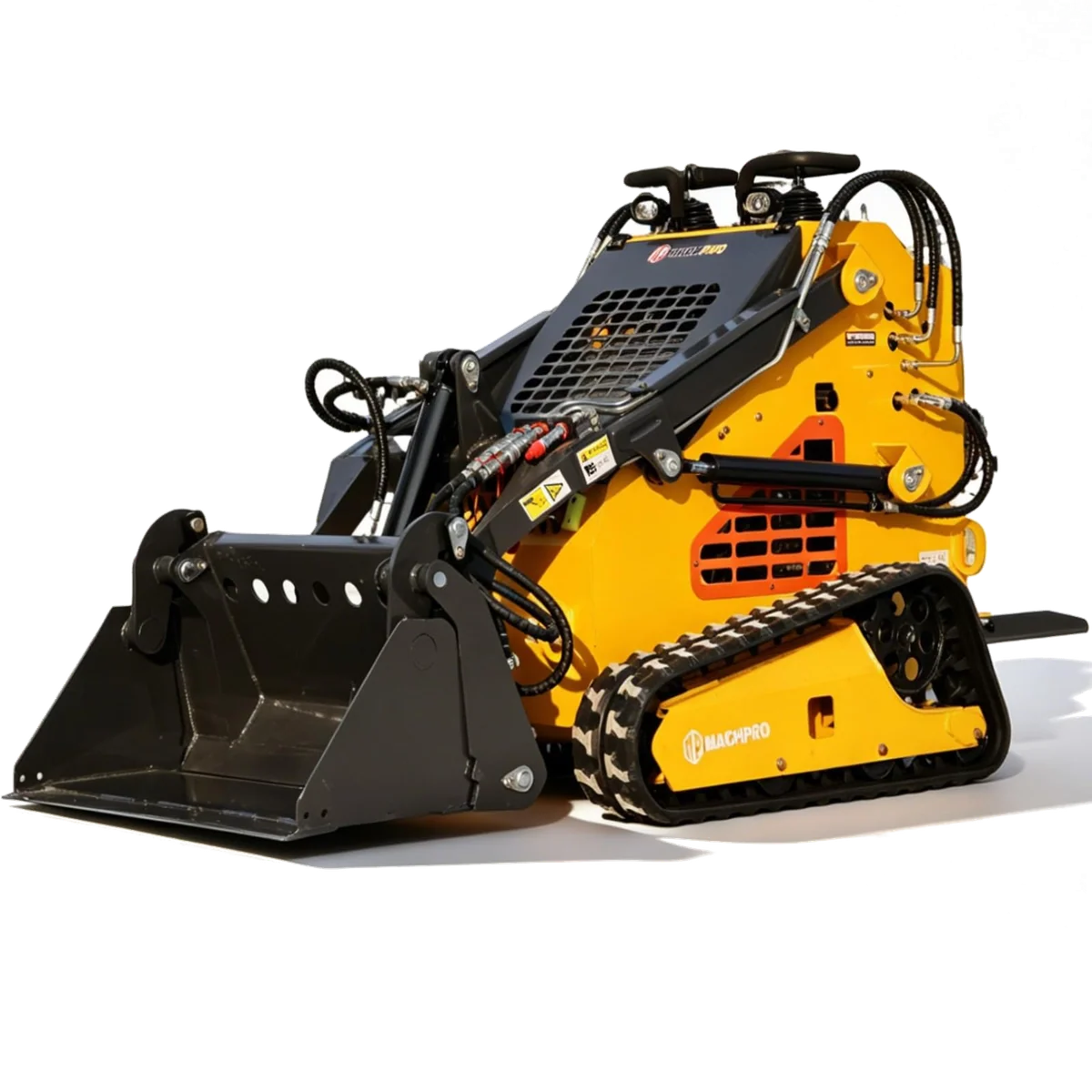
These are compact hydraulic loaders, usually controlled from a rear platform and steered by varying the left and right drive sides. Their small footprint creates the access advantage explained in our mini skid steer primer, but it also limits stability, service space and the amount of machine available to absorb a mistake.
Calling every one of them a Chinese mini skid steer hides the questions that decide the purchase. Two similar-looking loaders can use different engines, pump stacks, coolers, tracks, attachment plates, valves and safety logic. A recognizable badge can also cover several production revisions, and a familiar platform name such as T460 does not guarantee a common bill of materials across sellers.
The MMS MS360T supplies the sharpest warning. Amazon’s public listing describes a 13.5 HP Briggs & Stratton machine with triangular tracks, while a separate catalogue measurement tied the same ASIN to an MS380B with a 23 HP RATO engine and parallel tracks. Neither of the two brief customer comments identifies the engine, model plate or undercarriage, so even its favorable rating cannot settle which machine the reviewers received.
ATS Power and TYPHON show the same problem in less dramatic forms. The ATS listing gives two different lift figures, mentions tire dimensions on a tracked machine and supplies no coherent explanation of its hydraulic-flow number. The TYPHON listing calls its tracked STOMP both 2,000 and 1,830 pounds, then describes hydraulic four-wheel drive in the same record. Sloppy copy does not prove bad steel, but it prevents the copy from carrying a safety-critical decision.
Skid Steer Mulch did not operate, weigh, load-test or flow-test these machines. This assessment gives exact listings and exact customer reports the most weight, uses clearly identified sibling and category evidence only to expose mechanical questions, and leaves a number unknown when the record cannot support it.
The closest thing to a responsible shortlist
Recurring acreage work
Start the investigation with the HUAYEE HY480C
The HY480C has the best combination of exact-owner task evidence and visible hydraulic hardware in this set. Owners report moving dirt, rock, firewood, engine blocks and close-carried fork loads, while one 36-hour account describes the supplied bucket, forks, grapple and mixer in actual property work. Three hydraulic sections also make it more credible than a basic two-pump loader when an attachment and both tracks must operate together.
That recommendation remains conditional because the fuel-filler leak is a genuine hazard, the heat record is mixed and 36 hours is still a commissioning horizon. The seller must provide a manufacturer-approved response to the fuel leak, exact continuous auxiliary output, the delivered engine identity, track parts and written warranty obligations before this becomes a sensible order. The full HY480C review follows each of those issues to its source.
Light work on firm ground
Choose a wheeled loader only when the bucket is the point
The HUAYEE HY360C has the cleanest small-property story. One exact owner used its bucket in livestock stalls, another described smooth controls in the first three hours, and a 16-hour review remained favorable. Its Briggs engine is easier to identify than an unnamed powerplant, but the dual-pump architecture, missing auxiliary flow and absent long-term record make powered tools and commercial dependence poor bets. Read the HY360C review before treating its larger maximum-lift claim as payload.
The MMS MS360L and MS380L occupy a similar lane. Exact reports support greenhouse grading, landscaping, road-rock and dirt movement, while one 10-hour owner explicitly identifies a two-pump machine and says a three-pump configuration would offer more flexibility. Their wheels favor firm lanes, barn floors and established yards, but delivery reports include bad batteries, a poor pallet, shipping damage and broken hand levers. The MMS wheel-model comparison keeps the two versions separate.
Maximum usefulness from the first bucket
The MACHPRO MP-380-YE has the most persuasive included attachment
Its 4-in-1 bucket can scoop, clamp and doze without forcing the buyer to order a separate basic grapple immediately. Exact owners report grading, moving logs and using the jaw to dig, bulldoze and grab, while the longest disclosed account reached about 15 hours without reporting a failure.
The drawback is everything those 15 hours cannot answer. The listing’s 19 GPM headline is aggregate system flow rather than established auxiliary output, its 881-pound rated-load claim sits beside a lower 827-pound maximum-lifting-force claim, and its listed 43.3-inch width already excludes many residential openings. The MP-380-YE review explains why the bucket earns a conditional yes while the machine still fails a production-uptime test.
Promising hardware, missing proof
The TYPHON STOMP belongs behind the proven property tools
A close tracked GX690 owner showed three pumps, substantial-looking steel, large hoses, a thick cooler, greasable points and a cushioned platform after roughly eight to nine hours. That is better hardware evidence than many anonymous listings provide, and it gives the machine a plausible path to useful attachment work.
The exact Amazon listing had no ratings when captured and still does not define its 830-plus-pound lift claim, exact width, auxiliary flow, case drain or continuous-duty limit. It earns investigation by a capable owner, not priority over the better-documented HY480C. The TYPHON STOMP review separates this gasoline tracked model from the larger diesel machines that share the name.
Some listings disqualify themselves before the machine starts
A weak record is not proof of a weak machine, but equipment does not earn trust by asking the buyer to supply every missing fact. The following products remain passes because their unresolved risk is larger than the evidence of useful ownership.
HUAYEE HY480D: one severe reliability account changes the answer
One owner reports the original engine losing power and burning oil between roughly 11 and 20 hours, followed by a replacement engine that lasted no more than 12 hours. Three retained reviews cannot establish a failure rate, but two very early engines on one purchase are enough to rule out commercial duty and most homeowner recommendations while diagnosis, labor and freight remedies remain unclear. The HY480D review preserves the conflicting owner timeline rather than converting it into a maintenance theory.
MMS MS360T: the ASIN does not establish which loader will arrive
A 13.5 HP Briggs machine with triangle tracks and a 23 HP RATO machine with parallel tracks are not harmless variants of one fact sheet. The exact review record contains only two arrival-day comments, including one unresolved control complaint, so the seller must resolve the configuration conflict and provide hydraulic, capacity, track and safety data before the model deserves reconsideration.
Wolfequip T460S1 and T460S1WH: the safety question comes first
A close Wolf Equip owner account reports that the controls remained active with nobody on the platform, suggesting that the filmed configuration lacked an operator-presence interlock. The exact listings do not resolve that concern, define their lift methodology, publish useful hydraulic data or establish a long-term parts path. The bucket-and-forks bundle also advertises fork-component ratings far beyond the loader’s undefined lift claim, while the fork assembly consumes capacity before any cargo is added. The Wolfequip review remains a no until the current safety logic is documented.
ATS Power T460: basic work is plausible, dependable ownership is not
The exact listing conflicts between 770 and 840 pounds of lift, uses a malformed fuel-capacity unit, mentions tires on a tracked loader and leaves the meaning of its hydraulic-flow number unresolved. Its sole retained written review is positive about operation but says the owner’s manual was missing, which is a meaningful fault on a freight-delivered hydraulic machine. The ATS T460 review gives it a narrow property-owner path only after the engine, pumps, track code, manuals and parts route are confirmed.
DigSwift DS-S40 and DS-SS50: the product record is not finished
The DS-S40 advertises a compelling 39.4-inch width and coherent metric conversions, but it omits pump count, auxiliary output, tipping load, plate standard, safety systems, track parts, delivery obligations and a meaningful warranty, while its one retained review gives no hours or task. The DS-SS50 adds a 23 HP claim and useful plate dimensions, yet its two retained reviews are one unexplained one-star accusation and one unexplained five-star line; the listing still does not establish hydraulics, usable capacity, operating weight, safety logic or support.
Six tests matter more than the horsepower decal
-
Can the seller identify the machine that will actually ship?
Request current photographs of the machine plate, engine tag, EPA label, pump stack, cooler, front couplers, attachment plate, undercarriage and track marking. Put the engine, pump count, bucket, platform, build revision and every separate crate on the written order. If a substitution is allowed, define exactly what can change and who pays when the substitute removes a feature that motivated the purchase.
-
Can the hydraulics power the job while the loader still travels?
A two-pump machine can be perfectly useful with a bucket, forks, land plane or intermittent grapple. It becomes a poor carrier when continuous auxiliary flow takes oil that one drive side needs, as a separate attachment test demonstrated when a cutter could spin or the loader could travel normally, but not both in a useful straight pass. A third pump can separate those functions, yet pump count still does not reveal auxiliary flow at working pressure, relief setting, return restriction, case-drain provision, cooling capacity or duty cycle.
Before buying a cutter, trencher, tiller, sweeper, grinder or mulcher, obtain the exact machine’s continuous auxiliary output and match it to the attachment maker’s requirements. The site’s two-pump and three-pump guide explains the plumbing, while the attachment compatibility guide covers the mount, couplers, case drain, mass and hose routing.
-
Does the lift number describe a usable load?
Rated operating capacity, tipping load, breakout force and maximum hydraulic lifting force are not interchangeable. The attachment’s own weight counts before material is added, and forks move the load center forward as the pallet travels farther from the chassis. A seller who gives one large number without its measurement point, attachment, height, load center, surface and ballast condition has not supplied a load rating a buyer can use.
Never average contradictory claims or choose the largest label. Ask for the load chart and use the method in our mini skid steer capacity guide before planning pallets, boulders, logs or full-height truck loading.
-
Will the complete machine reach the work?
Overall chassis width, bucket width, platform position, approach angle and turning room all matter. A 39.4-inch machine does not belong in a 39.4-inch opening, and a narrow chassis does not help if its delivered bucket cannot clear the gate. Measure between hinges, latches, posts and trim, then follow the entire route with the method in our gate-width guide.
Wheels generally suit firm lanes and hard surfaces, while tracks provide better flotation and traction in soft ground. Neither undercarriage guarantees kindness to turf during a skid turn, and tracks do not make a short loader calm over roots, ledges or embedded rocks.
-
What stops the machine when the operator loses position?
Require a written description and demonstration of operator-presence logic, neutral-start protection, the parking or hydraulic lock, auxiliary lockout, emergency stop and the approved lift-arm support. The Wolfequip concern shows why this cannot be inferred from a photograph, while broader mini-loader evidence shows how a small rock can pitch a standing operator even when the tracks retain traction.
A climbing claim is not a side-slope rating, and a side-slope rating would still need a load, attachment and travel direction. Carry loads low, avoid abrupt turns and use the exact manual’s limits; our slope-safety guide explains why grip and stability answer different questions.
-
Can a real part be identified, bought and installed?
A local hydraulic shop may duplicate a marked hose, and familiar filters, bearings, fittings or pump geometry can sometimes be cross-referenced. Tracks, sprockets, idlers, drive motors, valve bodies, cylinders, pins, frames and wiring revisions are more model-specific. A machine can be simple to repair and remain unusable because the required part has no public number or domestic stock.
Get the warranty duration, exclusions, diagnostic process, labor coverage, parts freight, return freight and commercial-use terms in writing. Then request the operator manual, service schedule, hydraulic and wiring diagrams, fluid specifications, filter numbers, track code and major component identifiers before payment, when an unanswered question can still stop the sale.
Ownership begins when the freight truck arrives
Low-cost imported equipment often shifts work that a conventional dealer would perform onto the buyer. Category owners have reported useful service beyond the exact records on this page, including one roughly 40-hour account and another much longer ownership report, but their satisfaction commonly includes fluid changes, track work, added protection, bearing attention, electrical fixes or parts research. That is evidence that the ownership model can work for a capable person, not proof that every crate contains a finished machine.
Treat delivery day as a commissioning appointment
This checklist reflects recurring arrival and setup issues in the supplied record; it does not replace the exact machine’s manual, safe blocking procedure or carrier terms.
- Confirm the freight vehicle, packaged dimensions, shipping weight, access route, appointment notice, liftgate capacity, ground-placement obligation and failed-delivery charges before dispatch.
- Photograph the unopened crate or pallet, every side of the machine, the hour meter, data plate, engine tag, tracks or tires, attachments and visible damage before signing.
- Match the delivered engine, pump count, cooler, couplers, attachment plate, bucket and undercarriage to the written order before operating the machine.
- Check engine oil, hydraulic-fluid level and every other manual-specified fluid physically rather than assuming the factory fill is empty, full or correct.
- Inspect accessible fasteners, fittings, hoses, wiring, battery restraint, grease points, attachment locks, wheel hardware or track tension according to the exact service procedure.
- Identify the start sequence, auxiliary neutral, parking system, emergency stop and operator-presence functions before moving the loader from the delivery area.
- Test travel, steering, lift, curl and approved safety systems at low speed on clear, level ground, then stop for leaks, rubbing, abnormal heat, creep or loose hardware.
- Record the part numbers for filters, belts, tracks, rollers, idlers, seals, pumps, valves, controls and electrical components before the machine earns a time-sensitive job.
A missing manual is not a small annoyance when the owner needs track tension, fluid specifications, safety logic and service intervals. An attentive buyer can correct a loose fitting or weak battery; improvising relief pressure, ballast, slope limits or raised-arm service procedures is a different category of risk. Our first-use inspection guide expands the practical checks without assuming that every imported loader arrives unfinished.
Buy, rent or walk away according to the cost of a stopped machine
Buy cautiously
Recurring private-property work can justify the risk
Ownership can make sense when bucket, fork, grapple or light grading chores recur throughout the year, the route is known, storage is available and the owner can perform fluids, filters, fastener checks and basic diagnosis. Delayed work must be inconvenient rather than financially damaging, and the chosen machine still needs exact documentation before purchase.
Start with the small-farm and property shortlist when barns, acreage and repeated material handling define the job, or use the value-focused roundup when total ownership cost matters more than the lowest entry point.
Rent first
A concentrated project needs productivity, not a permanent experiment
One large grading, trenching, clearing or earthmoving project rarely justifies owning a lightly documented carrier plus an attachment whose productive match is unknown. A rental provides known capacity, a tested attachment, maintenance outside the buyer’s garage and a useful trial of access, controls and real workload.
Use the rent-or-buy framework to count transport, maintenance, storage and downtime rather than comparing only acquisition and rental charges.
Walk away
Commercial dependence deserves a stronger support chain
A one-machine contractor, repair-averse homeowner, steep property, rough access route or plan centered on a cutter, grinder, sweeper, trencher or mulcher falls outside the evidence for most of these products. The powered-attachment shortlist is the better starting point when hydraulic work must continue as the loader travels.
The final call
Some inexpensive imported mini skid steers are good at a narrow, valuable job: replacing manual material handling for a mechanically capable property owner. The HY480C presents the strongest conditional case in this set, while the HY360C, MMS wheel models and MACHPRO MP-380-YE can make sense when their simpler, bucket-led roles match the property and their limitations are accepted.
None of them has earned a blanket reliability endorsement, and several have not earned an order at all. If the seller cannot identify the exact machine, define the lift rating, document the hydraulics and safety systems, provide manuals and name the parts route before payment, the answer is no. The low purchase barrier does not remove the missing dealership; it appoints the buyer to run it.
Frequently Asked Questions
Questions buyers should settle before ordering
Can an inexpensive imported mini skid steer be reliable?
It can provide useful service, but the exact products here have owner records too short to establish normal lifespan, failure rates or dependable commercial uptime.
Which model has the strongest owner record in this group?
The HUAYEE HY480C has the strongest conditional case because exact owners document varied work through as much as 36 hours, although its fuel-leak, heat and support questions prevent an unconditional recommendation.
Can a two-pump machine run a brush cutter or trencher?
It may spin the attachment, but a two-pump layout can sacrifice one side of travel or require stop-and-start repositioning, so verify simultaneous operation and continuous hydraulic output before buying the tool.
Are parts for these loaders easy to obtain?
Common hoses, fittings, filters and some hydraulic components may be locally matchable, while tracks, motors, valve bodies, frames and revision-specific hardware can require seller help, overseas sourcing or extended downtime.
Does a familiar Briggs, Honda or RATO engine solve the support problem?
No, because engine identity may improve one parts path but does not supply the loader’s pumps, controls, cylinders, tracks, drive motors, wiring, safety logic or warranty labor.
Are tracked mini skid steers safer on slopes?
No, tracks can improve traction and flotation without improving the short chassis’s rollover, pitch or raised-load stability, so use the exact manual’s limits and avoid treating grip as permission.
Should a contractor buy one of these machines?
Not as a revenue-critical primary loader on the evidence available, because the exact durability records are short and the parts, labor and downtime remedies remain less certain than the jobs they would support.
Sources (2)
- Amazon listings and customer reviews
- Owner and reviewer video, 9 channels