Our low-cost Amazon snapshot showed most mini skid steer listings clustered in the middle of four figures, and the loader was only the first line on the ownership bill.
Skid Steer Mulch captured historical listing prices for 11 of the 13 machines on this page. Eight formed a tight cluster around the middle of four figures, while three sat above it; the highest captured listing was almost twice the lowest and stopped just short of five figures. Those are historical listing tiers and relative comparisons, not live offers, actual transaction prices or an all-in ownership range.
That captured purchase tier is not an ownership estimate: the budget must also cover required work tools, transport, commissioning, service, repairs and downtime that the listing does not settle.
Start with the first-year ledger, not the listing
No single annual-cost figure survives differences in taxes, workload, fuel, attachments, transport, insurance, repairs and resale, especially when most owner reports stop within a few dozen hours. A tidy number would hide the costs that separate a useful private-property tool from a stranded business asset.
First-year cash outlay
(Cash purchase price or first-year down payment and principal) + interest and financing fees + taxes and fees + required attachments + transport and storage setup + commissioning + first-year operation and repairs.
True annual ownership cost
Depreciation + interest and financing fees + insurance and storage + fuel and scheduled service + wear and repairs + the cost of downtime.
Cost per productive hour
True annual ownership cost ÷ hours spent doing the work that justified the purchase.
Productive hours are not the same as hour-meter hours. Freight-yard movement, warm-up, idling, diagnosis, attachment wrestling and a machine waiting with its hood open may advance time without completing the job. For a business, the denominator should be billable or genuinely useful work; for a property owner, it should be the recurring chores the loader actually replaces.
| Line item | Put this in the budget | The common undercount |
|---|---|---|
| Machine | The written price for the exact model, engine, undercarriage, bucket and production revision. | A cheaper sibling or reused model name may not have the same pumps, cooler, controls, tracks or engine. |
| Transaction and delivery | Tax, marketplace or financing costs, freight, appointment terms, liftgate service, ground placement and redelivery risk. | “Unloading included” does not define the truck, surface, pallet position, site access or damage process. |
| Work tools | Every bucket, fork, grapple, auger, adapter, hose, coupler and case-drain line required for the real job. | An attachment that latches but runs badly still creates a purchase cost and can become a stranded asset. |
| Transport and storage | Trailer payload, tow rating, ramps, brakes, tie-downs, secure storage and any floor or gate constraints. | Machine weight is only the start; the bucket, fuel, forks, spare tool and trailer all count. |
| Commissioning | Manuals, fluids, filters, grease, battery testing, torque checks, track or tire setup and a deliberate first inspection. | Inspection or assembly omitted before shipment can reappear as owner labor on freight day. |
| Routine operation | Fuel, engine oil, hydraulic service, filters, grease, cleaning and the owner’s maintenance time. | A seller’s fuel claim cannot establish operating cost for a particular tool, throttle setting and site. |
| Wear and repair | Tires or tracks, rollers, idlers, sprockets, pins, hoses, fittings, batteries, switches, seals and parts freight. | A generic hose may be local; a replacement track with the required pitch, a model-specific drive motor or a fabricated bracket may not be. |
| Downtime | Diagnosis, recovery, backup rental, rescheduling, idle labor and work that cannot be billed or completed. | A repair invoice records the part, not the days the machine failed to earn or save money. |
| Exit | Likely resale proceeds minus selling, transport and any repair needed to make the machine saleable. | A low purchase price is not low depreciation when the used market cannot identify or support the model. |
The budgeting rule
Do not compare a delivered loader quote with a rental day rate; compare total costs for the same jobs over the same period, or convert every option to cost per completed job or productive hour.
The bucket-alone test decides whether buying is sane
Remove every aspirational attachment from the plan for a moment. If the included bucket cannot justify the machine through recurring material moving, cleanup, backfilling or grading, do not buy the carrier in the hope that a cutter, trencher or grinder will rescue the economics. Powered tools add three separate risks before they perform one useful hour.
Records for the MMS MS360L, MMS MS380L and standard ATS T460 describe two-pump layouts that warrant caution because continuous attachment power can compete with travel. The three-section hydraulic system documented on the HUAYEE HY480C is a more credible starting point, but pump count still does not establish measured flow, pressure, case-drain plumbing or a sustainable hot-weather duty cycle. Our two-pump and three-pump guide explains the circuit problem, while the attachment-compatibility guide covers the complete match.
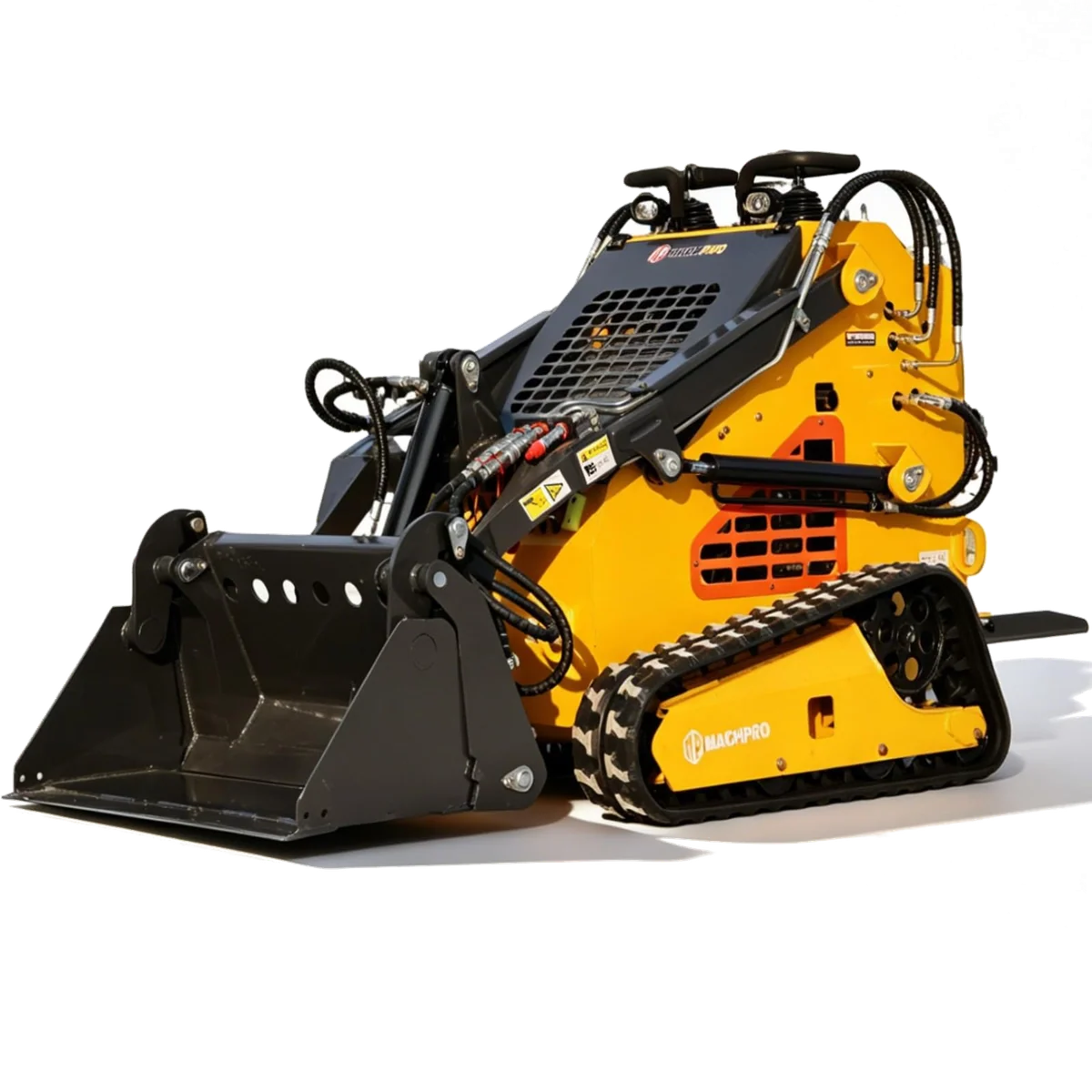
Included tools can change the first invoice without fixing the ownership case. The captured MACHPRO MP-380-YE package included a genuinely useful 4-in-1 bucket, but its four owner reviews cover about 15 hours at most. The captured Wolfequip T460S1WH package included pallet forks, yet the listed 210-pound bare frame consumed carrier capacity before the blades or load were counted, and the captured listing did not provide a usable fork-load chart.
If continuous mowing, sweeping, trenching or grinding is the main job, begin with the site’s powered-attachment shortlist rather than adding a hydraulic tool to the cheapest carrier after purchase.
What differed inside each captured price tier
Similar historical tiers conceal different packages and different ways to lose money. Each row keeps the conclusion of the product’s full review: a machine rejected there does not become a bargain here merely because it belonged to the main price cluster, and a conditional buy keeps the limitation that made it conditional.
| Machine | Historical price tier | Buying call | Cost the sticker does not settle |
|---|---|---|---|
| MACHPRO MP-380-YE | Main cluster, upper edge | Conditional for a self-maintaining property owner. | The 4-in-1 bucket adds value, but four owner reviews covering about 15 hours at most cannot prove long-term reliability, usable lift capacity or actual auxiliary output; the full MP-380-YE review audits the gaps. |
| MMS MS380L | Main cluster | Narrow yes for bucket work on firm ground. | Two-pump hydraulics and an owner record that stops at 10 hours make powered tools and uptime the expensive unknowns; the full MS380L review defines its narrow use case. |
| MMS MS360T | Lower cluster | No until the seller proves the exact identity and build. | Conflicting model information and missing hydraulic, capacity, track and safety details prevent a dependable parts or attachment budget. |
| HUAYEE HY480C | Above main cluster | Best-supported conditional buy for an owner-maintained property machine. | Its broader attachment record is encouraging, but one reported fuel-cap leak on an incline, one hydraulic-temperature report, track setup and a longest owner report of 36 hours still belong in the cost; the full HY480C review weighs that trade. |
| Wolfequip T460S1 | Main cluster | No until the seller documents operator protection, hydraulic architecture and model-specific parts support. | An owner of a closely related Wolf machine reported controls remaining active off the platform, which makes the interlock question more important than the bucket package; the full T460S1 review sets the documentation gate. |
| ATS Power T460 | Main cluster | Conditional for an owner-mechanic using mostly passive tools. | Two pumps, contradictory lift and reservoir copy, missing manual evidence and uncertain access to model-specific parts can turn savings into workshop time; the full ATS T460 review explains the conditional verdict. |
| MMS MS360L | Lowest captured | Conditional for recurring bucket work on firm ground. | Two-pump hydraulics, reported battery trouble, freight preparation and an owner record that stops at 10 hours limit the cheap end of the table; the full MS360L review narrows the job list. |
| DigSwift DS-S40 | Not captured | No until hydraulics, safety equipment, after-sales support and delivered cost are documented. | One vague first impression leaves the costs of unknown hydraulics, safety equipment, support, unloading and the real attachment package impossible to price. |
| HUAYEE HY360C | Lower cluster | Narrow yes for light bucket work on firm ground. | The longest owner report stops at 16 hours, while absent auxiliary-flow data and an undefined 1,323-pound force claim keep it out of heavy or attachment-led work; the full HY360C review explains the narrow yes. |
| TYPHON STOMP | Highest captured; near five figures | Conditional for an owner-mechanic. | A closely related tracked GX690 machine showed promising hardware, but it was not the exact listing; rated working capacity, exact hydraulics, support and durability on the listed machine remain unproved, as the full STOMP review makes clear. |
| DigSwift DS-SS50 | Not captured | Skip until the product record becomes coherent. | Model identity, hydraulics, safety, support and delivery remain unresolved, while two contradictory one-line reviews provide no usable ownership evidence. |
| HUAYEE HY480D | Upper outlier | Skip for most buyers and all uptime-sensitive work. | One owner reported the original engine and its replacement failing very early, an outsized risk in such a small evidence pool; the full HY480D review explains why most buyers should pass. |
| Wolfequip T460S1WH | Main cluster, upper edge | No until operator-presence protection and usable fork capacity are documented. | The included fork frame is heavy, the carrier has no usable pallet rating, and the safety report for a closely related Wolf machine remains unresolved. |
Freight day is the first service appointment
Commissioning is not a theoretical surcharge in this group. MMS owners report dead batteries, a bad pallet, broken hand levers and minor freight damage. HY480C owners describe early track adjustment, two derailments before correct tension, one machine whose hydraulic temperature kept climbing on the factory fluid and routine fluid changes. The sole ATS Amazon review says the manual was missing, while an HY480D owner installed a detached roof.
- Get written confirmation of the crate size, shipping weight, truck and liftgate limits, appointment terms and how the carrier will place the crate on the ground, then photograph the freight, data plate, hour meter and damage before signing.
- Match the engine, pumps, cooler, undercarriage, controls and attachments to the written order, then follow the delivered manuals when checking fluids, filters, battery restraint, grease, fasteners, hoses, wiring, track tension or tire pressure, attachment locks and safety interlocks.
- Test every function slowly on level ground, stop to recheck for leaks, heat, rubbing and loose hardware, then record service part numbers before you urgently need them.
The time spent doing those jobs is not free merely because no dealer sent an invoice.
Tracks, wheels and transport write different bills
Tracks buy traction and flotation, then add tension checks, undercarriage cleaning, rollers, idlers, sprockets, derailment recovery and eventual rubber replacement. Wheels remove that system and suit hard, firm travel, but they accept tire wear, punctures and poorer performance where the ground is soft or slick. Choose the surface first, because converting regret into another machine is the most expensive wear item of all; the wheeled-versus-tracked guide lays out the trade in full.
Transport can be a bigger upfront hurdle than routine service. The captured listings put the HY360C at 1,510 pounds and the HY480C and HY480D at 2,050 pounds, while the TYPHON STOMP copy conflicts between 1,830 and 2,000 pounds. None of those preliminary machine figures includes every possible attachment, fuel load, tool, trailer or towing margin. Price the complete moving combination with the vehicle and trailer manufacturers’ limits, not with the listing headline.
Access is also a cost before it is a dimension. A loader too wide for the only gate has a productive-hour denominator of zero, and removing a bucket outside the opening is useful only if the chassis, hoses, platform and turning path still clear. Use the gate-width planning method before paying for a machine that the listing calls “compact” but cannot reach the work.
Downtime is the number cheap listings omit
A private owner can postpone moving mulch until a fitting arrives. A contractor with wages, a rented attachment, a promised completion date and one carrier cannot. The same mechanical fault therefore has two radically different ownership costs, which is why the right buyer matters more than the badge.
Price one disabled week before trusting the savings
Add diagnosis time, recovery or transport, the replacement part and its freight, fluids and labor, then add backup rental, idle payroll, rescheduling and work that cannot be billed.
If that week breaks the business case, the machine needs a stronger local support path than these short owner records establish.
Simple construction helps only partway. A hydraulic shop may duplicate a marked hose, and a familiar engine may make filters or ignition parts easier to identify. Tracks, sprockets, idlers, drive motors, cylinders, control valves, fabricated brackets and wiring revisions can remain model-specific. “Generic parts” is not a support plan until the exact part numbers and lead times are on paper.
This is where the HY480D warning deserves its full weight. The evidence is too small to estimate a failure rate, but one owner’s report that both an original engine and its replacement failed early is enough to reject the machine for work that cannot wait. The correct response is not to pretend every unit will fail; it is to price the consequence if yours does.
Before buying any low-cost import, use the site’s first-use and common-problem inspection guide to see which faults can be caught early and which require parts or documentation the listing may not supply.
Buy only when the machine beats the alternative
No universal break-even hour count survives different jobs. One hour carrying bedding through a stall is not economically equal to one hour feeding a brush cutter, and a Saturday saved has a different cash value from a crew day saved. Use actual rental, hired-work and ownership quotes for the same job, access route and attachment.
Calculate break-even in completed jobs
Break-even bucket jobs = fixed net ownership cost ÷ (all-in rental cost per bucket job − owner variable cost per bucket job).
Fixed net ownership cost over the planned holding period includes delivered acquisition cost, taxes and fees, interest and financing fees, required attachments, insurance, storage, a trailer or other fixed transport setup, and commissioning minus conservative sale proceeds, while owner variable cost includes job transport, fuel, service, wear, repairs and downtime allocation.
If the denominator is zero or negative, buying cannot recover its fixed cost under those inputs; if the result works only after optimistic resale or speculative attachment jobs are added, rent.
Buying has a case
The bucket handles recurring work, the property suits the machine, storage and transport already make sense, the owner can perform routine service, downtime is tolerable and the seller documents the exact build and parts path.
Renting or hiring wins
The job is concentrated, annual use is uncertain, a powered attachment drives the project, the site demands a larger or narrower carrier, the deadline is firm or the buyer needs somebody else to own repair and transport risk.
For a fuller calculation, use our rent-versus-buy guide; if recurring work clears that test, continue to the value-focused shortlist.
The final call
Buy only when recurring bucket work can justify the loader, attachments, transport, service, downtime and conservative resale assumptions without asking speculative attachment jobs to rescue the math.
Frequently Asked Questions
How much should I add for annual maintenance?
No universal allowance is defensible from these records, so price the fluids, filters, grease and service intervals specified in the exact manual, then add a repair and parts-freight reserve that reflects your model and tolerance for downtime.
Are tracks more expensive to own than wheels?
Tracks generally add more undercarriage wear items and maintenance cost than wheels, but that premium can be justified when soft ground demands their traction and flotation, as the wheeled-versus-tracked guide explains.
Is a three-pump mini skid steer always worth more?
Only when the independent auxiliary circuit actually matches the powered tool, because pump count without usable flow at pressure, return limits, case drain and cooling does not prove productive attachment work.
Can I treat maximum lifting force as payload?
No, because determining safe working capacity requires a load center, attachment, lift height, tipping limit, operator or ballast condition and approved load chart, as the lift-capacity guide explains.
How many hours of use make buying cheaper than renting?
There is no universal threshold, so compare ownership, rental and hired work on the same per-job or productive-hour basis for the same carrier, attachment, transport and deadline.
Should a contractor buy one of these low-cost machines?
Not as the only revenue-critical carrier, because the owner records are too short and the documented parts, labor and downtime remedies are too thin to support dependable commercial use.
Sources (2)
- Amazon listings and customer reviews
- Owner and reviewer video, 5 channels