Two pumps are enough for bucket work; powered attachments deserve three.
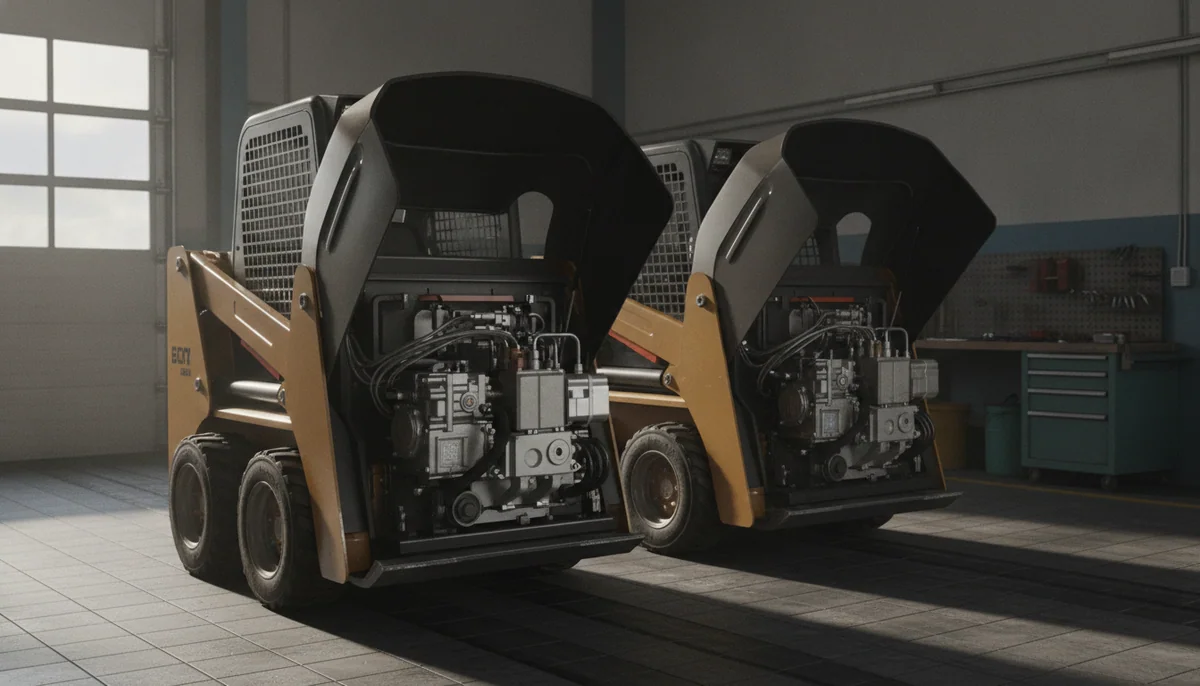
Two compact loaders can wear similar 23 hp engine labels and behave very differently once a hydraulic tool meets the ground. The engine may have enough power to spin that tool, yet the plumbing can force the operator to choose between powering it and driving straight. That is the problem pump count helps expose.
The clearest admission comes from an MMS MS380L owner who liked the loader after 10 hours of property work but identified it as a two-pump machine and said a three-pump version would offer more flexibility with equipment. The machine still moved road rock and dirt, which is why two pumps should not be confused with a useless loader.
A separate attachment trial made the limitation visible on another two-pump machine. Buckets, a land leveler, a grapple and a stationary auger performed useful work, but the brush cutter could spin or the loader could travel normally, not both in a practical straight pass; trenching became a repeated cycle of cutting, stopping and repositioning. That was not a test of every loader on this page, but it demonstrates the circuit problem a seller must answer.
The third pump buys simultaneous motion, not magic
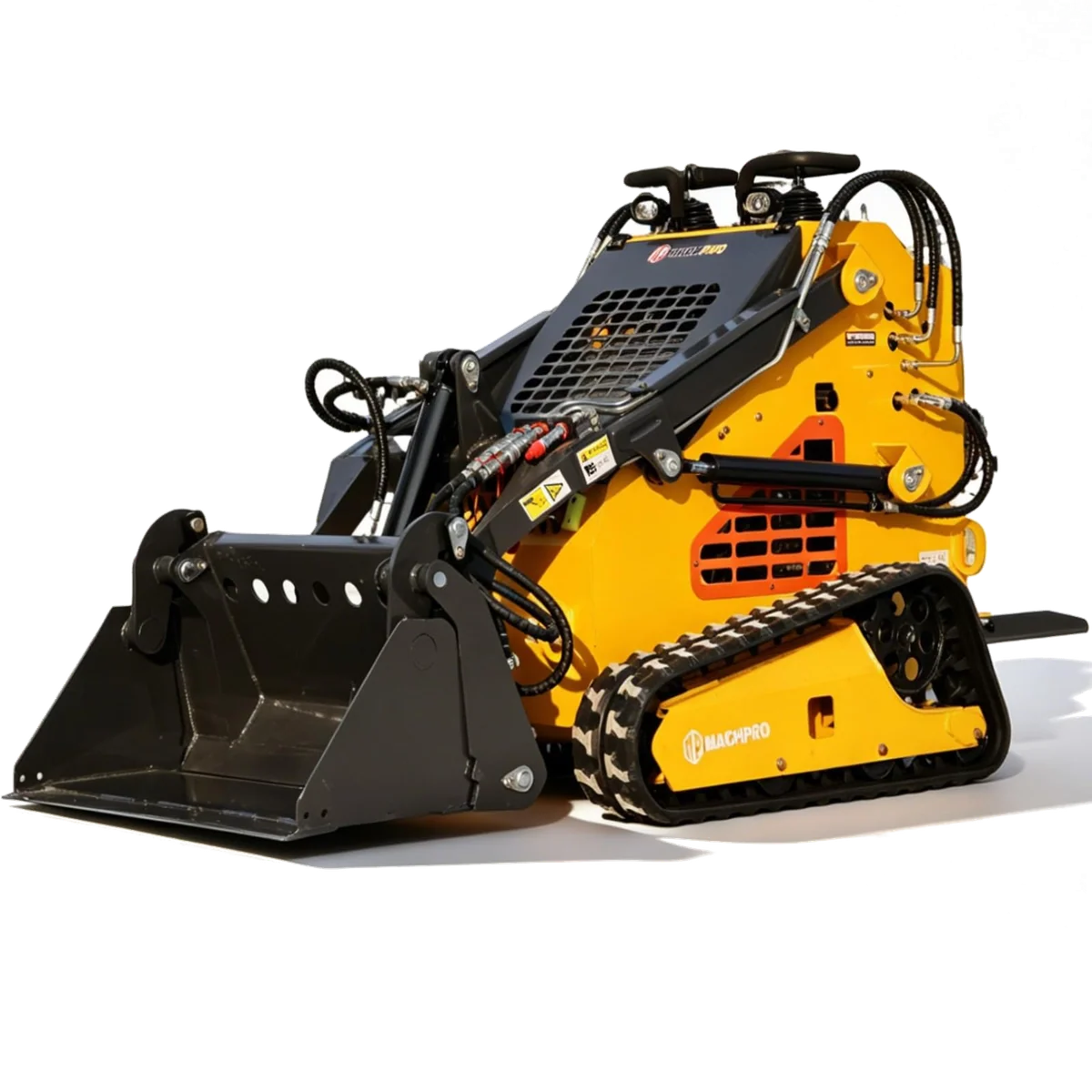
A two-pump loader does not necessarily freeze its boom whenever it moves. MMS describes the MS380L’s dual hydraulic circuit as separating travel from boom control, allowing ordinary loader actions such as traveling, lifting and curling to overlap. That is enough architecture for productive bucket cycles, and it explains why owners can like a two-pump machine even after recognizing its limit.
The trouble begins when the auxiliary circuit borrows the hydraulic path that normally serves one side of travel. Latch a motorized attachment on and oil that had been driving one track now turns the tool instead. The other track may still propel, so the machine arcs, pivots or waits while the attachment runs. More engine horsepower can provide reserve, but it cannot create a missing oil path.
A third pump can give the attachment its own supply while the two travel circuits remain available. The HY480C is the clearest covered example: its listing specifies three pumps and three valves, and exact owners describe the same three-section arrangement while reporting work with a cutter, power rake, trencher, concrete mixer and grapple. That is meaningful evidence of a more flexible architecture, not proof that every one of those tools can run continuously without heat or performance limits.
Pump count is also easy to misread in sales copy. Three valves are not automatically three pumps, three front hoses are not automatically three circuits, and a three-stage
system may be a marketing phrase rather than a diagram. A serious seller should identify the physical pump sections, the function each one serves and the oil path from reservoir to attachment and back.
Two pumps
Good loader work can still be honest
Bucket cycles, forks, passive grading tools and attachments that move a cylinder only occasionally can suit a two-pump machine well.
A third pump
Simultaneous work becomes plausible
A separately supplied auxiliary circuit can preserve both travel sides while a hydraulic motor consumes oil.
Still unresolved
The specification decides the tool
Flow at pressure, cooling, return restriction, case drain, attachment mass and duty cycle remain separate questions.
Choose by what the attachment does with oil
The easiest way to choose a pump layout is to ignore the attachment’s photograph and watch its hydraulic behavior. A tool that latches without hoses does not care how many pumps the carrier has. A tool that opens a jaw for two seconds presents a different problem from a cutter motor that must remain loaded for an entire pass.
| Tool or job | Hydraulic behavior | Starting pump choice | The limitation that remains |
|---|---|---|---|
| Plain bucket and rough grading | Lift and curl use loader cylinders during short cycles. | Two pumps can be enough | Digging ability still depends on machine weight, cutting edge, soil and breakout geometry. |
| Forks, land plane or trailer mover | The attachment itself needs no continuous auxiliary flow. | Two pumps can be enough | Mount fit, attachment weight, load center and rated capacity decide whether the job is safe. |
| Grapple, 4-in-1 bucket or hydraulic-angle blade | A cylinder moves intermittently, often while the machine pauses. | Two pumps are plausible | The operator may need to stop, actuate the tool and resume travel rather than blend every function. |
| Post-hole auger | The motor can work while the carrier remains stationary. | Two pumps may work | Bit size, reverse flow, pressure, actual auxiliary output and soil conditions still control performance. |
| Trencher | The cutting chain should remain powered while the loader creeps forward. | Choose a verified third pump | A two-pump machine may cut only through a slow stop, advance and restart routine. |
| Brush cutter, sweeper, tiller or power rake | The motor needs continuous oil while both travel sides remain controllable. | Choose a verified third pump | The machine still needs enough auxiliary flow at pressure, cooling and an approved continuous duty cycle. |
| Stump grinder or mulcher | High continuous demand combines with substantial attachment mass and a forward load center. | Pump count is not enough | The carrier may remain a poor match even with three pumps because flow, heat, return plumbing and stability can all run out first. |
Never treat total system flow as attachment flow. The MACHPRO MP-380-YE listing advertises 19 GPM by adding three circuits rated at 36, 18 and 18 L/min, but it does not identify which circuit feeds the front couplers. Adding all three numbers does not put all three streams through one attachment motor.
Pressure and flow must also be read together. Pressure helps the attachment resist load; flow determines motor speed, while the product of useful flow and pressure determines the hydraulic power available to do work. A large reservoir and visible cooler may help control temperature, but neither proves the system can reject heat through a long mowing or trenching pass.
Case-drain plumbing is another separate gate. Some hydraulic motors need a low-pressure line that carries internal leakage oil directly back to the tank. Pressure and ordinary return couplers cannot be assumed to provide that path, and plugging a tool into two matching connectors does not prove its shaft seals are protected.
Before ordering a powered tool, use the site’s attachment compatibility checks to match the plate, couplers, oil and weight on both sides. If mowing, trenching, sweeping or grinding is the main reason for buying the carrier, begin with the shortlist built around powered attachments rather than asking a basic loader to become one later.
The three-pump field has one clear leader and several asterisks
Clearest evidence
HY480C: the conditional front-runner
The HY480C has the strongest combination of an exact three-pump claim, corroborating owner descriptions and varied exact-machine attachment use. Skid Steer Mulch gives it a conditional yes for an owner-maintained property machine, not a commercial-uptime recommendation. Its drawback is real: one exact owner documented fuel escaping around the cap with a full tank while pointing uphill, another stopped a machine after the displayed hydraulic temperature climbed beyond 71 °C on the factory fluid, and the longest clearly documented ownership account reaches only 36 hours. The full HY480C review explains why better plumbing still comes with fuel, heat and support risk.
Promising, lightly proved
MP-380-YE: useful bucket package, unresolved auxiliary output
MACHPRO specifies three pumps, a 24 hp RATO engine and an included hydraulic 4-in-1 bucket, while exact owners report digging, dozing, grabbing, grading and moving logs. The verdict remains a narrow yes only for a mechanically capable property owner because the exact record stops around 15 disclosed hours, the advertised 19 GPM is aggregate flow and the case-drain arrangement is unidentified. Read the MP-380-YE review before treating its pump headline as powered-attachment proof.
Hardware clue, incomplete identity
TYPHON STOMP: keep it conditional
The exact STOMP listing says three valves, while the closest tracked GX690 owner account visibly identified three pumps on a related machine. That is encouraging architecture without conclusive mapping to the exact Amazon configuration, and the listing had no owner ratings when captured. Skid Steer Mulch gives it a conditional property-owner recommendation only after the seller documents the pump block, auxiliary output, undefined lift claim and parts path; the STOMP review keeps those missing answers attached to the verdict.
Three pumps, still a skip
HY480D: architecture cannot rescue reliability
The wheeled, seated HY480D has an exact three-pump and three-valve listing, yet one owner reports the original engine losing power and burning oil between roughly 11 and 20 hours before a replacement engine lasted no more than 12 hours. One severe account cannot establish a failure rate, but the exact review pool is far too small to dilute it. Most buyers should skip this machine because a third pump does not compensate for unresolved engine, labor, freight and remedy risk; the HY480D review sets out the narrow exception.
Two pumps are honest when the machine is sold as a loader
A two-pump machine is not automatically the cheaper mistake. It can be the rational purchase when the work is already defined as scooping, carrying, rough grading, placing passive tools and operating a grapple only occasionally. In that use case, delivery condition, controls, dimensions, parts and support may matter more than paying for an auxiliary circuit that will rarely run.
Wheeled property loader
MS380L: a narrow yes with a clear ceiling
The MS380L earns a conditional yes for bucket work, rough grading and intermittent auxiliary jobs on firm ground because exact owners report useful residential material work and one explicitly identifies the two-pump layout. Its drawback is the same owner’s warning that three pumps would provide more attachment flexibility, joined by delivery problems and an exact durability record that reaches only 10 hours. The MS380L review is the right next stop if wheels and a 23 hp engine fit the property.
Smaller wheeled alternative
MS360L: buy the bucket job, not the attachment fantasy
The MS360L also earns a conditional yes for recurring bucket and light grading work on firm ground, where exact owners report landscaping and small-property material handling. Its two-pump architecture, short 10-hour evidence horizon, missing flow and capacity data, weak manual and uneven arrival record rule out commercial dependence and continuous powered tools. The MS360L review covers the smaller engine and ownership trade, while the MMS comparison prevents horsepower from becoming a substitute for hydraulic evidence.
Light-duty barn and yard work
HY360C: useful inside its modest role
The HY360C’s dual-pump listing and exact owner record support a narrow yes for light bucket work in stalls, yards and other firm-ground spaces. The longest disclosed interval is only 16 hours, auxiliary flow is unpublished and the larger lift claim is not a usable payload rating, so this is not a mower, trencher or heavy-fork recommendation. The HY360C review explains why its recognizable engine and compact format do not remove those limits.
Basic tracked platform
ATS T460: acceptable only when the work stays simple
Direct standard-T460 material describes a two-pump arrangement, and the exact ATS listing supplies a hydraulic-flow number without establishing usable auxiliary output at working pressure. Skid Steer Mulch gives the machine a narrow yes for a repair-ready property owner moving loose material, but contradictory lift claims, assembly reports, sparse durability evidence and a weak model-specific parts path make it a no for paid production. Read the ATS T460 review, then use the T460 and T460A comparison if the third-pump variant is the attraction.
Unknown pump count is a no, not a tie
When a seller omits pump count, auxiliary flow and the circuit diagram, the buyer should not infer whichever architecture makes the purchase easier to justify. Unknown does not mean secretly upgraded. It means the machine has not earned a powered-attachment recommendation.
Insufficient exact evidence
MS360T: verify the machine before debating the pumps
The MS360T listing names a 13.5 hp Briggs & Stratton engine and triangular tracks but supplies no pump count, auxiliary flow, hydraulic pressure or case-drain specification. Its two retained reviews cover arrival-day impressions rather than attachment work or durability. The verdict is no until MMS documents the exact configuration, safety systems, lift data and hydraulic architecture in writing.
Narrow claims, wide information gap
DS-S40 and DS-SS50: dimensions do not replace hydraulics
The DS-S40 lists a 39.4-inch width and a 661-pound rated capacity, but it omits pump count, auxiliary output, pressure, couplers, case drain and cooling details; its single retained written review provides no task, hours or load. The more powerful DS-SS50 repeats the same hydraulic silence, while its two retained reviews amount to one unexplained one-star warning and one equally unexplained positive line. Both are skips until DigSwift supplies model-specific documentation, and the DigSwift comparison shows why choosing between two unknown systems does not resolve the risk.
Safety before pump count
Wolfequip T460S1 and T460S1WH: stop at the control question
Neither exact listing publishes the pump architecture or usable auxiliary output, and the closest relevant Wolf walkthrough reported controls that remained active with nobody on the platform. That close account does not prove every current unit shares the same configuration, but the apparent absence of an operator-presence interlock is a purchase blocker until the seller demonstrates otherwise. The T460S1 remains a no under the full Wolfequip review, while the T460S1WH remains a no despite including forks because its 210-pound bare fork frame consumes capacity before the blades or load are counted and the loader’s lift claims are undefined.
Ask for a circuit, not a slogan
The seller’s answer should identify the production revision that will actually ship. A family name, paint color or video of a similar loader cannot settle a circuit question when the same platform appears with different engines, pumps, coolers and attachments.
- Count the hardware: request current photographs of the engine plate, pump stack, valve sections, auxiliary couplers, cooler and case-drain port on the allocated machine.
- Map each pump: require a written explanation of which circuit serves the left travel side, right travel side, boom, bucket and front auxiliary connection.
- Measure useful output: ask for auxiliary flow in GPM at stated engine speed and working pressure, not total unloaded displacement from every pump added together.
- Prove simultaneous operation: require a continuous demonstration of the exact planned attachment working under load while the machine travels straight, steers both ways, lifts and curls normally.
- Define the return path: obtain coupler sizes, maximum permitted return pressure, bidirectional-flow behavior and a clear answer about case-drain plumbing.
- Set the heat boundary: ask for hydraulic-fluid specification, reservoir volume, cooler and fan control, warning or shutdown temperature, and the approved continuous duty cycle.
- Match the whole attachment: verify mounting geometry, latch engagement, attachment mass, center of gravity, hose travel, required flow, required pressure and manufacturer approval.
- Price the stopped machine: get manuals, diagrams, filter numbers, pump and motor identifiers, parts location, warranty labor, freight responsibility and expected response path in writing.
The buying order is deliberately boring
Start with the work, then choose the circuit. A buyer who moves mulch and gravel with a bucket should not reject a well-supported two-pump loader merely because three sounds better. A buyer who expects a cutter to stay powered through every turn should not accept a two-pump machine merely because the engine sounds strong.
The site’s capacity guide handles the load side of that decision, while the first-use inspection guide covers what to check when the freight truck arrives. If the entire ownership case still comes down to entry cost, the value-focused shortlist compares the machine, support burden and downtime together.
Frequently Asked Questions
Does a third pump guarantee higher attachment flow?
No, a third pump can separate the auxiliary circuit from travel, but only its displacement, speed, pressure and plumbing determine usable attachment output.
Can a two-pump loader run a brush cutter?
It may spin the cutter, but a shared travel circuit can prevent useful straight movement while the blade remains powered.
Is a third pump worth paying for if I only use a bucket?
Usually not by itself, because bucket work depends more directly on loader control, traction, geometry, capacity, access and support.
Does more engine horsepower overcome a shared hydraulic circuit?
No, additional engine reserve cannot create an independent oil path for a drive side that loses flow to the attachment.
What proves that a powered attachment will work while the loader travels?
A serial-specific circuit diagram, measured auxiliary output and a sustained loaded demonstration with both travel sides operating provide the useful proof.
Is a case drain the same as the normal return hose?
No, a case drain is a separate low-pressure path used by certain hydraulic motors to protect their internal seals from excessive housing pressure.
Which covered machine has the strongest three-pump evidence?
The HY480C has the clearest combination of listing, hardware and owner-use evidence, but its fuel-leak, heat and short-duration record keep the recommendation conditional.
Sources (2)
- Amazon listings and customer reviews
- Owner and reviewer video, 5 channels