The ATS Power T460 Is a Capable Loader with a Parts Problem
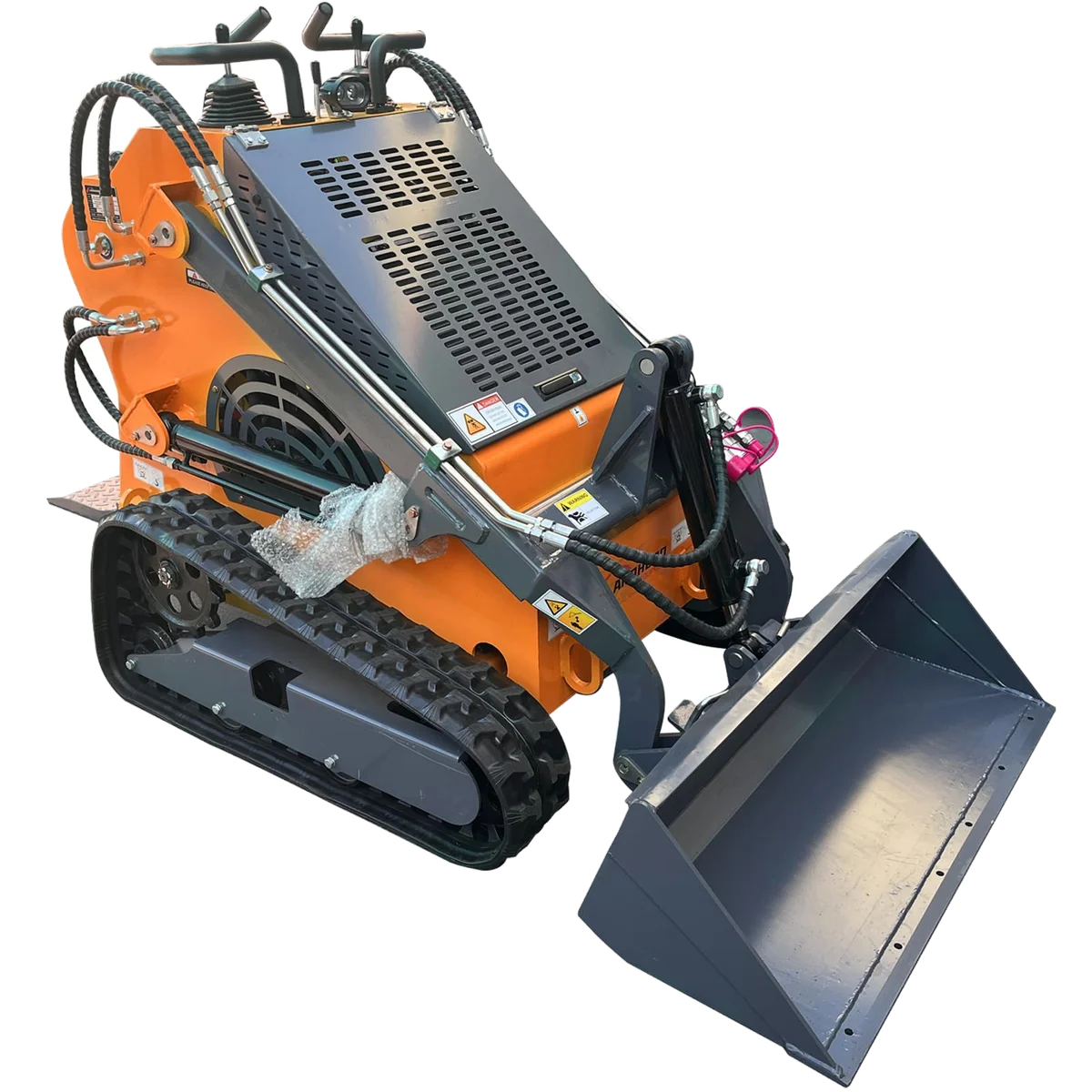
Buy the ATS Power T460 only for intermittent property work if you can inspect, service and sometimes sideline it yourself; anyone billing by the hour should walk away until the seller proves the exact specification and a stocked parts path.
Based on 1 owner ratings, 1 owner discussion and 2 other sources. We have not tested this machine ourselves.
We earn a commission if you buy through our links, which does not affect what we say.
Read how this site works →
Final verdict
Skid Steer Mulch’s call is a narrow yes for a mechanically confident property owner with flat, open access and forgiving deadlines, and a clear no for a buyer who needs a dealer-backed production asset. The T460 has enough demonstrated ability to be more than a novelty, especially with loose material and intermittent hydraulic tools, but the seller has not earned trust through a coherent specification sheet or a deep durability record.
Do not buy it because 840 pounds is the largest lift number on the page or because “multifunction” sounds attachment-ready. Buy only after the exact engine, pump count, auxiliary output, weight, load rating, track code, manuals and model-specific parts path arrive in writing. If the seller cannot provide those before payment, the uncertainty is part of the machine and walking away is the economical choice.
Buyers still drawn to this platform should compare the hydraulically stronger variant in the ATS T460 versus T460A guide and test the badge-versus-support question in the ATS T460 versus Wolfequip T460 comparison before committing.
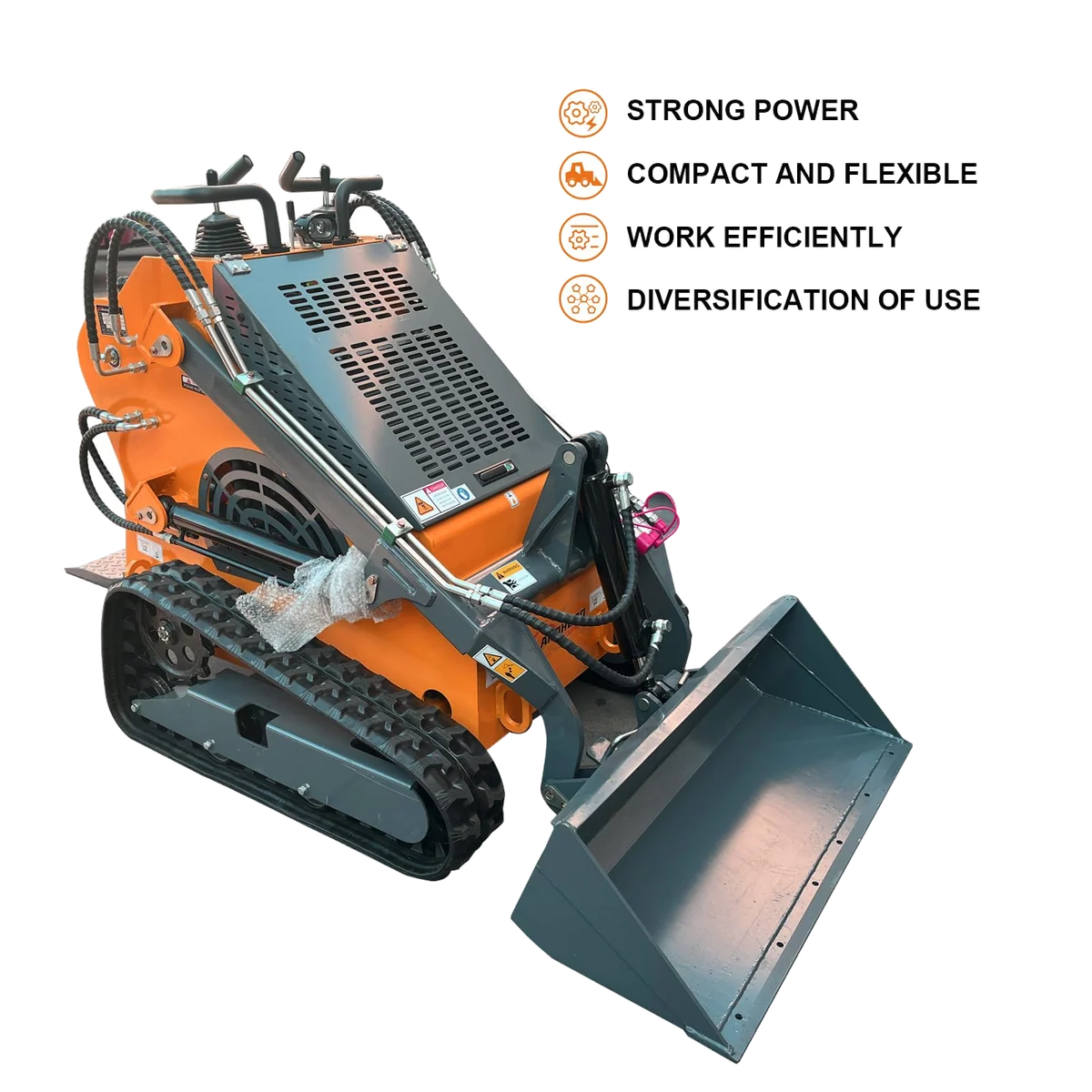
There is a useful little machine under the listing’s untidy translation. A direct ATS T460 clip shows the supplied bucket filling with loose dirt, with the operator reducing throttle to calm the travel controls and adding power for the scoop. Another RATO-powered T460 first look found an open, accessible mechanical layout, but its hour meter was still below one hour. That establishes basic function and little more.
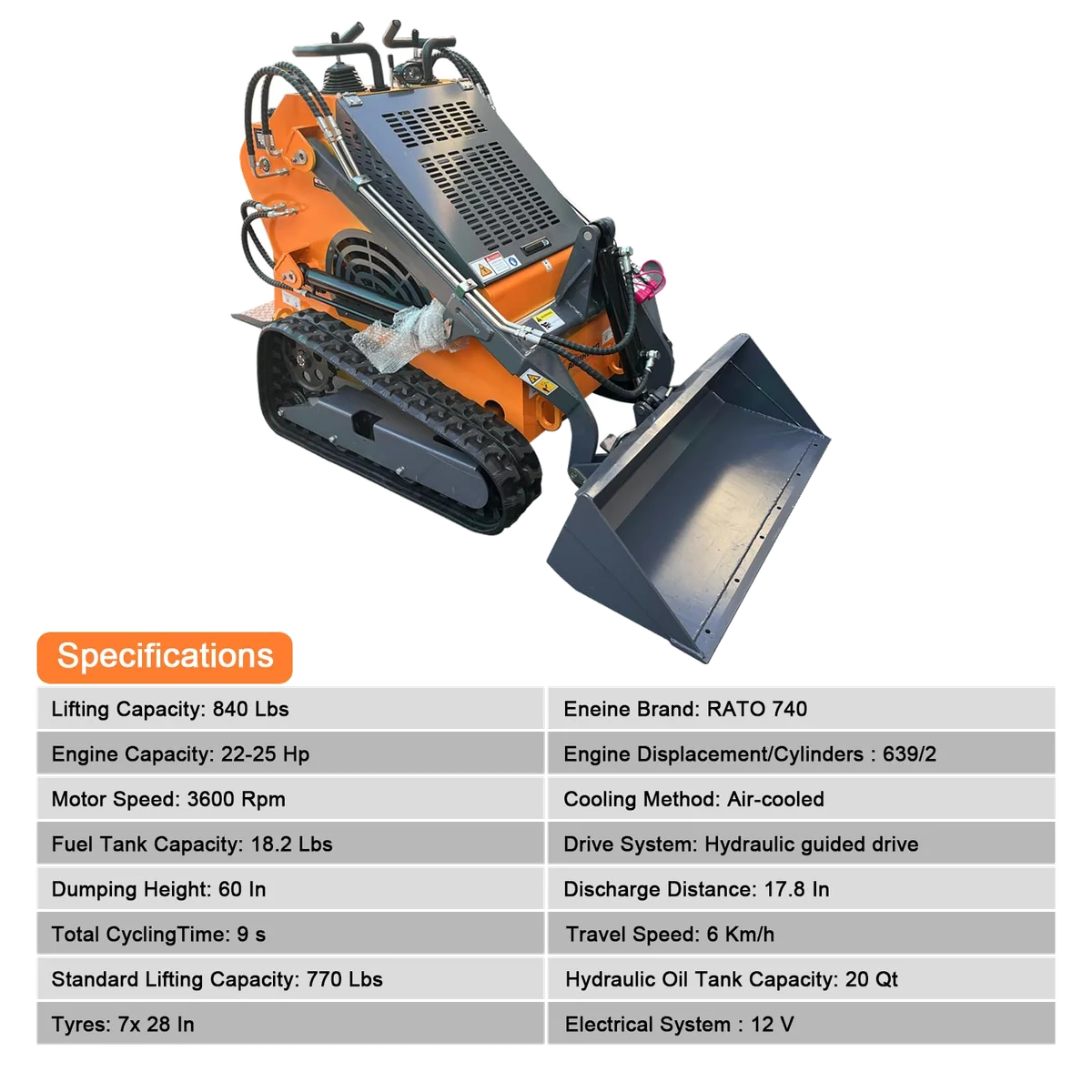
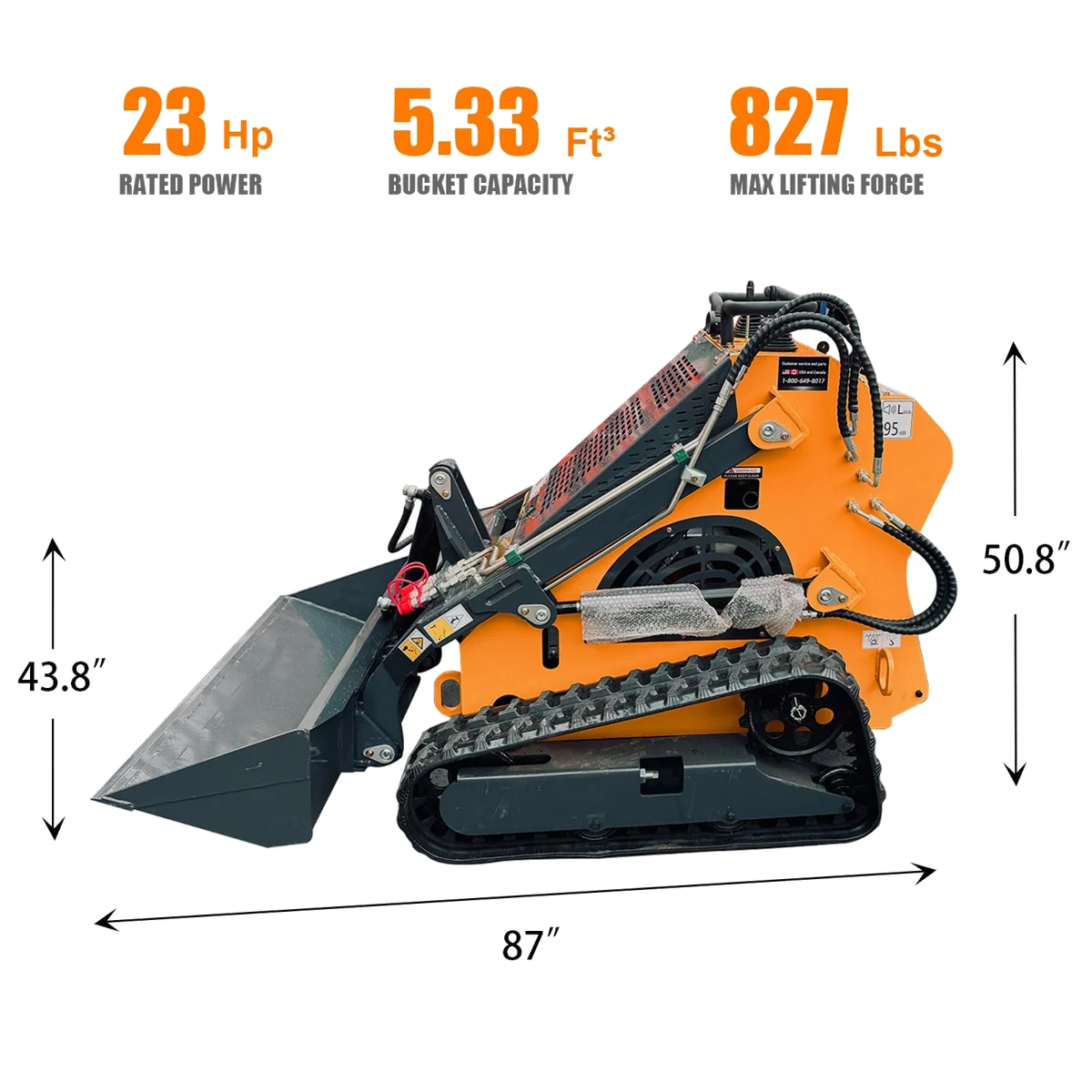
Buying it is harder than watching it work. The captured Amazon page identifies a 43.8-inch bucket and a RATO 740 engine, then claims both 840 and 770 pounds of lift in different bullets. It describes fuel capacity in pounds, leaves the meaning of its hydraulic-flow number unclear and even mentions conventional tire dimensions on a tracked machine. Those are not harmless copy errors when the same specifications determine safe loads, maintenance supplies and attachment choices.
The T460 name is also less precise than it looks. Direct examples appear with a roughly 739 cc RATO engine and with 680-class Zongshen engines, while a LandHero machine carrying the LDH-T460 designation arrived with a 39-inch bucket rather than the Amazon listing’s 43.8-inch bucket. Treat T460 as a platform label, not a promise that every seller ships an identical bill of materials.
Buy it for owner-operated property work
The strongest case is a farm, homestead or large property with mostly open, reasonably level access and a backlog of loose-soil, mulch, gravel, manure, grading, grapple or fork chores. The buyer should be comfortable inspecting hardware, tracing a fuel problem, sourcing a hose and waiting when a model-specific component is unavailable. That is the practical bargain described in our guide to what inexpensive Chinese mini loaders do well and where the savings go.
Walk away when uptime is the product
This is a poor fit when every lost day cancels paid work, when the operator expects refined simultaneous controls or when local dealer service is non-negotiable. It is also the wrong answer if the intended jobs center on continuous-flow mowing, sweeping or snow work. Buyers with only a short project list should first compare the economics in our mini skid steer rent-versus-buy guide.
Key Specifications
Choose attachments by hydraulic behavior, not by the plate alone
No supplied source verifies the Amazon machine’s attachment-plate dimensions, coupler standard, case drain or usable auxiliary pressure. A tool that physically latches can still be too heavy, demand too much flow or route its hoses into the lift arms. Confirm mount geometry, couplers, attachment weight, required pressure, motor displacement and hose travel using the process in our mini skid steer attachment-compatibility guide.
| Attachment | Fit for the standard T460 | Reason | Honest limitation |
|---|---|---|---|
| Supplied smooth bucket | Good | Direct evidence supports loose-material loading, cleanup and light finish work. | The broad edge is poorly suited to penetrating hard, undisturbed or rocky ground. |
| Grapple | Good with verification | Its cylinders can be actuated while stopped, so two-pump flow sharing is less disruptive. | A heavy grapple consumes usable lift and moves the load center forward. |
| Pallet forks | Useful with conservative loads | Forks need no continuous hydraulic motor and suit material-handling chores. | No exact T460 source performed a scaled fork test, and safe capacity falls as the load moves forward. |
| Toothed or stump bucket | Promising for ground entry | A close 23-horsepower analog used a narrow toothed tool to break hard soil before returning to its smooth bucket. | That result was not an ATS test, and attachment weight plus geometry still require confirmation. |
| Auger or trencher | Conditional | Direct T460 commentary says both can work within the machine’s modest hydraulic architecture. | The auger was described as slow, and trenching may require stop-and-start travel rather than continuous production. |
| Brush cutter, mulcher, sweeper, tiller or snowblower | Poor default match | These tools usually need continuous auxiliary power while the carrier advances. | Do not buy one until the seller demonstrates the exact attachment operating while both tracks travel normally. |
Strengths & Limitations
Strengths
- The roughly 23-horsepower twin-cylinder configuration and supplied bucket have demonstrated basic loose-dirt loading.
- Open panels and visible filters, pumps and valves favor owners who service their own equipment.
- Intermittent hydraulic tools such as grapples suit the standard model’s two-pump architecture.
- Front and rear tie-down points make transport preparation less improvised.
Limitations
- The exact listing conflicts on lift capacity and leaves key hydraulic, weight and track specifications unresolved.
- Two-pump flow sharing limits attachments that need continuous power while traveling.
- Separate exact-model reports include assembly faults, early control or fuel trouble and a drive motor that was hard to replace.
- The wide bucket, exposed hoses and short high-track undercarriage narrow the access and terrain it suits.
- The direct durability record is too short to support dependable production-uptime claims.
What it can do before the plumbing gets in the way
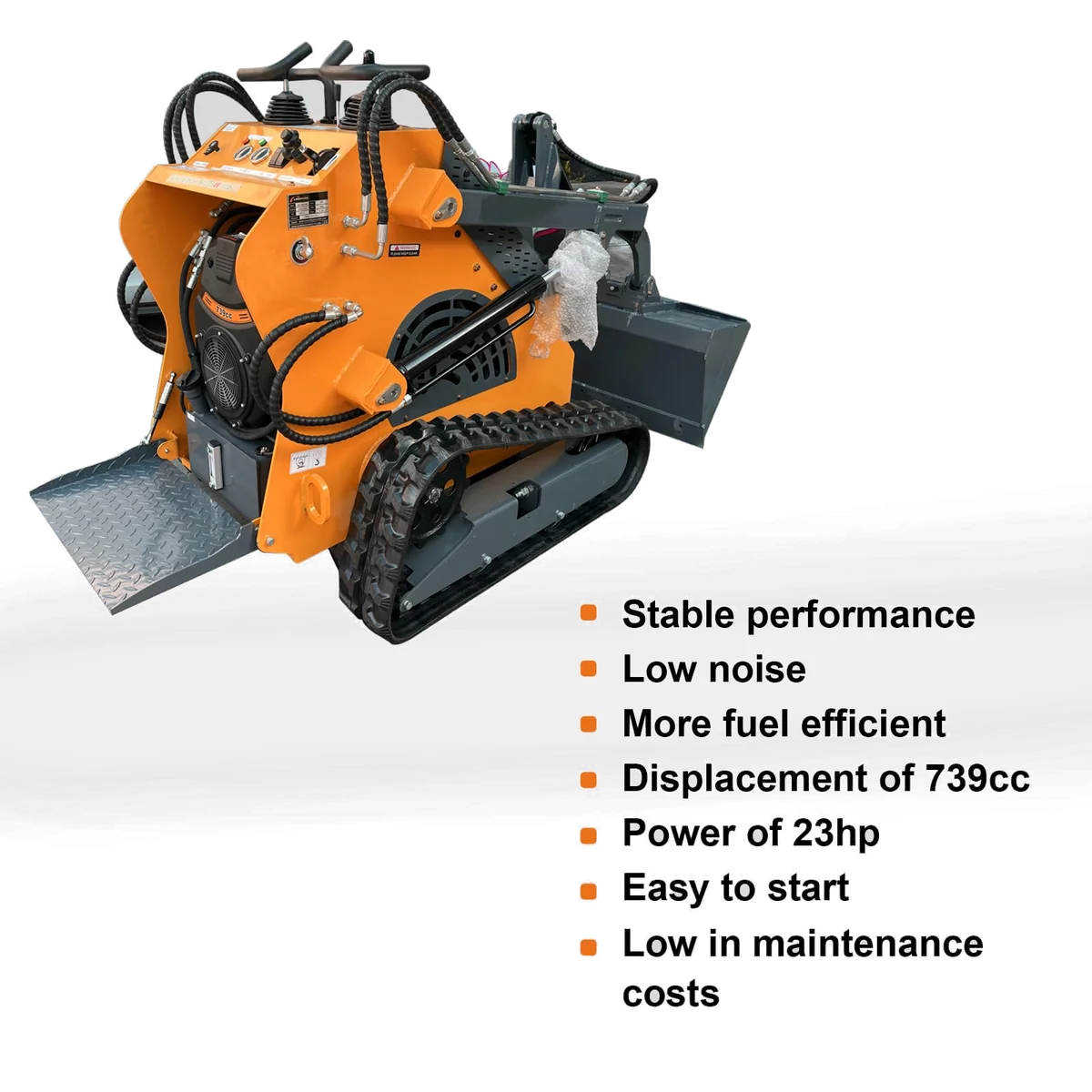
Loose material is the T460’s clearest lane. A broad, smooth bucket can scoop material that has already been broken up, carry it short distances and leave a reasonably clean finish. It is not automatically a digging bucket. In the closest supplied performance analog, a 23-horsepower, 739 cc loader with a 43-inch bucket struggled to bite extremely dry, rock-filled ground until a narrow toothed attachment broke the surface; the smooth bucket then handled the scooping and finish work. That was not an ATS test, but it is a useful lesson about choosing the cutting edge before blaming the engine.
Engine power is not the first ceiling here. Machine weight, balance, hydraulic routing and attachment geometry can stop useful work before the V-twin runs out of breath. A heavy load carried forward on forks can reach a stability limit well before a cylinder reaches its theoretical lifting force, and the wide bucket can skate over hard ground that a narrower toothed tool would penetrate.
The two-pump arrangement is the decisive performance limitation. Even a direct T460 seller says grapples work well because the operator can stop, actuate the grapple and move again, while an auger turns slowly, a trencher is merely workable and a mulcher is beyond the machine’s practical weight and flow. When a continuously powered attachment needs auxiliary flow while the loader travels, one track may stop receiving drive flow.
A different two-pump loader made the mechanism visible during attachment testing: its brush cutter could spin, but only one track remained available until the attachment stopped. That analog does not prove how quickly the ATS cutter would turn, but it does show why an advertised flow number cannot answer the simultaneous-operation question by itself. The distinction is explained more fully in our guide to two-pump and three-pump mini loaders, and buyers planning hydraulic tools should start with the machines selected for powered attachments rather than assuming every quick-coupler tool is a good match.
Careful inputs and reduced throttle appear to make ordinary travel manageable, but this remains a basic mechanical-control machine rather than a polished commercial pilot-control loader. Flow sharing also means travel, lift and curl may not blend with the speed or predictability an experienced operator expects. A five-minute empty-lot drive cannot reveal how the controls behave with a high load, warm oil or a cross-slope.
Tracks add traction and spread the contact patch, but they do not make a short stand-on loader calm on rough terrain. Category evidence shows how rocks, ledges and abrupt elevation changes can pitch a compact track base and leave the operator hanging onto the platform. The T460 belongs on deliberate routes and conservative slopes, not on terrain chosen simply because the machine has tracks; our slope and uneven-ground guide covers the geometry that sales copy tends to skip.
Access deserves the same realism. A commercial user of a close 43-inch machine liked its power but found that width excluded many backyards built around roughly 36-inch openings, while another operator had deliberately moved to a narrower loader for constrained gates and turns. The exact T460 chassis might be narrower after the bucket comes off, but that dimension is absent, so removal should not be treated as a guaranteed solution. Measure the whole route using the method in our gate-width planning guide.
The purchase price is not the cost of ownership
The exact Amazon listing’s historical capture sat above two lower auction transactions and was not a live quote. A LandHero LDH-T460 owner reported buying at auction with a 39-inch bucket and forks, while the owner of a close LRT23 reported an even lower auction purchase. Those transactions involved different dates, packages, sellers and protections, so the gap does not establish what an ATS unit should cost now.
Real ownership cost: delivered machine, unloading, taxes and fees, required attachments, initial inspection, fluids and filters, repairs, parts freight and the value of every day the machine cannot work.
Paying more through a familiar marketplace might buy easier transaction handling, but the captured listing’s support and return promises have not been tested in the supplied owner record. A short message-response promise is not the same as a drive motor on a shelf, and a seven-day exchange statement means little until someone explains who crates and transports a machine of this mass.
Pump count can also overturn the value calculation. One owner compared a standard T460 with a T460A at the same local asking price and chose the T460A specifically for its three-pump arrangement; the machine was doing well at roughly eight hours, which was encouraging but still very early. Anyone planning regular powered-attachment work should use our T460 versus T460A comparison and verify both quoted configurations rather than treating the extra letter as cosmetic.
The standard T460 can still be good value when it replaces recurring manual labor on a property, the owner can perform basic diagnosis and delayed projects do not cost revenue. It becomes false economy when savings at purchase are consumed by a single unavailable drive component or by attachment performance that never matched the job. Our value-focused mini skid steer roundup applies that total-cost test across the site’s reviewed options.
The first hour is encouraging; the next hundred are unknown
Amazon’s owner evidence consists of one five-star rating and one retained review. That buyer found the machine easy to use and was pleased overall, but supplied no hour count, workload, terrain or follow-up; the concrete complaint was that an owner’s manual was missing, along with a wish for a small tool set. Skid Steer Mulch would not turn that single early impression into a reliability score.
The exact-model reports outside Amazon point in both directions. One owner ran an ATS T460 for about seven straight hours moving dirt and reported no problems, while another suspected a fuel-delivery or carburetor issue at only 0.9 hour. These accounts establish that a T460 can complete a sustained day of basic work and that very early faults are possible, not that either outcome is typical.
Separate exact-model owners reported broken joystick brackets at purchase, a left drive motor said to have been assembled incorrectly and no replacement located after more than a month, and a left travel control that became stiff after roughly an hour of warm operation. In the control case, the owner found an incorrectly seated spool O-ring and reseated it; the heat-related timing should not be rewritten as proof that overheating caused the fault. These are different machines, not one catastrophic ownership story, but together they make inconsistent assembly and parts response credible purchase risks.
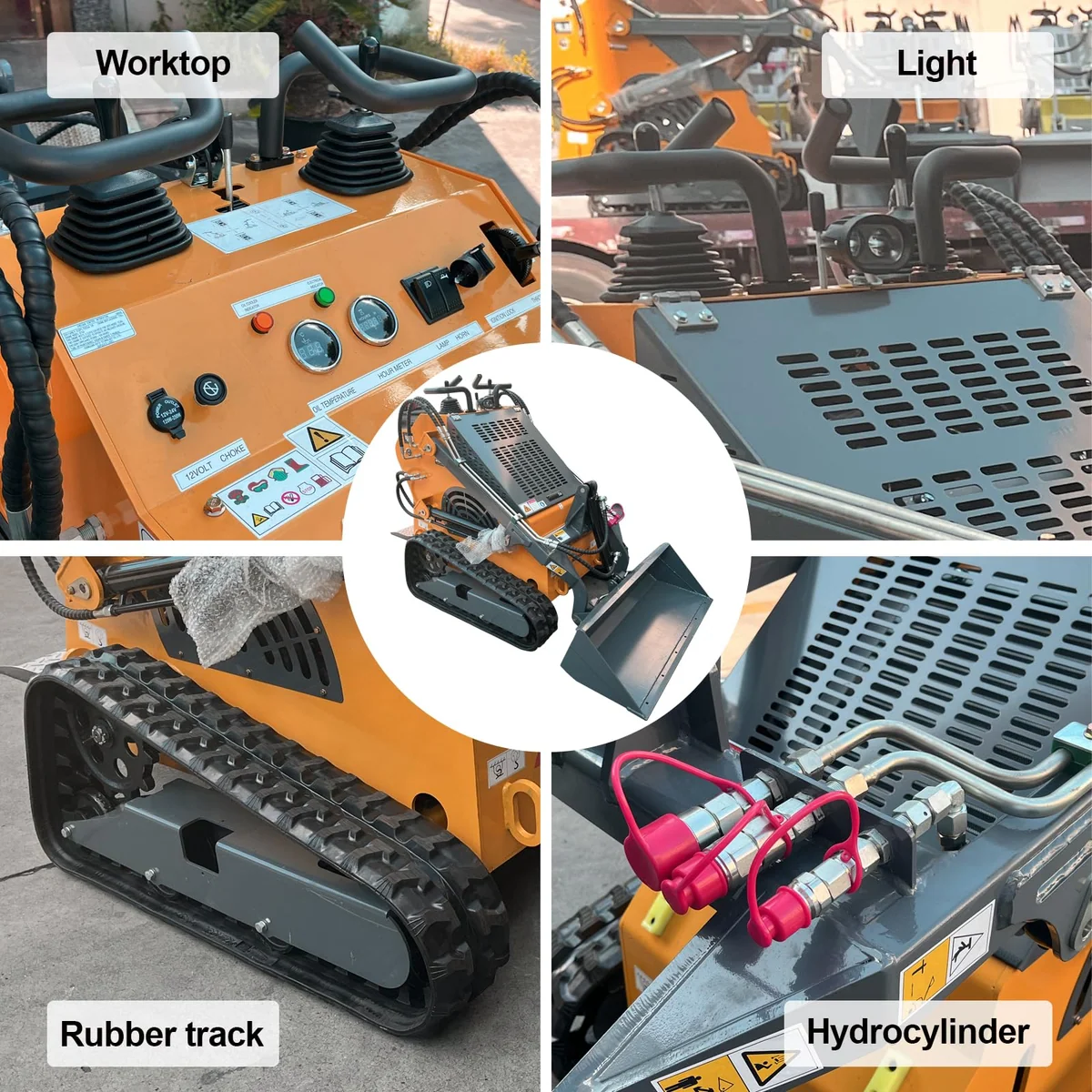
The good news is that much of the architecture is visible and mechanically straightforward. Removable panels expose the valve area, engine, pumps and filters, and an ATS procedure shows a control valve being replaced by marking every hose, documenting the routing and reconnecting the lines after installation. That accessibility favors a self-servicing owner, but a procedure video does not supply pressure specifications, a hydraulic schematic or a guaranteed source for the replacement valve.
Cooling deserves active attention rather than a universal diagnosis. An LDH-T460 owner called overheating a major complaint, noted the exhaust’s proximity to the cooler and altered airflow, while an owner of a very similar 23-horsepower LandHero platform added fans and changed their direction after seeing temperatures that caused concern. No factory operating-temperature range for this exact Amazon configuration was supplied, and one exact owner completed a seven-hour dirt session without reporting heat trouble. The actionable requirement is to establish whether the delivered fan is automatic, manual or both, then monitor it against written manufacturer limits.
The high triangular track layout also merits inspection without exaggeration. Two direct observers noticed only two lower rollers and a large unsupported gap, but neither documented a thrown track on the T460 during their very short use. Closely related high-track machines do provide examples of tight tracks accelerating wear, looser tracks derailing on inclines and gravel entering during sharp turns, so undercarriage geometry is a credible risk to investigate rather than a proven universal T460 failure.
Parts availability is not one yes-or-no question. Hoses, filters, fittings, batteries, relays and some valves may have local or generic equivalents; tracks, sprockets, idlers, drive motors, cylinders, brackets and attachment geometry can be configuration-specific. Owners of inexpensive imported loaders often report success cross-referencing commodity components, but the exact T460 drive-motor account shows why “generic parts” is not an adequate support plan.
Before money moves
- Receive and read the owner’s manual, engine manual, maintenance schedule, hydraulic schematic, electrical diagram and illustrated parts list.
- Get serial-number-linked photographs of the engine nameplate, control panel, pump arrangement, couplers, track markings and drive motors.
- Confirm whether the machine is a standard two-pump T460 or a three-pump T460A.
- Obtain auxiliary flow at the couplers, operating pressure, case-drain provision and the allowed continuous-duty hydraulic temperature range.
- Require separate figures for bare weight, rated operating capacity, tipping load, bucket weight and the load center used.
- Get replacement identifiers and written lead times for filters, tracks, rollers, sprockets, drive motors, cylinders and the control valve.
- Put warranty coverage, parts freight, labor, return freight, crating and damage-acceptance terms in writing.
Before the first working day
- Have a qualified person verify fluid types, levels and condition against the supplied manuals.
- Inspect the fuel tank and filters for contamination before debris reaches the carburetor.
- Check brackets, fasteners, hydraulic fittings, battery restraint and every accessible grease point.
- Inspect exposed hoses throughout full lift and curl travel so no line rubs, snags or contacts the bucket.
- Confirm cooler-fan operation in every documented automatic and manual mode.
- Set and inspect track tension only by the factory procedure rather than copying an owner’s modification.
- Function-test travel, lift, curl and auxiliary hydraulics cold and again at operating temperature.
- Do not alter relief pressure or add capacity-changing counterweights without specifications and engineering support.
Frequently Asked Questions
Does the exact Amazon T460 have a case-drain connection?
The supplied listing and direct-model evidence do not establish one, so require a clear coupler-panel photograph and written confirmation before choosing a motorized attachment.
What replacement track does the ATS T460 use?
No reliable track dimensions or part number were supplied, so require the installed track code, sprocket match and replacement lead time in writing.
Is a machine advertised for 2025 or 2026 a verified T460 revision?
The evidence does not establish a model-year revision, and the T460 label appears on machines with differing engines and bucket configurations.
Does the T460 arrive with an owner’s manual and a tool kit?
The sole Amazon reviewer said the manual was missing and wished for a small tool set, while an auction walkaround showed a toolbox on a different T460 package.
What does the advertised return promise cover?
The captured listing advertised a seven-day return or exchange service but did not supply the heavy-freight, crating or acceptance terms needed to judge it.
Sources (4)
- Amazon listings and customer reviews — Ats Power T460 Mini
- Owner reports across r/Skidsteer threads
- Owner and reviewer video, 12 channels
- Facebook — Article — www.facebook.com