Rent first, then buy only when the work repeats
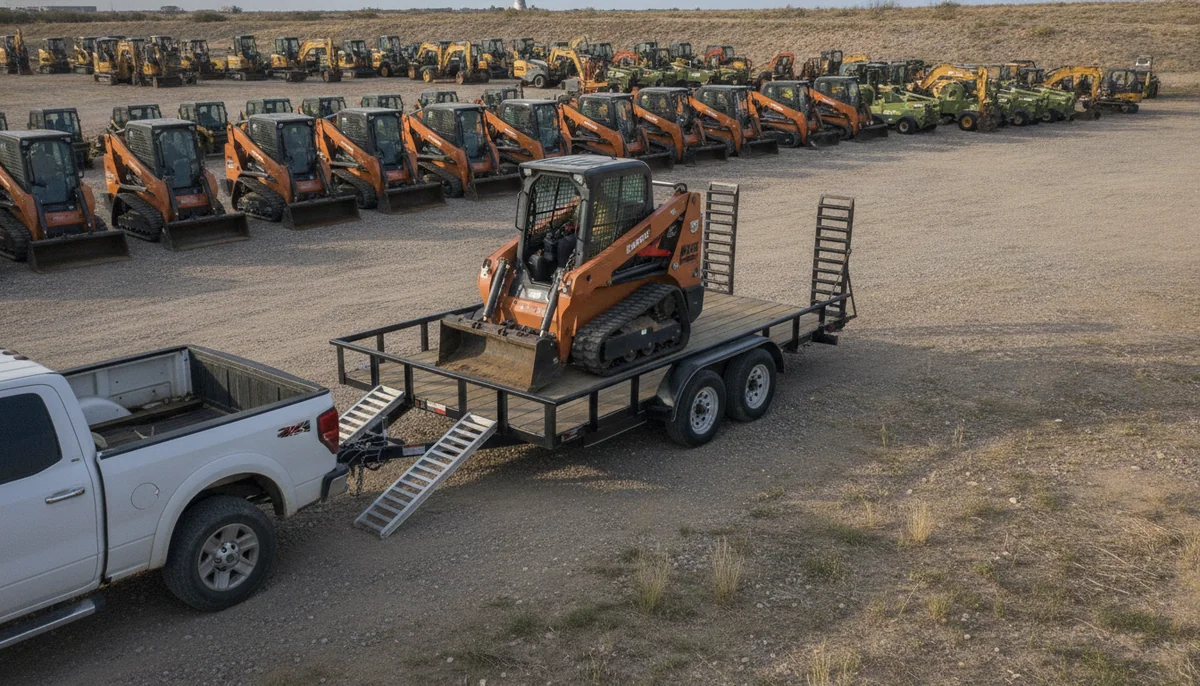
Ownership feels efficient because the machine is always nearby, but proximity is not productivity. A loader that works six hard days and then occupies a trailer, demands service, or waits for an unidentified part can cost more than a rental that leaves when the job ends. Renting first is not indecision; it is a paid field test of the work, the site and the operator.
Make those first rentals meaningfully different. Put one through the job that triggered the search, then use another on the next recurring task or with a different carrier, control layout or attachment. That comparison exposes whether the first result came from the equipment class, one unusually suitable machine, or the relief of replacing a shovel for a weekend.
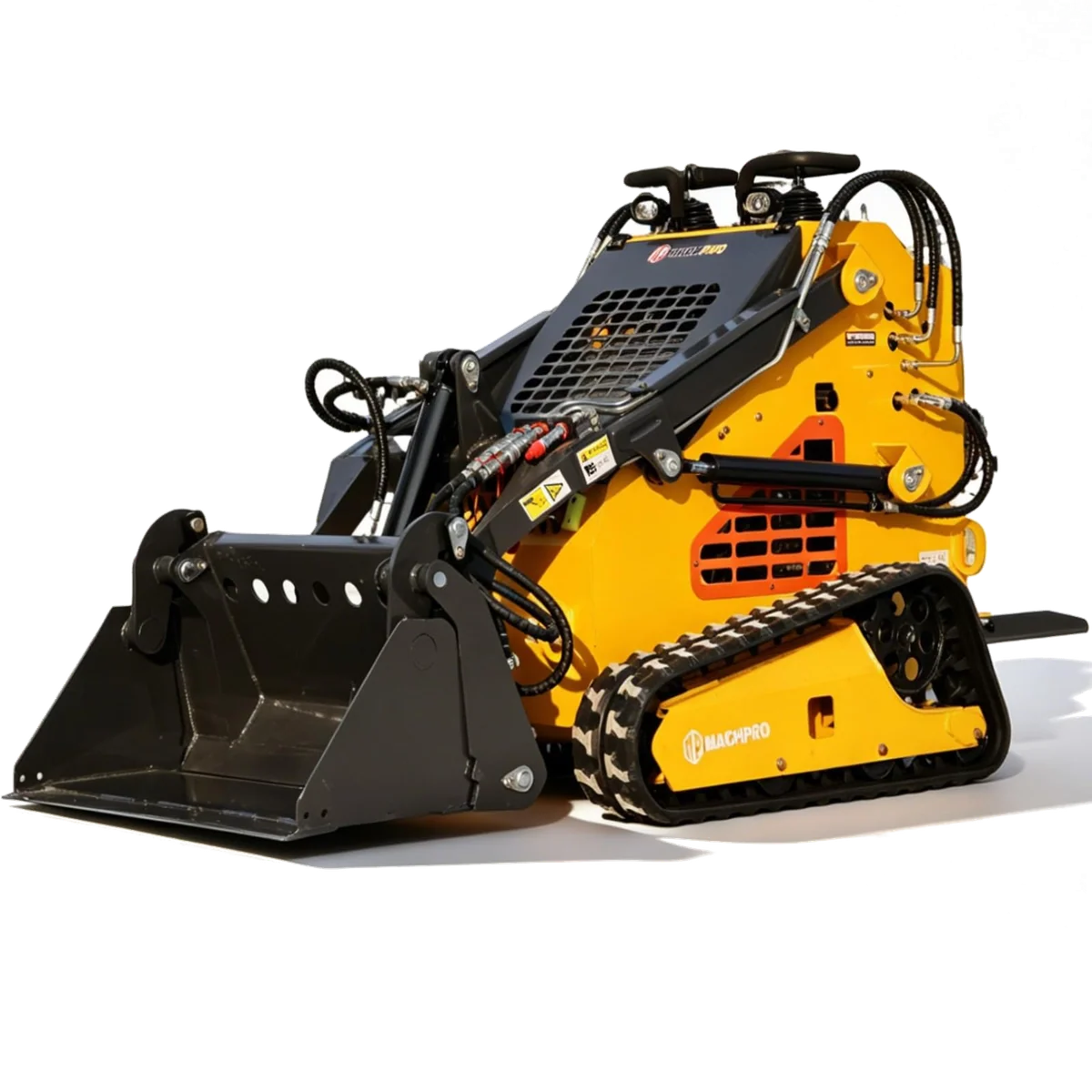
The MACHPRO MP-380-YE shows why a tempting ownership package still needs that test. Its listing specifies a 24 hp RATO gasoline engine, three hydraulic pumps and an included 4-in-1 bucket, but the exact evidence consists of only four five-star reviews, with the longest disclosed use at about 15 hours. The listing promises technical help and replacement-parts service without supplying the warranty duration, labor coverage, freight responsibility or response standard that would make those promises dependable.
Rent now
The work is new, the site is unmeasured, the attachment is unsettled, the schedule is temporary, or a breakdown would leave you without a recovery plan.
Buy now
The same work already returns, real rental records favor ownership, the exact machine fits every route, and you have transport, storage, service and a way to survive downtime.
Count completed work, not the machine in the shed
The wrong comparison places one rental invoice beside one purchase quote. The useful comparison covers the period in which the work is genuinely likely to recur and includes everything required to turn either option into a finished job. Use written local rental quotes and a delivered purchase quote rather than a remembered rate, an old listing or a monthly payment stripped of its term.
| Cost or constraint | Rent | Buy |
|---|---|---|
| Machine and tool | Quote the carrier with the exact bucket, forks, auger, trencher or other tool the work requires. | Use the delivered machine cost plus every attachment, coupler, hose and adapter needed to perform the same work. |
| Mobilization | Include delivery and pickup, or the time, trailer and tow vehicle needed for self-transport. | Include a suitable trailer, tow vehicle capacity, securement equipment, registration requirements and loading time. |
| Possession | Account for minimum periods, hour limits, weather delays, extension rules and return deadlines. | Account for financing, storage, security, insurance decisions and the capital tied up while the loader is idle. |
| Condition | Clarify fuel, cleaning, tire or track damage, attachment wear and damage-waiver terms before the machine arrives. | Budget for fluids, filters, grease, hoses, cutting edges, tracks or tires, pins, batteries and unplanned repairs. |
| Breakdown | Ask what happens to the clock and whether a replacement is available if the rented unit fails. | Price the lost work, emergency rental, diagnosis, freight and part lead time that follow an owned-machine failure. |
| Exit | The obligation normally ends when the machine is accepted back under the agreement. | Resale requires a buyer, an honest condition assessment and a sale price that may differ from the estimate used today. |
Use productive days in the denominator, not days of possession and not optimistic annual hours. A productive day is one in which the machine reaches the work, carries the correct tool and advances the project. If delivery, setup, weather, access trouble or attachment mismatch consumes half the booking, the lesson belongs in the calculation rather than being dismissed as bad luck.
Cost is not the only gate. A purchased machine can still be the wrong answer when one failure stops paid work, while a rental can still be wasteful when frequent short jobs repeatedly incur mobilization charges. The site’s ownership-cost guide expands the expenses that disappear when buyers compare only the invoice and the rental counter.
Make the rental earn its fee
Do not treat the trial as a pleasant demonstration with an empty bucket on flat gravel. Reproduce the route, material, grade, dumping target and attachment cycle that will justify ownership. Record what happened while the details are fresh enough to challenge the original plan.
- Prove access. Measure the narrowest clear opening, the approach turn, overhead clearance, working envelope and exit route with the intended attachment fitted; the gate-width guide covers the clearance that a quoted machine width leaves out.
- Prove the undercarriage. Compare rutting, turning disturbance, ride, traction and cleanup on the actual surface rather than deciding from the labels “wheeled” and “tracked”; the undercarriage comparison explains the trade.
- Prove the tool. Run the attachment through a complete working cycle, including travel, lift, curl, reverse flow and any sustained hydraulic demand.
- Prove output. Record delivery time, setup, actual operating time, material moved, hand finishing, refueling, cleaning and return time instead of relying on how fast the machine felt.
- Prove the operator fit. Note control precision, visibility, mounting and dismounting, fatigue, vibration and whether the operator can make a controlled stop without searching for a lever.
- Prove recovery. Learn what the rental agreement does after a breakdown, then ask how the same failed hose, track, switch, pump or engine component would be identified and sourced on the machine being considered for purchase.
Uneven ground deserves its own pass. On a different stand-on loader, short tracks meeting small embedded rocks produced a sharp pitch even though the owner was comfortable on steady inclines. That account does not predict the behavior of every model, but it shows why traction and climbing ability cannot substitute for a stability trial on the actual route.
Powered tools can overturn the decision just as quickly. Testing on a separate two-pump loader found that a brush cutter could spin or the carrier could travel normally, but the combination would not make a useful straight pass, while trenching became a stop-and-restart exercise. Before buying around a cutter, trencher, sweeper or grinder, verify continuous auxiliary flow at working pressure, return restriction, case-drain needs, couplers, cooling, hose routing and attachment mass; the compatibility guide shows why matching pins alone is not enough.
Repeat the terrain trial with the load low, avoid improvised side-slope tests and follow the rented machine’s manual. The slope-safety guide separates usable traction from rollover stability without turning a seller’s climbing angle into permission to work across a hill.
The jobs that point one way or the other
| Work pattern | Call | What could change the call |
|---|---|---|
| One cleanup, grading or construction phase | Rent | Buy only if the project reveals recurring work that survives a written cost comparison and a second field test. |
| Several short jobs separated by long idle periods | Usually rent | Ownership can win when repeated delivery charges dominate and the machine can be stored, transported and serviced cheaply between jobs. |
| Recurring farm or property maintenance | Rent through the proof stage | Buy when logged work establishes a stable task list, the right attachment set and enough productive days to cross the conservative break-even point. |
| Customer work with firm deadlines | Rent a supported package first | Buy only with reliable parts, service and backup capacity, because a low acquisition cost does not compensate a crew for a stopped job. |
| Remote property with frequent mobilization | Ownership may fit | The case strengthens when rentals are difficult to move repeatedly and the owner can inspect, maintain and secure the machine on site. |
| Work built around a hydraulic motor attachment | Rent the exact carrier-and-tool combination | Buy only after useful simultaneous travel and tool operation, temperature control, plumbing and physical compatibility are demonstrated. |
| Sites with narrow openings or awkward turns | Rent by measured dimensions | Buy after the complete machine and attachment clear every route with operating room rather than merely squeezing between two posts. |
No universal annual-hour threshold can replace this table. An owner moving material in ten-minute bursts beside a barn has a different mobilization cost from a contractor transporting the same loader across town, and a plain bucket creates a different repair and hydraulic burden from a continuously powered cutter. The work pattern decides which hours are valuable.
The MACHPRO case: a useful bucket and an unfinished support story
The MP-380-YE makes its strongest argument with equipment included in the crate. The seller specifies a 5.3-cubic-foot hydraulic 4-in-1 bucket, a folding stand-on platform and a 24 hp RATO 739cc gasoline engine. An exact owner reports using the bucket to dig, bulldoze and grab material, so this is one feature with evidence beyond the product copy.
The hydraulic headline is less settled. The advertised 19 GPM is the total of three listed circuits, broken into 36, 18 and 18 L/min, while the listing does not identify which pump serves the front couplers or state continuous attachment flow. A three-pump design may be promising, but aggregate system flow is not permission to select a brush cutter, trencher or grinder.
The lift labels are also unusable for planning. The listing places an 881-pound rated operating load beside an 827-pound maximum lifting force without defining the measurement point, load center, tipping load or reason the stated maximum is lower. The larger number should not become a pallet, log or bucket target until the seller supplies a serial-specific load chart and reconciles the terms in writing.
Access is not especially narrow. The seller lists the machine at 43.3 inches wide, which already excludes 36-inch and nominal 42-inch clear openings before hinges, latches, attachment width and turning room are considered. Buyers serving fenced backyards should treat that figure as a hard screening measurement, not as evidence that the loader will fit any gate described as compact.
What supports a conditional yes
Intermittent work on an owner-managed property
The included bucket can cover scooping, light clamping and rough dozing, exact reviewers describe smooth controls and real grading or log movement, and a capable owner may value keeping that package nearby.
What keeps the answer narrow
Commercial dependence and unverified powered tools
Four perfect early reviews, about 15 hours at the longest disclosed interval, unresolved lift language, unidentified auxiliary flow and undefined support terms do not establish reliable uptime.
Skid Steer Mulch did not operate, own or measure this loader. The verdict gives the exact listing and exact customer reviews the most weight, then treats adjacent-machine records only as prompts for inspection rather than as proof that this model has inherited their faults.
If that narrow ownership case still describes you, read the full MP-380-YE evidence audit before accepting its lift, hydraulics or support claims, then compare the complete commissioned package in the value-focused loader shortlist.
Ownership needs three kinds of backup
Mechanical simplicity helps, but it does not erase downtime. An engineer examining a comparable imported loader found an understandable collection of engine, pumps, valves, cylinders, hoses, motors and basic wiring, with some marked hoses and common hydraulic components suitable for local matching. The same examination warned that rubbing lines, unsupported pins, fabrication choices and machine-specific structures remain harder long-term problems.
Parts identification can turn a routine service into detective work. A relevant MACHPRO-family buyer with a RATO 739cc engine received an oil filter that did not fit and had to cross-match the original, while another owner seeking a numbered PGP hydraulic pump eventually sourced it directly from the manufacturer in China. Neither event establishes an MP-380-YE failure, but both show why “replacement parts available” is incomplete without exact numbers, stocking locations and lead times.
Production revisions add another reason to inspect the current unit rather than buy a family resemblance. An owner of an adjacent MACHPRO MPS330 described different cooler arrangements across similar machines and considered track tension, tank cleanliness, fasteners, controls and fluid service worthy of commissioning checks. Those observations do not transfer defects to the MP-380-YE; they make current photographs, tags and component numbers part of a serious purchase.
Workshop backup
Inspect, service and diagnose
The owner needs the manuals, safe lifting and lockout procedures, suitable tools, fluid specifications and either personal ability or a shop willing to work on the machine.
Parts backup
Identify before failure
Record filters, belts, hoses, couplers, tracks, idlers, seals, switches, pumps and engine components while their labels can still be read.
Calendar backup
Keep the work moving
Decide in advance whether a failed machine can wait, whether another loader can be rented, and who bears the cost when a job must be rescheduled.
Delivery day should therefore be treated as a commissioning appointment rather than the first production shift. Photograph the crate and tags, verify fluids according to the delivered manual, inspect tracks, fasteners, hoses, wiring and leaks, then test documented safety systems and attachment locks in a clear area. The first-use inspection guide turns that work into a repeatable check rather than a hopeful walk-around.
Buy only after all six gates close
A purchase is ready when every statement below is true without leaning on a future job, an assumed specification or an unnamed person who might repair the machine.
- The work has repeated. At least two real jobs have established a stable need rather than a single project creating temporary urgency.
- The ledger favors ownership. Written rental and purchase quotes, realistic productive days, variable costs and conservative resale assumptions cross the break-even point.
- The exact carrier and tool match. Dimensions, mount geometry, couplers, flow, pressure, return, case drain, attachment mass and load capacity are documented.
- The jobsite has been proved. The intended machine can enter, turn, work, dump and leave on the actual terrain with useful clearance.
- The ownership infrastructure exists. Transport, secure storage, routine service, inspection tools and identifiable parts are ready before delivery.
- Downtime has an answer. The work can wait, a backup can be rented, or a support channel has demonstrated that it can supply the needed service and parts.
For most first-time buyers, rent the next two jobs and keep the records. Buy after the pattern, not before it; the exception is an owner with proven recurring work, verified machine fit and enough mechanical and financial slack to carry the loader when it is not earning its keep.
Frequently Asked Questions
Is renting first just delaying an inevitable purchase?
No, a deliberate rental supplies the access, productivity, attachment and operating evidence needed to determine whether the purchase is inevitable at all.
How many working days make ownership worthwhile?
No universal day count works, because the answer depends on local rental terms, mobilization, attachment costs, owned running costs, downtime and conservative resale value.
Does a low purchase quote automatically beat repeated rentals?
No, because transport, commissioning, attachments, storage, service, repairs, idle capital and resale uncertainty belong in the ownership total.
Can the MACHPRO MP-380-YE be trusted for deadline-driven work?
Not from the current evidence, because four exact reviews with only about 15 disclosed hours do not establish long-term uptime, parts response, cooling, track life or structural durability.
Should the attachment be chosen before the carrier?
Usually yes, because the tool determines the required mount, couplers, hydraulic flow, pressure, return path, case drain, cooling, attachment mass and safe working capacity.
What would make the MACHPRO purchase rational?
It becomes rational for a mechanically capable property owner when recurring bucket work, 43.3-inch access, documented specifications, service preparation and tolerance for parts-related downtime are all established.
Can expensive delivery make buying the better option?
Yes, repeated mobilization can strengthen the ownership case, but only after transport, storage, maintenance, repairs, downtime and resale are added to the other side of the comparison.
Sources (4)
- Amazon listings and customer reviews
- Owner reports across r/sweatystartup threads
- Owner and reviewer video, 5 channels
- Facebook — Article — www.facebook.com