No mini skid steer on this list gets through a narrow gate on faith.
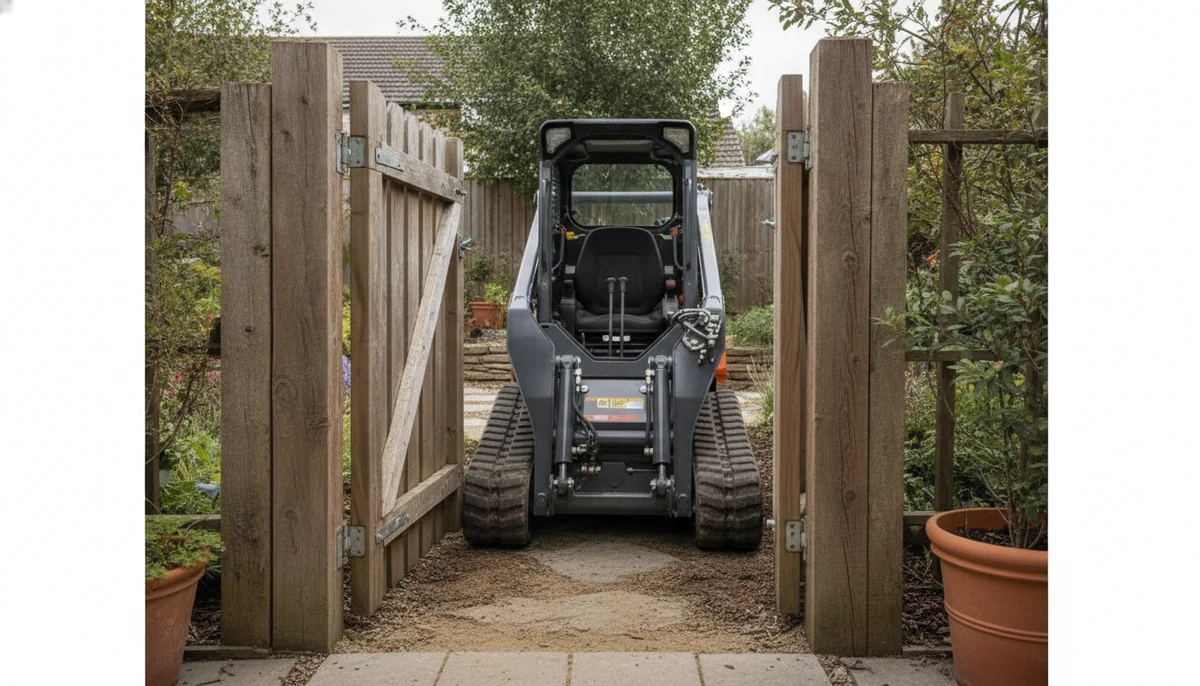
A narrow-gate buyer is not shopping for the smallest-looking loader. The route is a chain of hard limits: the clear opening, the attachment, the turn beyond the posts, the ground beneath the machine, and the space needed to operate without scraping steel or crushing fingers. One failed limit makes horsepower irrelevant.
The two smallest explicit overall-width claims belong to the DigSwift DS-S40 and DS-SS50 at 39.4 inches. Neither earns a recommendation. The S40 has one vague owner comment and leaves its hydraulics, stability conditions, safety equipment, delivery preparation, and support terms unresolved; the SS50 adds confused product copy and two customer comments that explain almost nothing.
The HY360C makes the stronger case because its 41-inch listing is paired with exact owner reports of stall access, small-farm chores, smooth early operation, and useful bucket work. That does not turn 41 inches into a promise for a nominal 42-inch gate, nor does it rescue the machine’s undefined 1,323-pound lift claim or missing auxiliary-flow figure. It simply makes the HY360C the least speculative exception once the route genuinely clears it.
Skid Steer Mulch did not own, operate, weigh, or measure these machines. Seller dimensions remain seller claims, owner reports establish only the jobs and intervals they actually describe, and an empty specification field remains empty rather than borrowing a number from a similar model.
The route splits the decision in two
Route below 41 inches
There is no supported buy here.
The DigSwift machines are the only documented sub-41-inch candidates, but their evidence is too weak to justify a freight-delivered equipment purchase without current tape-measure photographs, a complete build sheet, and written support terms.
Route safely beyond 41 inches
The HY360C becomes the narrow exception.
Keep it on the shortlist for light bucket work on firm, mostly level ground when the exact delivered machine and attachment clear every part of the route and downtime will postpone a chore rather than cancel paid work.
Measure the route, not the gate label
A fence panel advertised as four feet wide does not guarantee a four-foot clear opening. Hinges, latch receivers, posts that lean inward, raised thresholds, roots, and a gate that does not swing fully open can remove usable space. Measure the opening where the machine will actually pass, at every height occupied by its tires or tracks, bodywork, hoses, controls, and attachment.
| Measurement | What to capture | What commonly defeats the plan |
|---|---|---|
| Clear opening | Measure between the closest fixed or protruding points with the gate fully open, then repeat near the ground, through the machine body height, and at the control station. | A nominal gate size can ignore hinges, latch hardware, trim, sag, or posts that are not parallel. |
| Machine envelope | Obtain the widest as-delivered dimension across tires or tracks, guards, body panels, hoses, couplers, and any fixed control hardware. | A seller may quote track width, body width, or a rounded metric figure rather than the true widest point. |
| Attachment envelope | Measure the supplied bucket and every planned fork frame, grapple, auger drive, or powered tool in the travel position. | The chassis may clear while the attachment catches a post, and removing it is useful only when safe coupling space exists on both sides. |
| Vertical envelope | Record machine height, control-handle height, overhead branches, eaves, braces, and any change caused by the ground rising through the opening. | A loader can be narrow enough at ground level and still strike something above the operator or boom. |
| Maneuvering envelope | Map the straight approach, the distance available before turning, the rear platform, the standing operator, and the attachment’s swept path. | Passing between the posts does not prove the machine can align with them or turn once it reaches the other side. |
| Surface and staging | Check slope, ruts, soft edges, drainage channels, curbs, and the level area needed for unloading or changing attachments. | A rut or cross-slope can lean the machine into a post, while a cramped staging area can make an otherwise possible attachment change unsafe. |
The full process is covered in the site’s mini skid steer gate-width guide, including why matching a machine’s published width to an opening of the same size leaves no workable margin.
Narrow access is only the first veto.
A carrier that reaches the yard can still be wrong for the work. A bucket, land plane, or fork frame avoids continuous hydraulic-motor demand, while a cutter, trencher, sweeper, tiller, or grinder must match the machine’s auxiliary flow at pressure, pump architecture, return plumbing, cooling, attachment mass, and stability. The attachment-compatibility guide covers the complete match, and the powered-attachment shortlist is the better starting point when the hydraulic tool is the reason for buying.
Undercarriage choice does not settle access either. Tracks can help with traction and flotation in soft conditions, while wheels often suit firm lanes, pavement, and barn floors with less undercarriage maintenance. The route, surface, turning method, and intended work should decide that trade, which is examined in the wheeled-versus-tracked guide.
Most of this list is an elimination exercise
Missing width is not neutral on a narrow-access page, contradictory dimensions are not close enough, and a five-star arrival comment is not a durability record. Each machine below has to clear the physical route, suit the actual job, and leave the buyer with a credible way to maintain it.
This anonymous listing is not a recommendation.
It earns no buying case because the captured page supplies no brand, model, specifications, rating, description, or customer evidence.
Without even a width, it cannot answer the only question this roundup exists to settle.
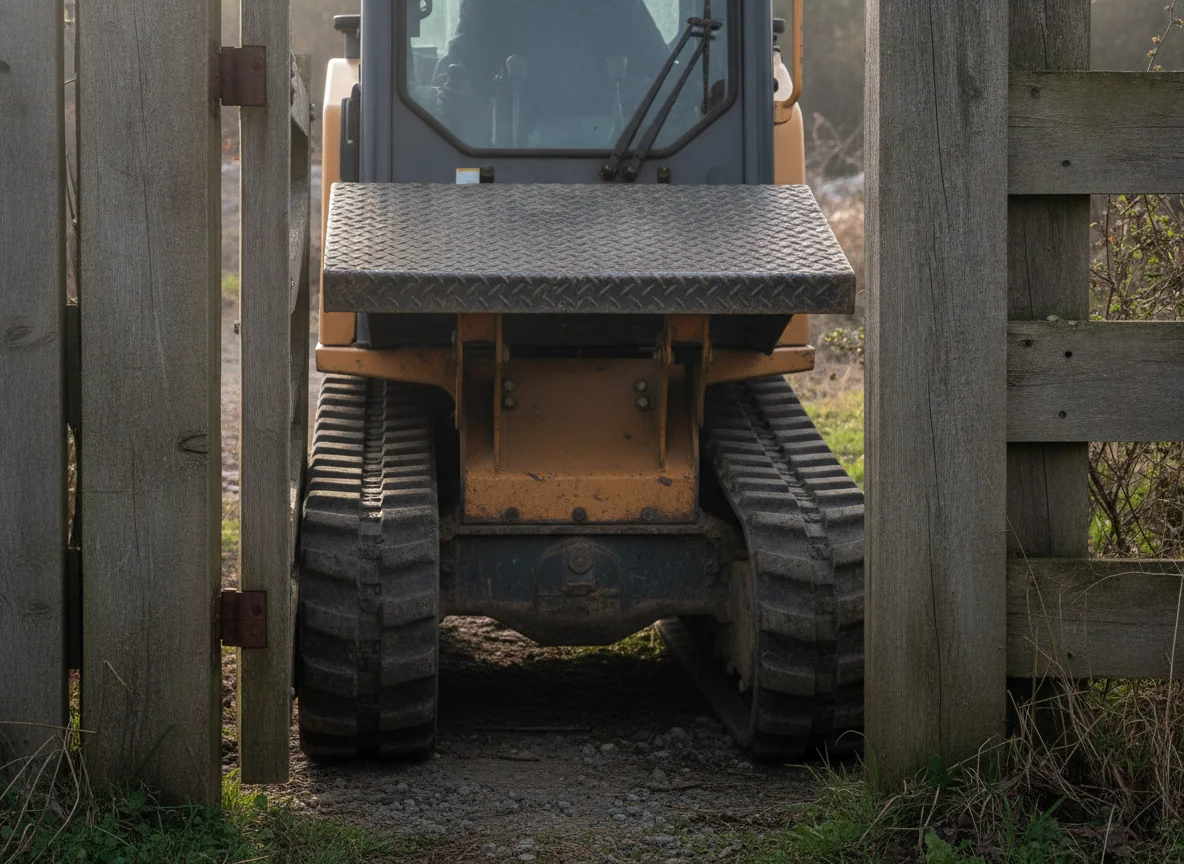
The MACHPRO MP-380-YE is useful, but not narrow enough.
Its included 4-in-1 bucket and early owner work make it a credible property loader for a capable mechanic, yet the listed 43.3-inch width removes it from 42-inch access.
Four perfect reviews reach only about 15 disclosed hours, and the listing’s lift numbers and auxiliary-flow claim remain unresolved.
The MMS MS380L is a wheeled bucket worker with no defensible gate width.
Owner reports support light grading and material work on firm ground, but the listing omits overall width and therefore cannot support a tight-access promise.
Two-pump hydraulics, uneven arrival quality, and a ten-hour evidence horizon make it unsuitable for continuous powered tools or commercial dependence.
The DIGMIGHT MP310 fails its own gate test.
The listing gives a 45.3-inch machine width while separately promising passage through a 36-inch gate, so its own dimension defeats the sales claim.
Two short positive reviews supply no measurements, operating hours, defined loads, support history, or durability evidence.
The MMS MS360T cannot be recommended from arrival-day evidence.
The listing describes a 13.5-horsepower Briggs and Stratton machine on triangle tracks, but it omits the overall width required to qualify it for this job.
Two arrival-day reviews, including one report of a control that appeared unresponsive, do not establish hydraulics, capacity, track durability, or support.
The HUAYEE HY480C is the strongest tracked loader here, not the narrowest.
Its listed 44-inch width, three-pump claim, and useful exact-owner reports suit wider access on an owner-maintained property.
One owner saw factory-fluid temperatures pass 71 °C, another threw tracks before correcting tension, and the exact record reaches only 36 hours.
The Wolfequip T460S1 is a wait, not a narrow-gate buy.
Its listing includes a 46-inch bucket but omits chassis width, so removing the attachment cannot be assumed to solve access.
The specification sheet conflicts with itself, the owner evidence barely clears commissioning, and the closest walkthrough raises an operator-presence concern.
The LUROFAN is simply too wide for this assignment.
Its listing gives a 53.58-inch width, making its compact language irrelevant to a genuinely narrow gate.
Two generic five-star comments supply no operating hours, measured loads, dimensional verification, or after-sales experience.
The ATS Power T460 is a 43.8-inch-bucket machine with too many unknowns.
It can be considered for loose-material work through wider access, but the missing chassis width and unclear hydraulic figure keep it out of the narrow-gate lead.
The listing conflicts on lift, mixes tire language into a tracked product, and one retained review says the owner’s manual was missing.
The MMS MS360L is a useful wheel machine that never states its width.
Owner reports support home grading and material work on firm ground, but an unstated overall width blocks a narrow-access recommendation.
Its two-pump ceiling, weak manual, bad batteries, shipping issues, and ten-hour evidence horizon make it a poor powered-tool or commercial choice.
The DigSwift DS-S40 is the narrowest plausible candidate, not the safest recommendation.
Its listing claims a 39.4-inch tracked body, the smallest explicit overall width in this set and the sole reason it remains in the conversation.
One vague review and missing pump, flow, pressure, tipping-load, safety, delivery, and support details leave the purchase unjustified.
The HUAYEE HY360C is the least speculative narrow-access choice.
Its listed 41-inch width, Briggs and Stratton engine, included bucket, and exact owner reports of stall and small-property work form the most coherent case here.
The two-pump design lacks a published auxiliary-flow figure, the 1,323-pound lift claim is not a usable payload, and the longest disclosed ownership is 16 hours.
The TYPHON STOMP brings a serious engine to an unanswered width question.
Its GX690 engine claim and tracked layout make it interesting for property work, but the exact listing publishes neither overall nor bucket width.
The 830-plus-pound lift claim is undefined, the listing conflicts on machine weight, and there are no exact-ASIN ratings.
The DigSwift DS-SS50 puts a 39.4-inch claim behind a wall of missing evidence.
Its published dimensions make it a theoretical sub-40-inch option, but the seller does not define whether that width includes the bucket, hoses, or widest working point.
Unspecified hydraulics and safety systems, confused stand-on or walk-behind copy, and two reviews split between a single line of praise and an unsupported accusation make this a walk-away.
The HUAYEE HY480D is too wide and too risky for this job.
Its seated format may suit firm-ground bucket work, but the listed 45-inch width excludes it from 42-inch access before working clearance is considered.
One owner reported the original engine failing very early and a replacement lasting no more than 12 hours, which is too serious for this tiny evidence pool.
This second anonymous SKU is also unrankable.
The captured page identifies no brand, model, width, dimensions, features, ratings, or customer record that could support a buying case.
A buyer cannot verify gate fit, machine identity, or even the basic package from the available listing.
The Wolfequip T460S1WH adds forks, not confidence.
The included bucket-and-forks package could help on a roomy, level property, but the listing never gives overall machine width and the fork frame consumes part of an undefined loader capacity.
Zero exact ratings, no auxiliary-flow data, no clear safety description, and an apparent operator-presence gap in the closest owner account make this a pass.
The generic T460 is an anonymous duplicate, not a bargain.
Its 43.8-inch bucket already rules out tighter routes with the attachment installed, while chassis width remains absent.
Zero ratings, contradictory 770- and 840-pound lift claims, tire language on a tracked listing, and no named support organization leave no responsible purchase case.
Frequently Asked Questions
How much clearance should I leave beyond the published width?
No single number fits every machine or route, so use the manufacturer’s required clearance and confirm enough room for hardware, steering correction, surface tilt, and the complete attachment rather than matching two nominal dimensions.
Can I remove the bucket to pass through a narrower opening?
Possibly, but only after proving the chassis is narrower and confirming that the attachment can be removed, moved, and reattached safely on level staging areas at both sides of the opening.
Do tracks make a mini skid steer easier to use in tight access?
Tracks can improve traction and flotation while wheels often suit firm surfaces, but neither undercarriage changes the need to measure the full outside width, attachment, approach, and turning envelope.
Will a powered attachment fit wherever the carrier fits?
No, because the tool may be wider than the carrier and must also match the mounting plate, auxiliary flow at working pressure, pump layout, return plumbing, cooling, weight, and stability.
Should I rent before buying for a confined property?
Renting is the better first move when the route or workload is uncertain because one real job reveals access, turns, surface disturbance, control feel, and attachment needs before ownership shifts service risk onto you.
Sources (2)
- Amazon listings and customer reviews
- Owner and reviewer video, 1 channel