Choose wheels unless your ground gives tracks a real job
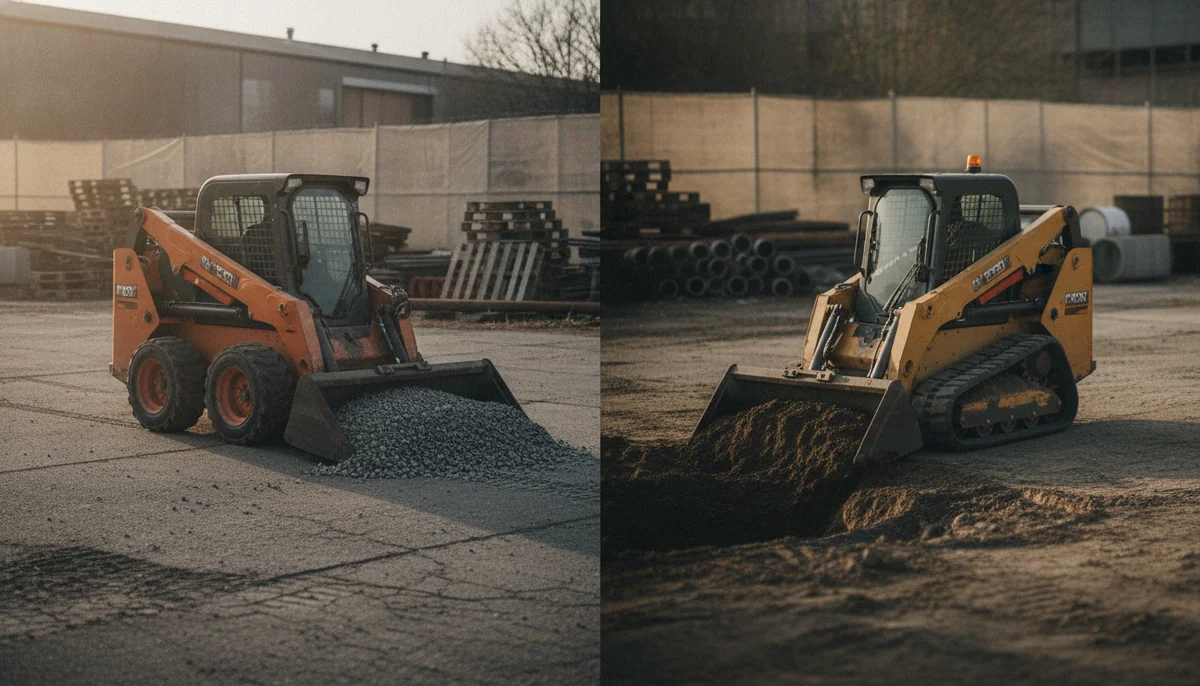
The undercarriage should answer the least glamorous question in the purchase: what surface must carry the machine from storage to the work, during the worst conditions in which the job cannot wait? If that route is firm, reasonably smooth and usually dry, wheels are the sensible default. Choosing tracks merely because they look more capable turns extra rubber, rollers, tension hardware and cleaning into payment for traction you may never need.
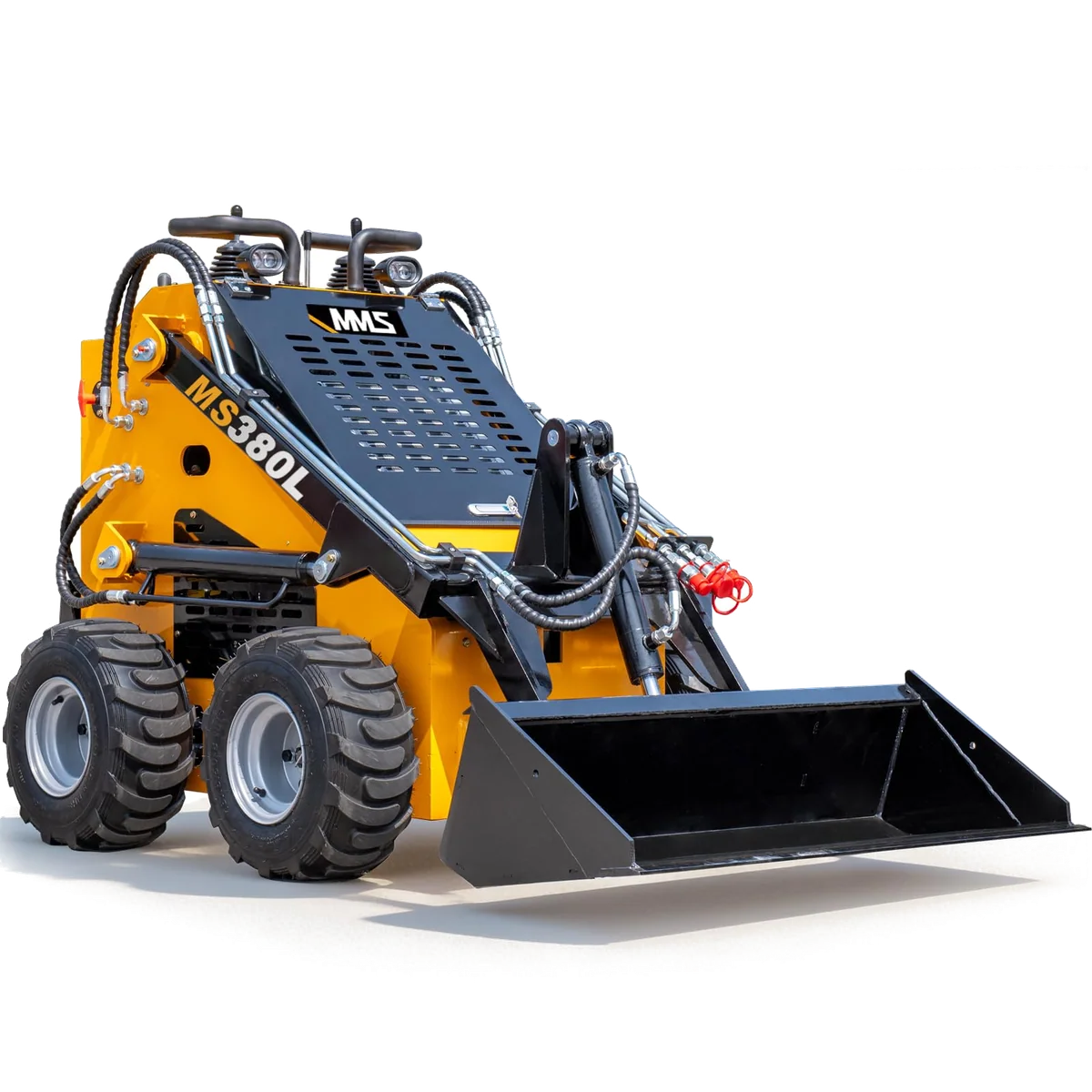
The exact owner records show both sides of the bargain. An MMS MS380L buyer deliberately chose wheels for residential material work and accepted the machine as a firm-ground property tool. An HY480C owner gained useful tracked traction across dirt, clay, gravel and pavement, but only after two early derailments led to a track-tension correction. The track then stayed on through the owner’s reported 36-hour mark, which is encouraging setup evidence rather than a full service-life record.
Tracks therefore deserve neither automatic praise nor automatic rejection. They earn their keep when they let the loader reach and complete work that tires would abandon through spinning, sinking or rutting. When the surface already supports wheels, the same undercarriage becomes weight, drag, wear points and downtime with no corresponding improvement in the job.
The ground gets the first vote
Start with the full route rather than the photogenic patch where the bucket will work. A tracked machine that crosses pavement, a narrow gate and a coarse-gravel turn before reaching one damp corner may spend most of its life paying penalties for a problem found only at the destination. A wheeled machine that must cross a wet swale every morning may be the wrong choice before its engine or lift rating enters the discussion.
| Route or work surface | Starting choice | Why | What can overturn the choice |
|---|---|---|---|
| Concrete, asphalt, barn floors and established hard-packed lanes | Wheels | Firm surfaces already provide support, so the simpler undercarriage and easier repositioning matter more than flotation. | Embedded debris, sharp scrap or a recurring soft approach may justify a different tire or a tracked route. |
| Firm lawn during its usable season | Wheels, with restrained turns | A tire can follow a broad arc without dragging a long rubber belt sideways through the grass. | Wet soil can turn the same tire into a rut cutter, while sharp wheel pivots can still tear turf. |
| Recurring mud, loose fill or soft cultivated ground | Tracks | A longer contact patch can spread the machine’s load and preserve drive where tires would spin or sink. | Exact operating weight, track contact area and ground pressure still need confirmation for the specific machine. |
| Coarse gravel, rubble or root-filled approaches | Improve the route first | Tracks can gain traction while rocks and debris enter the undercarriage, and wheels can puncture or lose grip. | A cleared travel lane may matter more than either undercarriage. |
| Side slopes, ledges and abrupt grade changes | Neither format earns permission | Traction does not prevent a short machine from pitching or rolling when the load and center of gravity move. | Use a safer approach, reduce the job, or choose equipment with documented stability guidance. |
| Long shuttles between scattered jobs | Wheels on a firm route | The wheel format generally suits repeated hard-surface travel better than a slow tracked undercarriage. | A soft route that stops the machine is more important than the time saved on its dry sections. |
| A narrow gate or crowded barn entrance | Measure either machine | Overall width, bucket width, hose protrusion, platform position and turning room decide access. | The word compact and the presence of tracks reveal none of those dimensions. |
The clean decision rule is blunt: tracks are worth owning when lack of traction changes whether the work gets done. A vague wish for all-terrain ability is not enough because no undercarriage makes a compact stand-on loader calm over every rock, rut or slope.
What you gain, and what follows you home
Wheel case
Four tires keep the machine honest
- Firm ground lets wheels turn the loader’s power into useful travel without carrying a complete track system.
- Tire pressure, tread, punctures, hubs and the wheel-drive system still require inspection and service.
- A tire can spin, dig a rut or lose steering authority when the supporting surface becomes soft or slick.
- Ground clearance may be modest, so roots, curbs, ruts and trailer transitions still belong in the route plan.
- Broad moving turns are kinder to finished ground than stationary counter-rotation, but no skid-steer turn is turf-neutral.
Track case
Rubber tracks buy grip with a maintenance contract
- The longer contact patch can deliver traction and flotation where a wheeled machine spins or sinks.
- Track tension must suit the exact undercarriage because both excessive and insufficient tension create costly failure paths.
- Rollers, idlers, bearings, sprockets, tensioners and the rubber track become additional wear items.
- Sticks, wire, stone and packed soil need removal before debris damages the track path or encourages derailment.
- A tight pivot drags a large rubber patch sideways, which can tear turf even when the machine’s static footprint looks gentle.
The useful owner evidence fits that mechanical logic. Wheeled buyers in the MMS and HUAYEE records deliberately avoided track-specific trouble and used their machines for residential landscaping, greenhouse grading, barn access and small-property material work. Those accounts remain short, and wheels did not erase complaints about low clearance, batteries, shipping damage or missing documentation.
The hydraulic circuit can overrule the undercarriage
A buyer planning bucket work can give the terrain decision priority because the bucket does not require a continuous auxiliary motor. A buyer planning mowing, trenching, sweeping, grinding or powered raking must reverse the order: hydraulic architecture comes first, then the undercarriage that can carry the tool across the intended surface.
A documented attachment test on a separate two-pump Chinese mini loader makes the problem visible. The rotary cutter could receive oil, or the machine could travel normally, but the operator could not sustain both functions in a practical straight pass because auxiliary flow consumed a circuit needed by one drive side. More engine horsepower would provide reserve, but it would not create the missing hydraulic path.
A genuine three-section arrangement can separate attachment flow from the two travel sides and make simultaneous work more plausible. The HY480C record supports that architecture and contains exact-owner reports of a brush cutter, power rake and trencher operating, but it also contains a hydraulic-temperature concern and a poor result with a direct-motor stump grinder. Three pumps widen the menu; they do not prove adequate flow at pressure, cooling, case-drain plumbing or continuous duty for every tool.
| Tool or job | Primary decision | Wheel-or-track effect | Missing proof to obtain |
|---|---|---|---|
| Standard bucket and loose-material grading | Surface support and usable loader capacity | Wheels suit firm routes; tracks earn their place when soft ground stops travel. | Rated capacity, tipping load, bucket width, dump clearance and machine weight. |
| Pallet forks, land leveler or trailer mover | Stability, load center and attachment weight | The undercarriage changes traction but does not increase the documented payload. | Load chart, fork weight, approved ballast and capacity at the intended height. |
| Grapple or four-in-one bucket | Intermittent auxiliary compatibility | Either format can work because the attachment can often be actuated while stopped. | Plate geometry, couplers, pressure, hose clearance and added attachment mass. |
| Stationary auger | Flow, pressure, bit size and soil | Tracks may hold position better in soft ground, but the auger still needs a documented hydraulic match. | Auxiliary output at working pressure, motor demand, case drain and attachment approval. |
| Brush cutter, trencher, sweeper, tiller or power rake | Independent continuous auxiliary flow | Traction matters only after the carrier can power the tool while both drive sides remain useful. | Pump layout, measured flow, pressure, cooling limit, return plumbing and continuous detent. |
| Mulcher or stump grinder | Complete carrier-and-tool engineering | Tracks cannot rescue an attachment that is too heavy, too demanding or too far forward. | Written approval covering mass, balance, hydraulic horsepower, case drain, cooling and duty cycle. |
The site’s hydraulic-circuit guide explains the plumbing, while the attachment compatibility guide checks the mount, oil and stability as one system. If a continuously powered tool is the reason for buying the carrier, begin with the powered-attachment shortlist rather than choosing tracks first and hoping the couplers finish the argument.
The undercarriage can pass while the machine still fails
Wheel or track is only the first gate. Safety logic, pump layout, capacity definitions, exact dimensions, documentation, parts and the owner record can still turn the right format into the wrong purchase. The products attached to this page therefore do not receive equal recommendations merely because they share an undercarriage.
The four wheeled choices
| Model | Verdict | Honest drawback | Read next |
|---|---|---|---|
| MMS MS380L | A conditional buy for occasional bucket work, rough grading and intermittent auxiliary jobs on firm ground. | Its exact timed record ends at 10 hours, its two-pump layout limits continuous powered tools and its arrival record includes batteries, levers, pallets and freight damage. | Read the full MS380L evidence review. |
| MMS MS360L | A conditional buy for recurring light material work when the owner can perform basic inspection and service. | Two-pump hydraulics, missing capacity and flow data, low-clearance feedback and uneven arrival quality narrow the job considerably. | Read the full MS360L evidence review. |
| HUAYEE HY360C | A narrow yes for stalls, barns and light bucket work on firm, mostly level property. | The longest stated exact-owner interval is 16 hours, auxiliary flow is unpublished and the large maximum-lift claim is not a usable payload rating. | Read the full HY360C evidence review. |
| HUAYEE HY480D | A pass for most buyers despite its seated format and three-pump architecture. | One owner reports the original engine failing extremely early and a replacement lasting no more than 12 hours, while the small owner pool cannot establish a dependable rate either way. | Read the full HY480D evidence review. |
The eight tracked choices
| Model | Verdict | Honest drawback | Read next |
|---|---|---|---|
| MMS MS360T | Do not order until MMS proves the exact engine, model and undercarriage that the ASIN will produce. | The product identity is conflicted, the retained owner evidence stops on delivery day and the hydraulic, capacity, track and safety specifications remain inadequate. | Require serial-specific proof before any buying action. |
| HUAYEE HY480C | The strongest conditional tracked choice here for a hands-on property owner who needs traction and broader attachment ability. | The exact record reaches only 36 hours and includes early track adjustment, a full-tank fuel-cap leak on an incline and one factory-fluid temperature problem. | Read the full HY480C evidence review. |
| Wolfequip T460S1 | Pass unless the seller documents the exact safety system, hydraulics, dimensions, parts and warranty. | A close Wolf machine appeared to keep its controls active off the platform, while the exact listing leaves lift methodology and hydraulic performance vague. | Read the full Wolfequip evidence review. |
| ATS Power T460 | A narrow maybe for intermittent bucket and grading work in the hands of an owner-mechanic. | The standard two-pump layout limits continuous powered attachments, the lift claims conflict and exact-model parts support remains thin. | Read the full ATS T460 evidence review. |
| DigSwift DS-S40 | Walk away until the seller supplies a stable configuration, hydraulic data, load chart, safety information and support terms. | One brief favorable comment cannot validate the claimed capacity, narrow access, attachment interface or long-term ownership case. | Use the proof checklist below before reconsidering it. |
| TYPHON STOMP gasoline model | A conditional buy only for a mechanically capable property owner with modest work and forgiving deadlines. | The exact listing had no owner ratings when captured and conflicts on weight while leaving capacity, exact pump mapping, dimensions and support unresolved. | Read the full TYPHON STOMP evidence review. |
| DigSwift DS-SS50 | Walk away until the loader is documented as equipment rather than a collection of broad claims. | Its two retained customer lines provide opposite conclusions without facts, while pump count, safety systems, usable lift, weight, delivery and warranty remain unclear. | Require a complete written build and support record. |
| Wolfequip T460S1WH bucket-and-forks package | Pass unless the seller resolves the operator-presence concern and defines the complete loader-and-forks capacity. | The included fork frame’s component rating does not increase the loader’s limit, and the same close Wolf evidence leaves off-platform control behavior unresolved. | Demand the exact safety demonstration and load chart first. |
The model table is not a ranking of paint colors. A conditional tracked machine can be the right answer for soft acreage while remaining a bad commercial asset, and a conditional wheeled machine can be the right bucket loader while remaining useless for a mulcher. A no stays a no until the evidence gap that caused it is closed.
Measure the ownership penalty before choosing the benefit
Every seller should supply the common machine facts: operating weight with the delivered bucket and fluids, overall width at the widest fixed point, bucket width, rated operating capacity, tipping load, dump clearance, attachment-plate drawing, hydraulic output, safety systems, manuals and written support terms. The undercarriage then adds its own questions.
Wheel order
Ask what the tires conceal
- Obtain the tire size, construction, pressure, load rating and replacement identifier for the delivered machine.
- Confirm the wheel-drive design, lubrication points and service access rather than assuming every four-wheel mini uses the same arrangement.
- Measure ground clearance at the lowest fixed point and check the breakover at ramps, curbs and ruts.
- Ask whether different approved tread or tire options exist for the property’s firm and soft seasons.
- Price a realistic puncture response and confirm whether the machine can be safely recovered with one disabled wheel.
Track order
Get the wear parts before the wear
- Record track width, pitch, link count and the complete installed marking from the exact production unit.
- Obtain the manufacturer’s tension procedure and measurement rather than copying a sag rule from another chassis.
- Identify every roller, idler, bearing, sprocket and tensioner part number before one of them stops the machine.
- Ask which parts are greaseable, which are sealed and how debris is removed without entering a crush zone.
- Confirm replacement-track compatibility, lead time and freight responsibility in writing.
- Inspect whether guards make routine tension checks easy enough to perform at the required interval.
Every order
Do not let compact replace dimensions
- Measure the narrowest opening, approach angle, turn beyond the opening and overhead clearance on the actual route.
- Compare those measurements with both chassis and attachment dimensions, including working clearance rather than a zero-margin fit.
- Require a load chart that defines attachment, load center, height, operator and approved ballast conditions.
- Get auxiliary flow at working pressure, case-drain status, coupler specification and continuous-duty temperature limits.
- Confirm operator-presence logic, neutral-start behavior, parking or hydraulic locks and the approved lift-arm service restraint.
- Put delivery, damage reporting, diagnosis, labor, parts freight and disabled-machine transport into the written terms.
The site’s access-planning guide handles the route measurements, and the lift-capacity guide separates hydraulic force from a stable working load. Both questions need answers before the undercarriage reaches the property.
A short property audit settles most of the argument
- Trace the route: mark every surface from unloading and storage to each recurring job during the wettest season in which the work cannot wait.
- Count real work: separate weekly bucket and grading chores from attachments that are merely attractive in a catalogue.
- Find the stopping point: identify the exact stretch where tires would spin, sink or rut deeply enough to cancel the job.
- Measure access: record gates, posts, slopes, turns, overhead limits, trailer ramps and the space needed to remove an attachment.
- Match the main tool: verify capacity and hydraulic demand before letting undercarriage preference choose the carrier.
- Price the repair path: count tires or track parts, inspection time, cleaning, freight, tools and the consequence of a delayed job.
If every critical route remains firm enough to carry the machine and the work is dominated by buckets, forks, grading or intermittent hydraulics, choose wheels.
If a recurring soft section prevents useful wheel travel and the job justifies track inspection, cleaning, tension and wear parts, choose tracks.
If the choice is still close, the undercarriage is probably not the deciding risk; compare the machine’s hydraulics, capacity, documentation and support instead.
Property owners can continue with the farm and barn shortlist, while buyers with a concentrated project should test ownership against the rent-or-buy framework. Renting a better-supported machine for one muddy project can be cheaper than owning tracks for years of dry work.
The final call
Wheels win the default because most property loader work occurs on ground that already supports the machine, and simplicity has value every day that mud does not. Tracks win the exception because one impassable soft route can make every advantage of a wheeled loader irrelevant.
Choose the exception only when the property proves it needs one. Then buy the tracked machine whose tension procedure, replacement parts, hydraulics and safety record survive scrutiny rather than the machine with the most aggressive terrain language. If the ground does not prove the case, keep the wheels and spend the saved complexity on a better-documented carrier, the right attachment or a safer route.
Frequently Asked Questions
Do tracks make a mini skid steer safer on slopes?
No, tracks can improve traction but they do not prevent a compact loader from pitching or rolling when slope, load height, direction and terrain move its center of gravity.
Which undercarriage is kinder to a finished lawn?
Neither guarantees turf protection, although broad moving turns on firm soil are usually less destructive than tight skid turns with either tires or tracks.
Are wheeled mini loaders always faster?
Wheels generally favor firm-surface travel, but the exact machine’s measured speed, control quality and route matter more than the category label.
Can a wheeled loader work in mud?
It can work where the soil still supports the tires, but recurring spin, sinking or deep rutting is the practical case for tracks or a repaired route.
Do tracks make a brush cutter or trencher perform better?
Not by themselves, because pump architecture, auxiliary flow at pressure, cooling, case drain and simultaneous travel determine whether the tool can work productively.
Which format is easier to maintain?
Wheels usually remove track tension, rollers, idlers, sprockets and derailment from the service list, although tires and the wheel-drive system still need maintenance.
Will a tracked model fit through a narrower gate?
No, access depends on the exact overall and bucket widths plus working clearance, not on whether rubber reaches the ground as tires or tracks.
Sources (2)
- Amazon listings and customer reviews
- Owner and reviewer video, 4 channels