Choose a stand-on mini skid steer unless the job truly requires a seat
The operator station is not a capacity rating. Standing does not automatically make a loader small, and sitting does not automatically make one powerful, stable or safe. The machine’s weight, wheelbase, hydraulics, load chart, attachment and undercarriage decide what it can do; the platform or seat decides how the operator occupies it.
That distinction matters in this six-machine group because the formats are badly unbalanced. Five loaders use a rear stand-on platform, while the HUAYEE HY480D is the only seated model. It is also the heaviest and largest machine with complete published dimensions: HUAYEE lists the stand-on HY360C at 83 by 41 by 52 inches and 1,510 pounds, while the seated HY480D is listed at 102 by 45 by 74 inches and 2,050 pounds. Those figures compare two actual products, not every machine ever built in either format.
Default choice
Use the rear platform
Choose it for gates, stalls, compact storage, frequent mounting and dismounting, short work cycles and ordinary property jobs where the loader replaces a shovel or wheelbarrow.
Real exception
Choose a seat for the operator
Consider it when the same person will remain aboard for long, uninterrupted cycles and has a genuine reason not to stand, provided the larger machine still clears every route and transport limit.
No compromise
Reject the wrong machine
Neither posture compensates for missing safety systems, undocumented hydraulic flow, an unsuitable load rating or a support record that cannot absorb the consequences of a breakdown.
Exact owners give the stand-on HY360C a credible small-property job: entering livestock stalls and moving sawdust with the included bucket. HY480D owners describe intuitive hand controls and useful lifting, but the seated model’s thin record also contains one account of an original engine losing power and burning oil at extremely low hours, followed by a replacement engine that reportedly lasted no more than 12 hours. Comfort cannot rescue that ownership risk.
Skid Steer Mulch did not operate, weigh, load-test or measure these machines, and this is not a controlled experiment in which otherwise identical loaders received different operator stations. The comparison uses exact listings, retained owner reports and clearly labeled category evidence, so differences caused by chassis size, wheels, tracks, engines or hydraulic architecture stay attached to those features rather than being credited to the seat.
The rear platform wins when access is the work
A stand-on loader earns its place before the engine starts when it can reach a chore that a larger machine cannot. The HY360C owner who drove into livestock stalls provides the clearest exact example in this group. That report does not measure the opening, but it connects the machine’s compact scale to a real recurring task instead of a seller’s generic promise about tight spaces.
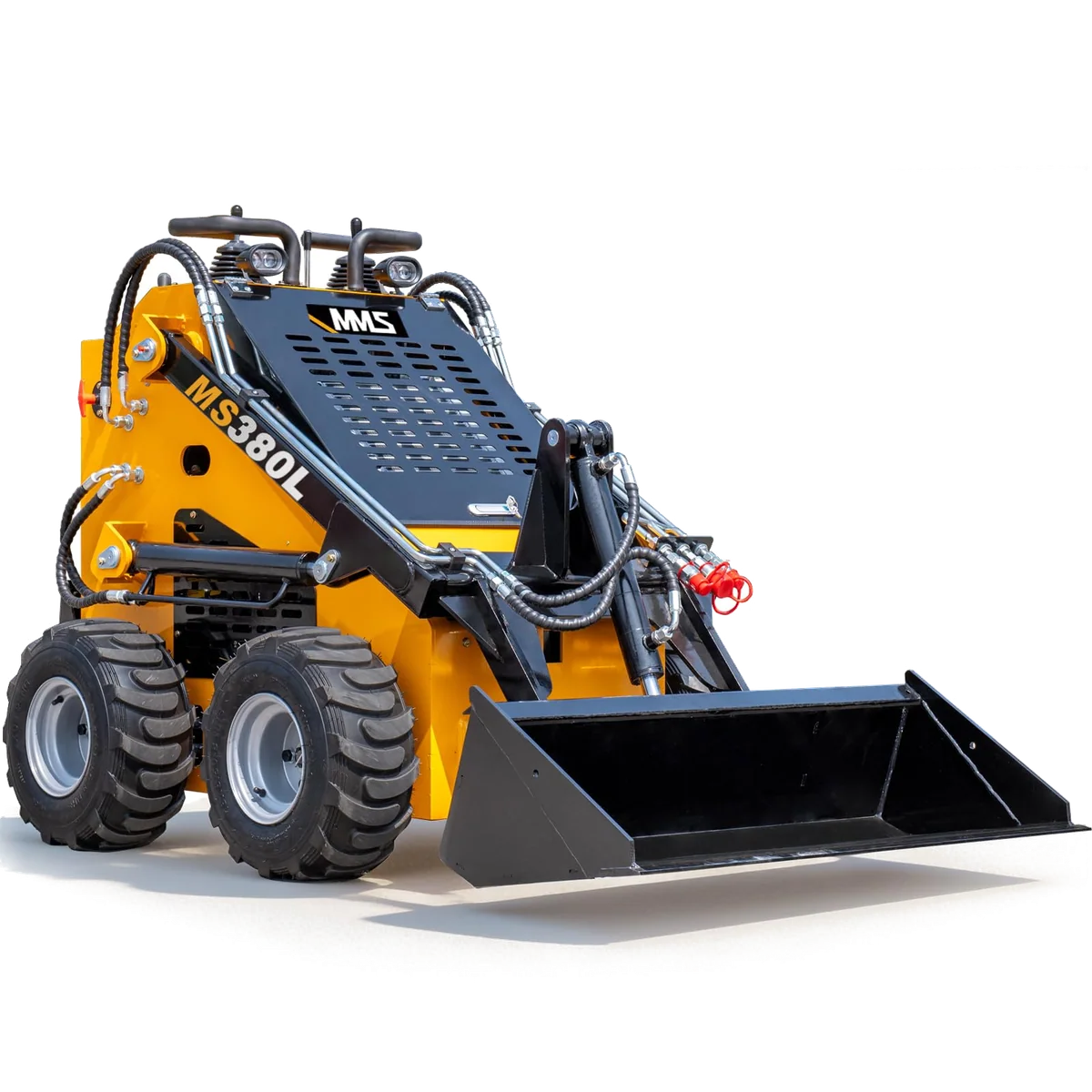
Folding platforms can improve storage and transport geometry, but only after the seller supplies both deployed and folded dimensions. MMS advertises folding operator platforms on the MS380L and tracked MS360T, yet neither collected listing gives the complete measurements needed to prove clearance through a gate, around a corner or onto a particular trailer. A hinge is useful hardware, not permission to skip the tape measure.
Nor does the word mini settle the matter. The HY360C’s listed 41-inch width is narrower than the HY480D’s listed 45 inches, but several other stand-on listings omit a trustworthy overall chassis width. No responsible ranking can call one of all six the smallest when the comparison lacks measurements for half the field.
| Decision | Rear stand-on platform | Sit-down station | What must still be verified |
|---|---|---|---|
| Tight access | Often accompanies a shorter, simpler package and can fold on some models. | May add chassis length, height and structure around the operator, as the HY480D does. | Overall width, bucket width, height, deployed length, folded length and turning room. |
| Long operating periods | The operator supports body weight and absorbs movement through the feet and legs. | A seat removes the need to stand, but comfort still depends on reach, padding, vibration and control layout. | An actual trial on the production configuration rather than a photograph of the station. |
| Frequent stops | Mounting and dismounting can be direct, which suits short cycles and attachment checks. | Repeated entry and exit may involve a step, seat, belt and canopy structure. | Neutral, parking, auxiliary-control and operator-presence procedures from the exact manual. |
| Rough ground | An exposed standing operator can be pitched when a short chassis meets rocks, ruts or abrupt changes. | A seat can retain the operator’s position, but a canopy is not automatically certified rollover protection. | Approved slope limits, restraint details, protective-structure certification and low-load travel guidance. |
| Lift capacity | No inherent advantage follows from standing. | No inherent advantage follows from sitting. | Rated operating capacity, tipping load, load center, attachment mass, lift height and ballast condition. |
| Powered attachments | The platform says nothing about auxiliary flow or circuit independence. | The seat says nothing about auxiliary flow or circuit independence. | Flow, pressure, pump layout, case drain, cooling and simultaneous travel behavior. |
The practical advantage is therefore access with a specific machine, not a universal law about everything with a rear platform. Measure the narrowest fixed component, the supplied attachment, the approach and the turn beyond the opening. The site’s gate-width guide covers that route from property entrance to working area, including the clearance a catalogue width leaves out.
A seat may help the operator; it does not improve the chassis by itself
Sitting can be the correct choice for an operator who cannot comfortably remain on a rear platform through the intended work cycle. It may also suit repetitive loading on an open site where entry width is irrelevant and the operator rarely dismounts. That is a valid reason to accept more machine around the operator, but the decision should follow a real trial of control reach, entry, exit, visibility and vibration rather than the assumption that every seat is comfortable.
The HY480D supplies an adjustable seated concept, hand controls and an overhead canopy, and one exact owner describes the controls as intuitive. The same owner says the roof arrived detached and required a helper for installation. Nothing in the supplied record certifies that canopy as a rollover or falling-object protective structure, so its presence should not be promoted into protection the documentation does not establish.
More importantly, the seat belongs to a different machine rather than a seated version of the HY360C. The HY480D listing claims three pumps, a 772-pound rated operating capacity and a 2,050-pound operating weight. The HY360C listing describes dual-pump hydraulics, a 525-pound rated operating capacity and a 1,510-pound operating weight. The extra published capacity and hydraulic section belong to the larger chassis and system; they do not prove that sitting created either benefit.
The HY480D then loses the model decision on reliability. One owner reports that the first engine began losing power and burning oil somewhere between roughly 11 and 20 hours, and that the replacement lasted no more than 12 hours. The cause is unresolved and the sample is too small to calculate a failure rate, but a buyer seeking comfort for long shifts needs dependable long shifts, not a seat attached to an uncertain engine and remedy.
The six-machine shortlist is lopsided
A good operator format cannot rehabilitate a weak product record. The table keeps those two judgments separate: first, whether the station fits the work; second, whether the exact loader deserves consideration.
| Machine | Station and undercarriage | Supported job | Honest drawback | Our call |
|---|---|---|---|---|
| HUAYEE HY360C | Rear stand-on platform with wheels. | Light bucket work in stalls, barns and firm yards has exact early-owner support. | The ownership record stops at 16 hours, auxiliary flow is missing and the larger lift claim lacks a usable load chart. | Narrow yes for a hands-on property owner doing light bucket work. |
| MMS MS380L | Rear stand-on platform with wheels. | Owners report moving rock and dirt, grading and residential landscaping on firm ground. | Its exact record identifies a two-pump ceiling, arrival faults appear in the review pool and timed durability ends at 10 hours. | Conditional yes for bucket and intermittent auxiliary work. |
| MMS MS360L | Rear stand-on platform with wheels. | Household material moving, garden work and light grading fit the exact owner evidence. | Two-pump hydraulics, weak documentation, low ground clearance and uneven delivery preparation limit the case. | Conditional yes when simple firm-ground work dominates. |
| MMS MS360T | Rear stand-on platform with triangular tracks on the current listing. | Light material handling is plausible, but exact owner evidence covers little beyond arrival and initial operation. | The retained catalogue identity conflicts with the listing, while capacity, dimensions, hydraulic architecture and meaningful durability remain unresolved. | Do not order yet without written proof of the configuration that will ship. |
| Wolfequip T460S1 | Rear stand-on platform with tracks. | The listing presents a bucket loader for property material work, but exact performance evidence is extremely thin. | Hydraulics, dimensions, lift methodology and safety logic are vague, and a close Wolf owner walkthrough suggests the controls may remain active with nobody on the platform. | Skip until the safety and specification record becomes real. |
| HUAYEE HY480D | Sit-down station with wheels and an overhead canopy. | Owners report bucket, grading, fork and other property work, while the seller publishes a 772-pound operating-capacity claim. | One owner reports extremely early failure of both the original and replacement engines, with an uncertain remedy afterward. | Pass for commercial work and most homeowners. |
The HY360C is the cleanest match for light property work
Its case is not glamorous, which is why it is credible. A named Briggs & Stratton engine, wheels, a listed 41-inch overall width, an included bucket and an owner who connected the machine to stall work form a coherent package. The full HY360C review explains why its 525-pound published operating rating deserves more respect than the undefined 1,323-pound maximum-lift boast, and why missing auxiliary flow keeps powered tools outside the recommendation.
The two wheeled MMS loaders are bucket machines first
The MS380L’s 23 HP headline may appeal beside the 13.5 HP MS360L, but neither horsepower number creates an independent attachment circuit. Both earn conditional consideration for material moving and light grading, not continuous mulching or mowing. The MS360L and MS380L comparison keeps their differences beside the shared two-pump concern, while the separate MS360L review and MS380L review show where each narrow yes stops.
The tracked stand-on options need more than traction
Tracks can be appropriate on soft ground, but the MS360T’s identity conflict and the Wolfequip’s safety and specification gaps block a recommendation before terrain even enters the argument. Readers still comparing the T460S1 against a wheeled MMS machine should use the Wolfequip and MS380L comparison, then read the full Wolfequip review before treating its 23 HP claim as a buying reason.
The HY480D is not the seated exception worth buying
Its three-pump layout, larger published operating capacity and seat are attractive on paper, but the reported original and replacement engine failures outweigh that appeal for buyers who need dependable use. The HY480D review stages the capability evidence against the reliability and remedy problem, while the HY360C and HY480D comparison shows exactly what the larger seated package adds and costs in access.
Hydraulics can overturn the platform decision
A buyer can choose the correct place to put the operator and still buy the wrong machine for the attachment. Bucket work, forks, land levelers and trailer movers do not need a hydraulic motor to run continuously while the loader travels. Brush cutters, sweepers, tillers, power rakes and mulchers usually do, which makes circuit architecture more important than standing or sitting.
An exact MS380L owner identifies the machine as a two-pump model and says a three-pump design would have offered more operating flexibility. The retained MS360L owner record carries the same warning. In a separate test of another roughly 14 HP two-pump mini loader, a rotary cutter could spin or the machine could drive normally, but the tester could not combine both functions into a practical straight cutting pass. That machine is not either MMS loader, yet it demonstrates the mechanical consequence the missing third circuit can create.
The HY360C listing openly describes a dual-pump system but omits auxiliary gallons per minute. The HY480D listing claims three pumps and three valves but also omits exact auxiliary flow, continuous-duty limits and a confirmed case-drain arrangement. Three pumps are more promising for simultaneous travel and attachment use, but pump count alone cannot certify a cutter, grinder or mulcher.
| Main work | Operator-station implication | Specification that actually decides the machine |
|---|---|---|
| Loose material, manure, mulch and light grading | A stand-on machine usually preserves the compact-access advantage without sacrificing anything the bucket requires. | Width, rated capacity, bucket geometry, ground clearance and support. |
| Pallet forks and dense loads | A seat does not create stability, and a rear platform does not establish counterweight. | Load chart, load center, fork weight, tipping load, lift height and approved ballast. |
| Augering while stationary | Either station can work if the operator can control the attachment safely from the intended position. | Plate fit, attachment weight, flow, pressure, couplers, bit size and case drain. |
| Continuous cutting, sweeping or raking | Do not choose by platform or seat. | Verified independent auxiliary flow, normal two-side travel, cooling and continuous-duty approval. |
| Soft or wet ground | Operator posture is secondary to undercarriage and stability. | Tracks or tires, operating weight, ground pressure, track support and slope guidance. |
The site’s two-pump and three-pump guide explains the circuit distinction, and the attachment compatibility guide covers the plate, hoses, couplers and case drain that still matter after a tool physically latches. If powered implements are the whole reason for buying, start instead with the powered-attachment shortlist.
Posture is not a safety system
A rear platform puts the operator on a short machine that can react abruptly to terrain. A category-level demonstration, not a test of any loader in the table, shows small embedded rocks lifting the front of a stand-on machine and pitching its operator. Tracks may increase grip, but grip can carry a loader farther onto rough ground without making the chassis less sensitive to load height, slope direction or sudden steering.
The controls also need to know when the platform is empty. In a close Wolf Equip walkthrough, the owner reported that the machine’s controls remained active with nobody standing on the platform. That is not serial-specific proof about every T460S1, but it is enough to require written confirmation of the current operator-presence interlock, neutral-start logic and parking system before buying one.
Sitting does not settle the safety case either. The HY480D’s seat and canopy may help the operator remain in position, but the supplied record does not establish certified rollover or falling-object protection. A seat belt should be used only within the manufacturer’s documented protective system and operating procedure, not as evidence that an uncertified canopy turns a compact loader into a cab machine.
Carry loads low, avoid side slopes and do not turn a seller’s climbing angle into a working limit. The slope-safety guide explains how operator position, load height and travel direction change the balance, while the lift-capacity guide separates hydraulic force from stable rated payload.
Make the purchase decision in the right order
- Prove access first.
Measure the narrowest opening, attachment, approach, turn, overhead clearance, trailer and storage position; if the route rejects the loader, comfort and horsepower no longer matter.
- Match the operator to a real work cycle.
Estimate how long the operator will remain aboard, how often dismounting occurs and whether standing is genuinely unsuitable, then trial the actual control layout rather than choosing from a photograph.
- Match the hydraulics to the implement.
Bucket-dominated work favors the simpler compact machine, while a motorized tool demands written flow, pressure, circuit, cooling and case-drain specifications regardless of where the operator rides.
- Choose wheels or tracks separately.
Wheels favor firm surfaces and remove track tension and derailment from maintenance, while tracks may improve flotation and traction on soft ground at the cost of undercarriage care.
- Price the support gap.
Manuals, parts identification, freight remedies, labor coverage and downtime decide whether a lower-cost machine remains useful after the first battery, hose, control or engine problem.
The operator station belongs second in that sequence, after access and before the attachment plan. Buyers who start with a seat can end up with a machine too wide for the property; buyers who start with a folding platform can end up with two-pump hydraulics that cannot run the desired tool. The right comparison keeps the body, site and work in separate columns until one exact machine satisfies all three.
Terrain deserves its own decision as well. Our wheeled and tracked mini skid steer guide covers flotation, traction, surface damage and undercarriage maintenance without pretending that a seat determines any of them. Buyers concerned about commissioning and early faults should also use the first-use inspection guide before freight day.
The final call
For most readers choosing among these six machines, buy the rear-platform format and keep the work modest: the HUAYEE HY360C is the cleanest light-property choice, while the wheeled MMS MS360L and MS380L remain conditional bucket-first alternatives for owners who can maintain them and tolerate downtime.
Do not choose the MS360T until MMS proves which machine the ASIN will deliver, and do not choose the Wolfequip until its safety logic and specifications are documented. Most importantly, do not buy the HY480D merely because sitting sounds better. This group does not contain a seated machine that clears the current reliability bar, so a buyer who genuinely requires a seat should rent or keep shopping rather than force the wrong exception; the rent-versus-buy guide helps put that decision beside transport, maintenance and downtime.
Readers whose work is centered on barns, lanes and recurring material chores can continue with the small-farm shortlist, while paid landscape crews should start with the landscaping shortlist and give uptime more weight than operator-station preference.
Frequently Asked Questions
Does a seat make a mini skid steer safer?
No, because safety depends on stability, restraints, interlocks, protective structures, load position and operating limits rather than sitting alone.
Is every stand-on mini skid steer narrower than a seated model?
No, although the listed HY360C is 41 inches wide and the seated HY480D is 45 inches wide, several other machines here lack complete dimensions and prevent a universal ranking.
Which listed machine has the strongest case for light property work?
The stand-on HUAYEE HY360C earns the clearest narrow yes for light bucket work on firm ground, provided its short durability record and missing auxiliary-flow data are acceptable.
Should a powered attachment decide whether the operator stands or sits?
No, because a cutter, sweeper, tiller or power rake should be matched to verified flow, pressure, circuit independence, cooling and case-drain requirements before operator posture is considered.
Is the HY480D worth choosing solely because it has a seat?
No, because one owner reported extremely early failure of both the original and replacement engines, and the available record does not establish a dependable remedy.
Which of these loaders is the narrowest?
No complete ranking is defensible because the HY360C has a published 41-inch width but several competing stand-on listings omit trustworthy overall chassis dimensions.
Can a rear-platform loader work safely on a slope?
Only within the exact manufacturer’s documented limits, with the attachment and load kept in the approved position, because standing and track traction do not prevent pitching or rollover.
How should I check whether a loader will fit through my gate?
Measure the machine’s widest fixed point and attachment, then allow working clearance for posts, hinges, surface irregularities, the approach and the turn beyond the opening.
Sources (2)
- Amazon listings and customer reviews
- Owner and reviewer video, 3 channels