A 42-inch gate rules out this 43.3-inch mini skid steer.
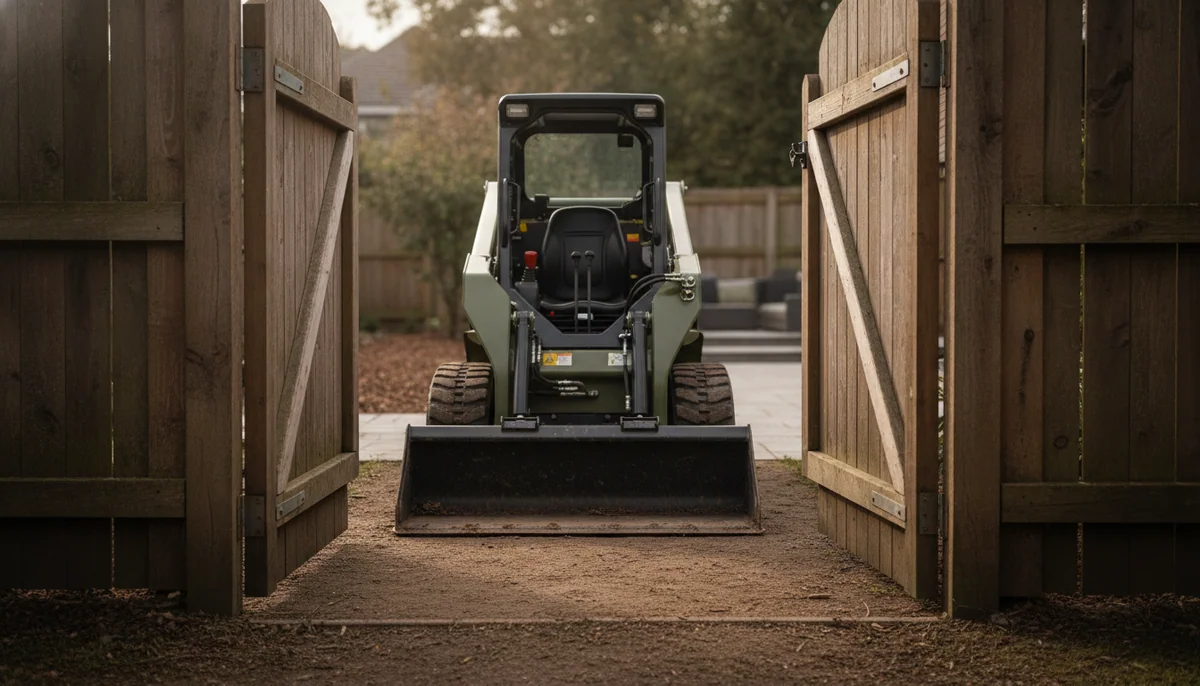
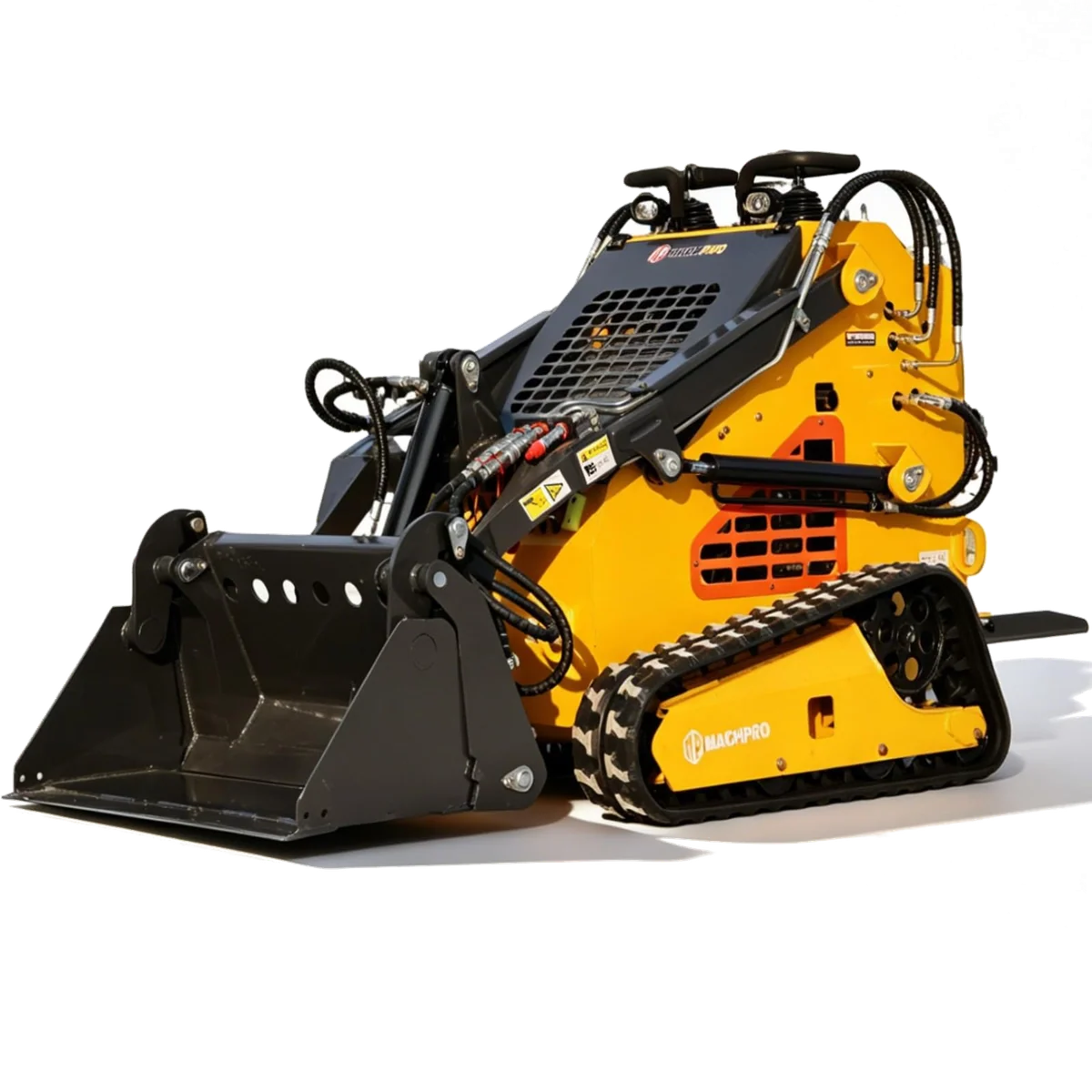
A “compact” label cannot make a 43.3-inch machine pass through a smaller opening. The MP-380-YE listing gives overall dimensions of 68.9 × 43.3 × 49.2 inches and describes the loader as suitable for tight gates. Its own width figure settles the first decision: a measured 36- or 42-inch opening is too small before hinge barrels, latch stops, leaning posts, or a steering correction enter the picture.
The 43.3-inch figure is still less useful than it first appears. The listing does not identify whether the outside of the tracks, bodywork, or included 4-in-1 bucket establishes that width, and it publishes no turning envelope. Skid Steer Mulch did not operate or measure this machine, so the advertised figure is a minimum number the opening must beat, not a certificate that any slightly wider gate will work.
| Measured clear opening | Opening minus 43.3 inches | Clearance if perfectly centered | Skid Steer Mulch call |
|---|---|---|---|
| 36 inches | −7.3 inches | Impossible | No: the opening is physically narrower than the listed machine. |
| 42 inches | −1.3 inches | Impossible | No: calling the loader compact does not change the subtraction. |
| 43.3 inches | 0 inches | 0 inches per side | No: matching dimensions leave no working clearance. |
| 44 inches | +0.7 inch | About 0.35 inch per side | Reject as a buying assumption: this is a paper fit with virtually no room for error. |
| 46 inches | +2.7 inches | About 1.35 inches per side | Conditional: verify the actual machine, every projection, and both turns. |
| 48 inches | +4.7 inches | About 2.35 inches per side | Plausible, not proven: the installed hardware, bucket, surface, and route still decide. |
No universal allowance in the supplied record turns one of those positive numbers into an automatic yes. The honest threshold is deliberate rather than accidental clearance, chosen after the exact machine and property have been measured.
Measure the gap that remains when the gate is open
A gate’s advertised or remembered size is not the usable opening. The number that matters is the shortest straight-line distance between anything that remains in the machine’s path when the leaf is secured open. Hinges, latches, stops, posts, trim, masonry, and a second gate leaf all count.
- Put the gate in its actual travel position. Open and secure every leaf exactly as it would be while the loader passes, rather than measuring an opening that requires someone to hold hardware out of the way.
- Measure at several heights. Check near the bottom, through the machine’s likely widest zone, and higher up where guards, handles, or the attachment may pass.
- Include every fixed projection. Run the tape from the nearest hinge barrel, latch, stop, bolt, trim edge, or post face on one side to the nearest obstruction on the other.
- Keep the smallest result. An opening that measures 48 inches at the top and 46 inches beside the latch is a 46-inch opening for this decision.
- Record the surface condition. A rut, crown, threshold, or cross-slope can tilt the loader toward a post even when the opening looks adequate on paper.
Model identity matters here. Dimensions attached to a MACHPRO MPS300 or MPS330 cannot settle access for the MP-380-YE because the documented siblings use different engines, hydraulic arrangements, buckets, tracks, and cooling layouts. Match the photograph, model plate, and measurement to the machine actually being offered rather than borrowing a more convenient figure from a nearby search result.
The listing says the operator platform folds to shorten the machine for transport, but it does not claim that folding the platform reduces width. Treat the platform as a length and staging question unless the seller supplies an exact operating configuration and measurements showing otherwise.
A width number answers only the straight-line problem
A loader can be narrower than the opening and still fail the route. It must approach the gate nearly square, carry its widest point fully past the posts, and have enough space on the far side to straighten or turn without swinging the attachment, rear structure, or operator area into something solid. A fence corner, shed wall, tree, retaining wall, parked vehicle, or abrupt grade can make a generous-looking opening unusable.
A hardscaper using a different 43-inch import found that many properties with 36- to 42-inch backyard openings were closed to it and later preferred a 38-inch machine for tight turns. That experience is not an MP-380-YE measurement, but it shows why access-first buyers should optimize for the whole route rather than celebrate a nominally compact chassis.
Before the posts
The approach
Mark the full machine width and operating length on the ground, then check whether that footprint can line up with the opening before its front edge reaches the gate.
Between the posts
The passage
Use the narrowest measured opening and account for the gate hardware, surface, bucket, hoses, and every other part that must cross the same plane.
Beyond the posts
The departure
Confirm that the entire machine can clear the posts before the route demands a turn, and remember that the return trip must work with the intended attachment and load configuration too.
Do not turn the listing’s 30-degree climbing claim into approval for a sloped gateway. The seller does not define direction, surface, attachment, load position, operator weight, or whether that number is a test maximum rather than a working limit. A route with a slope, drop, cross-fall, or uneven threshold needs the exact manual and a separate stability decision, which the mini skid steer slope-safety guide addresses directly.
Every attachment reruns the calculation
The MP-380-YE arrives with a hydraulic 4-in-1 bucket, so access should be checked with that bucket in the configuration required to reach the work. The listing’s combined dimensions do not separate chassis width from bucket width, and they do not identify the width of pins, cylinders, or hose protection. A buyer therefore cannot assume either that the bucket fits inside 43.3 inches or that removing it will create a useful narrower machine.
- Outside of tracks
- Establish the bare undercarriage width at its widest fixed point.
- Body and guards
- Check whether tanks, engine covers, control guards, or fasteners extend beyond the tracks.
- Closed bucket
- Measure the attachment itself, including the jaw, side plates, pins, cylinders, and protected plumbing.
- Operating projections
- Find anything that changes position as the loader arms, bucket, controls, or platform move through the approved range.
- Future tools
- Repeat the route calculation for every grapple, fork frame, auger, trencher, or other attachment expected to enter the property.
- Working length
- Measure the configuration used at the gate rather than substituting a folded transport dimension.
If the chassis is genuinely narrower than the bucket, carrying or moving the attachment separately may be possible only when the manufacturer’s approved removal procedure, the bare-machine measurement, and safe reattachment space inside the property all support it. Do not build an access plan around that possibility from the listing alone. The attachment compatibility guide explains the mechanical and hydraulic checks that remain after a tool is narrow enough.
Passing the gate does not make the MACHPRO a safe bet
Once the route genuinely clears, the MP-380-YE has a coherent property-work pitch. The seller specifies a 24 hp RATO 739cc gasoline engine, three hydraulic pumps, a folding stand-on platform, and the included 4-in-1 bucket. An exact-product owner reports using that bucket to dig, bulldoze, and grab material, while another reports about 15 hours of backyard grading and log movement with smooth, responsive controls.
Those early reports do not establish durable ownership. The exact record contains only four five-star reviews, the longest disclosed interval is about 15 hours, one reviewer had not yet put the machine to work, and no review supplies a season of track, pump, cooler, pin, hose, electrical, or support history. The listing promises technical help and replacement-parts service without supplying clear warranty terms, response standards, labor coverage, freight responsibility, or a serial-specific parts catalogue in the record provided here.
The lift language also needs written clarification before the machine is assigned serious material-handling work. The seller places an 881-pound rated operating load beside an 827-pound maximum lifting force without definitions that explain why the stated maximum is lower. Gate fit cannot repair an unresolved capacity claim.
Skid Steer Mulch’s full MP-380-YE review therefore reaches a narrow conclusion: this machine can suit intermittent property work for an owner able to inspect, maintain, and wait for parts, but it is not a sensible one-machine foundation for deadline-driven commercial work. The gate is the first veto, not the last evaluation.
If the route fails, fix the access problem instead of arguing with the tape
Repeated backyard work
Choose a genuinely narrower machine
Start with the narrow-access mini skid steer shortlist, then verify the exact current unit and attachment rather than trusting a category label.
Permanent property access
Change the opening deliberately
A removable leaf, latch relocation, post alteration, or wider entrance helps only when the finished clear opening and both turns are measured again and the property can support the change safely.
One project
Rent the machine that fits the route
Ask the rental yard to confirm the actual machine-and-attachment width, then use the rent-or-buy guide to decide whether recurring work justifies permanent equipment.
Plan for the work after the first bucket job as well. A loader that reaches the backyard with one narrow tool but cannot carry the attachment that justified buying it has only moved the access problem. When hydraulic tools are the goal, check the route alongside the machines in the powered-attachment shortlist.
Frequently Asked Questions
Can I remove the gate leaf instead of buying a narrower loader?
Only if the leaf can be removed and reinstalled safely and the remaining posts, hinges, stops, and route provide a newly measured opening with deliberate clearance.
Can I carry the 4-in-1 bucket through separately and drive the bare loader behind it?
Possibly, but the listing does not separate chassis width from bucket width, so confirm the approved attachment-removal procedure and measure the bare machine before treating that plan as access.
Does folding the operator platform make the MP-380-YE narrower?
No, the listing says the fold shortens overall machine length for transport and makes no claim that it reduces width.
Should future attachments be measured before I choose the loader?
Yes, because every intended tool must fit the gate and route in its working configuration even when the base machine passes comfortably.
Can I use the dimensions of a MACHPRO MPS300 or MPS330 instead?
No, the nearby MACHPRO models have documented hardware differences, so only an exact MP-380-YE measurement can settle this access decision.
Sources (2)
- Amazon listings and customer reviews
- Owner and reviewer video, 2 channels