Mini skid steers are not slope machines
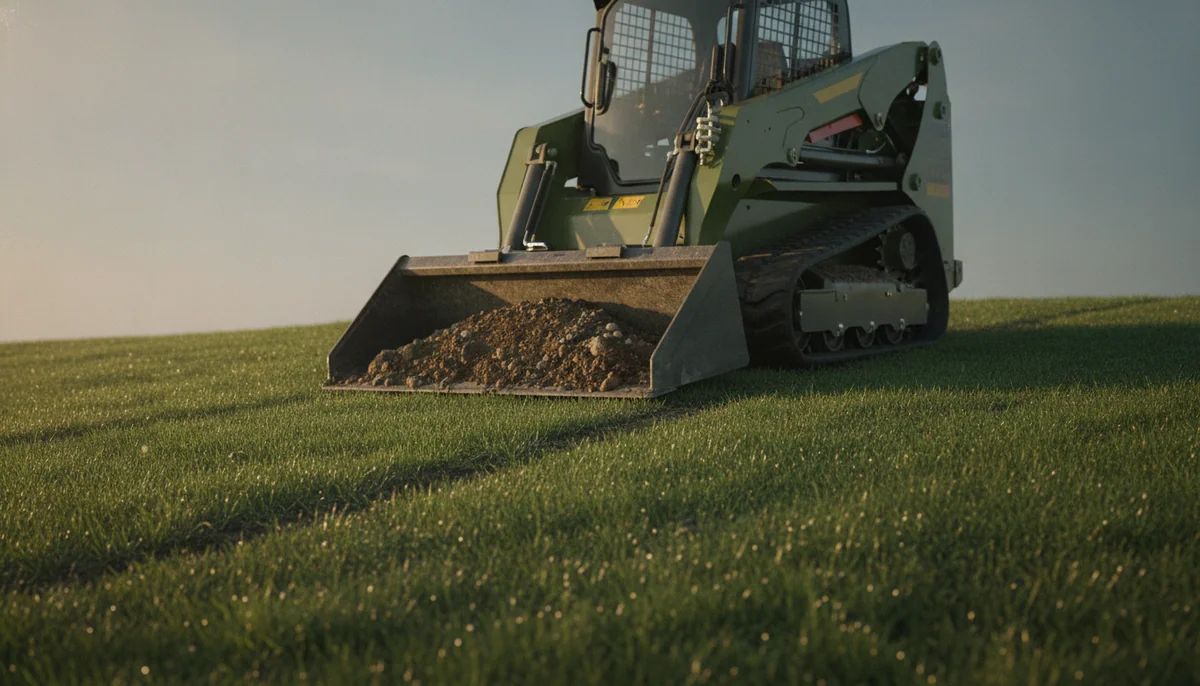
Traction can keep pulling after the stability margin has run out. That is the trap with a compact loader: its narrow footprint reaches confined work, but its short track or wheel base turns a small change in ground height into a sharp pitch beneath a standing or seated operator.
The clearest category demonstration in the supplied record did not involve a dramatic hillside. Small embedded rocks lifted the front of a tracked mini loader and threw the standing operator around on terrain that looked fairly modest from a distance. The machine had enough grip to keep going; it did not have enough length to make the route calm.
Several listings attached to this guide advertise a 30° climbing ability. None of those captured claims defines travel direction, surface, attachment, load, operator weight, tire or track condition, steering input, or whether the number is a momentary test maximum rather than an approved working limit. A climbing claim is not a side-slope rating.
Traction can carry a machine past its stability margin
Traction answers whether the machine can push against the ground. Stability answers whether the combined center of gravity stays inside the support area formed by the tires or track contact patches. Those limits can arrive in either order, which is why a machine that climbs confidently can still pitch forward, roll sideways or slide after a turn.
Tracks
More grip does not create more wheelbase
Tracks can improve flotation and forward traction in soft soil, but they do not lengthen a short chassis, widen its stance or prevent lateral sliding. A tight skid turn also drags a long contact patch across the surface and can pull gravel or debris into the undercarriage.
Wheels
Firm-ground simplicity has a traction limit
Wheels remove track-tension, roller and derailment work and often suit pavement, barns and established drives. They surrender flotation and grip sooner in mud, wet grass and loose soil, while low ground clearance can make ruts and roots the deciding obstacle.
Both
The small footprint remains small
Neither undercarriage fixes a high load, an abrupt control input, a downhill attachment, a collapsing edge or a side slope. The safer undercarriage is the one suited to the surface, not the one used to justify a route the chassis should avoid.
The site’s guide to how wheels and tracks trade firm-ground control for soft-ground traction covers the ownership decision in full. For terrain safety, the shorter answer is that tracks may help a loader reach the hazard before they help it survive the hazard.
A precise angle can still be an empty claim
A useful slope limit belongs to a complete operating envelope, not a single degree symbol. Even a legitimate straight-climb result cannot be carried across to turning, side-hill travel, loaded descent or work with a raised attachment.
| Missing condition | Question the manual must answer | Why it changes the result |
|---|---|---|
| Travel direction | Does the figure apply uphill, downhill, across the slope or only to straight ascent? | A machine can have enough drive force to climb while lacking a safe lateral or downhill operating margin. |
| Surface | Was the grade dry pavement, packed soil, loose aggregate, grass, mud or another defined test surface? | Grip, sliding behavior, rut formation and edge support change with moisture and material. |
| Configuration | Which attachment, fuel level, operator, tire pressure, track tension and approved ballast were fitted? | Every added mass changes the combined center of gravity and the load carried by the undercarriage. |
| Load position | Was the attachment empty and lowered, loaded and low, or raised to working height? | Moving mass forward or upward reduces the margin against pitching and rollover. |
| Motion | Were turns, stops, reversals, lift movement and auxiliary operation allowed on the grade? | Dynamic forces and flow sharing can change steering, braking and balance after a static approach looks acceptable. |
| Meaning of the number | Is it an approved continuous working limit, a transport limit, a test maximum or merely a seller claim? | A test maximum leaves no sensible operating reserve for surface variation, wear or control error. |
Uneven ground is a sequence of small ramps
A smooth incline changes the machine’s attitude gradually. Rough ground changes it one tire, roller or track end at a time. A rock can become a short ramp, a root can become a pivot, and a rut can remove support from one side just as steering or loader movement adds another force.
| Terrain feature | Primary hazard | Conservative call |
|---|---|---|
| Firm, smooth, modest longitudinal grade | The combined center of gravity still shifts toward one end of the machine. | Conditional Use it only when the exact manual permits the grade and configuration, with a straight route and smooth controls. |
| Cross slope | Side-to-side support shrinks while the machine’s mass moves toward the downhill tire or track edge. | Avoid Re-route so travel is aligned with the grade or choose another method. |
| Wet grass, mud or thawing soil | Grip can disappear unevenly, and a loaded track or wheel can cut a rut that steepens the machine locally. | Stop when graded A surface that was manageable dry is not the same route after rain. |
| Embedded rocks, roots or stumps | One end can climb abruptly while the operator and load continue moving. | Remove or bypass Do not use traction to force a short chassis over the obstacle. |
| Curbs, ledges, holes and washouts | Contact can transfer suddenly from four support points to three, two or one edge. | Do not improvise Regrade, bridge with an engineered solution or use equipment approved for the transition. |
| Trench bank, retaining edge or soft shoulder | The ground beneath the machine can fail even when the loader itself remains level. | Create an exclusion zone Keep the machine and stockpiled material away from unsupported edges under a competent site plan. |
| Loose gravel during a skid turn | The undercarriage can displace its own support while stones enter tracks or tires slide sideways. | Minimize turning Use broad, deliberate arcs on a prepared route rather than counter-rotating on the hazard. |
| Trailer or loading ramp | The approach angle, narrow deck, edge exposure and surface transition combine in one short movement. | Use only a documented plan Ramp capacity, traction, alignment, trailer restraint and the manufacturer’s loading procedure all have to agree. |
Walk the full route before starting, including the approach, turn, dumping point and return path. If any obstacle will alternately unload one side or one end of the machine, fix the route before the loader becomes the tool used to discover how severe it is.
The load redraws the machine
The relevant object on a slope is not the bare loader. It is the combined system of machine, operator, fuel, attachment and payload. Moving any part of that system forward, upward or downhill changes the margin even when the scale weight stays the same.
One HY480C owner reported feeling comfortable on hilly property and emphasized traveling with the load low. The same account says an excessive forward load can lift the machine’s rear, which is the stability boundary announcing itself before the hydraulics stop lifting. A separate exact-model account documented fuel leaking around the cap when a full tank was pointed uphill, adding a fire hazard to the geometry problem.
Improvised counterweight is not a universal cure. An HY480D owner added a fabricated rear carriage after the machine’s rear lifted under an unweighed fork load, then reported that the carriage fell off when the loader jerked and had to be altered. That episode demonstrates why ballast needs an approved mounting system and a revised load chart rather than a home-built subtraction from a seller’s lift number.
Carrying a load low and close reduces risk; it does not make an undocumented load safe. Use the exact attachment deduction, load center and operating chart described in our mini skid steer capacity guide, and remember that the machine’s heavy end can change between an empty bucket and a loaded attachment.
The interlock belongs in the buying decision
The operator-position question is not theoretical in this product group. A close Wolf Equip owner walkthrough reported that the controls remained active with nobody standing on the platform. The video does not prove that every Wolfequip model or production batch has the same arrangement, but it makes a serial-specific demonstration of the delivered machine mandatory.
A mechanically capable owner can replace a hose or tighten a fitting. Mechanical ability does not replace an operator-presence system, neutral-start protection, a reliable parking or hydraulic lock, an emergency stop, an attachment lock, or a manufacturer-approved lift-arm support.
Require these answers before payment
- What happens to travel, lift, curl and auxiliary flow when the operator leaves the platform or seat?
- Can the engine start while either travel or auxiliary control is engaged?
- Which device prevents movement during attachment changes, service and parking?
- What emergency stop or hydraulic shutdown is reachable from the operating position?
- Which lift-arm support is approved for inspection beneath or beside raised arms?
- Is any canopy or frame certified as rollover or falling-object protection, and what restraint must be used with it?
- Which slopes, travel directions, loads and attachments are approved in the exact manual?
- How does the manufacturer instruct the operator to respond to slipping, loss of steering, a hydraulic leak, a fuel leak or a partial tip?
The site’s stand-on and sit-down format guide explains the ergonomic trade, but a seat or platform should never be mistaken for proof of a complete safety system.
Every machine in this set gets a terrain verdict
Skid Steer Mulch did not operate, instrument or slope-test these loaders. The calls below preserve the verdicts from the site’s product reviews, give exact-product records the most weight and refuse to transfer one machine’s climbing claim, track behavior or safety hardware to another.
| Machine | Terrain call | Decisive evidence and honest drawback |
|---|---|---|
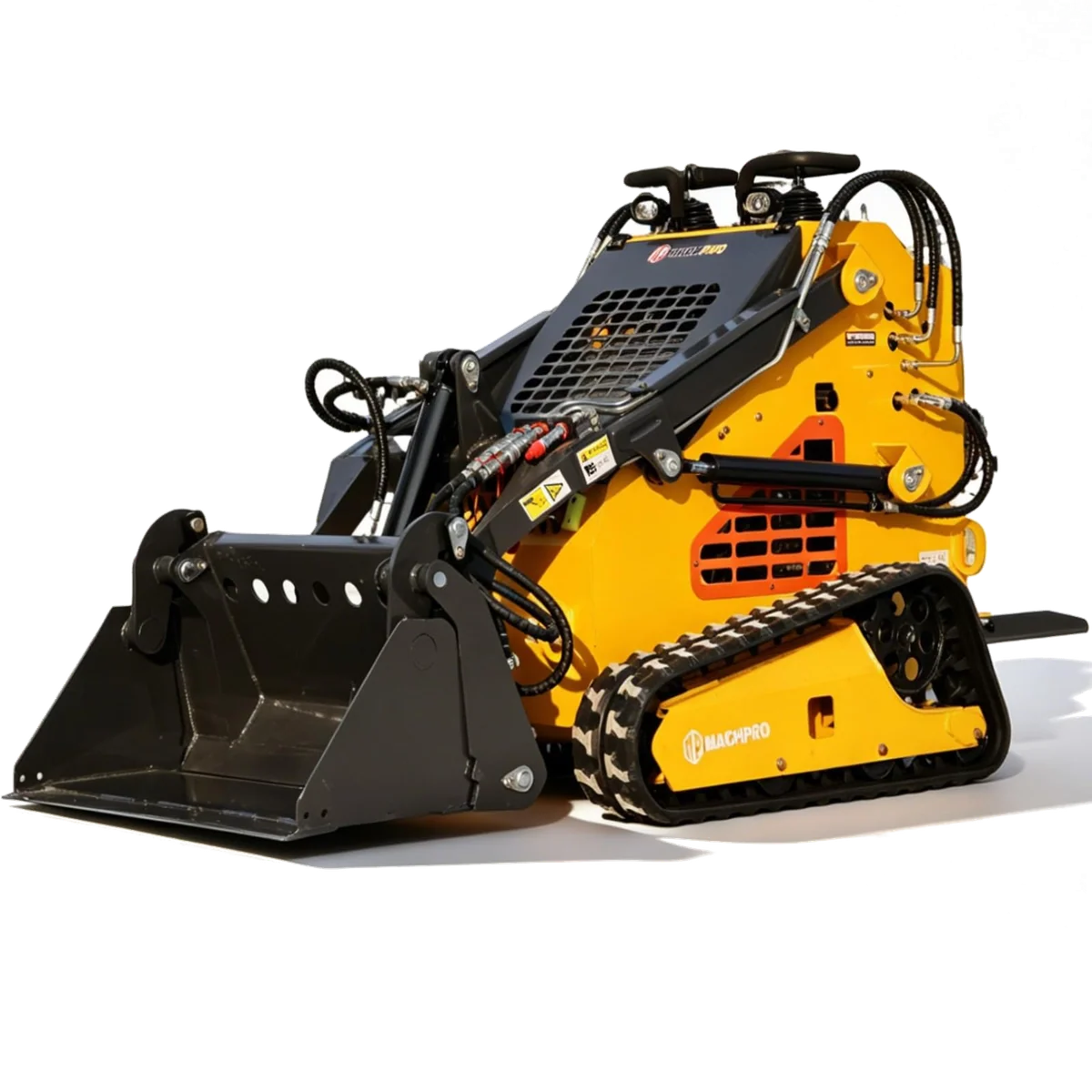
| MACHPRO MP-380-YE | Conditional on smooth, modest grades only | The tracked loader has encouraging early bucket, grading and log-moving reports, but the longest disclosed exact use is about 15 hours and contains no slope test; the seller’s 30° claim supplies none of the conditions needed for a working limit. |
| MMS MS380L | Conditional on firm, mostly level ground | Exact owners support residential material work and one deliberately chose wheels, but the record also notes low ground clearance, a two-pump layout and no documented slope performance; the listing’s 30° figure remains an undefined seller claim. |
| MMS MS360T | No recommendation on the current record | The listing presents a 13.5 hp Briggs machine on triangular tracks, while the catalogue record conflicts with a 23 hp MS380B identity; two arrival-day comments cannot resolve the machine, slope limits, capacity or safety equipment that would actually ship. |
| HUAYEE HY480C | Conditional for soft ground that is still mostly level | This is the strongest exact tracked-property record in the group, but owner evidence also includes rear lift under excessive forward load, a full-tank fuel leak when pointed uphill and a hydraulic-temperature concern; no model-specific safe working angle closes those risks. |
| Wolfequip T460S1 | No until the safety system is demonstrated | The listing lacks a usable slope envelope, and the closest narrated Wolf machine reportedly allowed control operation with nobody on the platform; a compact tracked layout does not compensate for an unresolved operator-presence question. |
| ATS Power T460 | No slope recommendation | The tracked machine may suit intermittent level-ground bucket work, but its listing conflicts on lift, mixes tire language into a tracked product and supplies no approved slope limit; the sole retained owner comment also says the manual was missing. |
| MMS MS360L | Conditional on firm, level routes | Exact owner evidence supports light home material work and favors wheels on firm surfaces, but the record stops at ten stated hours, notes low clearance and establishes neither slope behavior nor a stability chart. |
| DigSwift DS-S40 | No on the current record | A claimed 39.4-inch tracked body and internally consistent capacity conversions are not enough when operating weight, hydraulic architecture, approved slopes, interlocks, included attachment and delivery preparation remain undocumented; the only retained review is a vague first impression. |
| HUAYEE HY360C | Conditional on firm, mostly level property work | The wheeled loader has credible early barn and yard use, but its longest disclosed interval is 16 hours and no owner supplied a slope test; the seller’s 30° climbing claim has no surface, load, direction or working procedure attached. |
| TYPHON STOMP gasoline tracked model | Conditional only after written specifications, then mainly on level ground | A close tracked GX690 owner record shows promising hardware, but the exact listing supplies conflicting machine weights and no overall dimensions, load chart, safe slope or settled auxiliary-flow specification. |
| DigSwift DS-SS50 | No on the current record | The listing says the tracks conquer mud, slopes and uneven ground, yet publishes no approved angle, operating weight, control safeguards or hydraulic architecture; its exact customer record consists of two unexplained extremes. |
| HUAYEE HY480D | No for slope work and a pass for most buyers | The seated wheeled format has no exact slope evidence or load chart, while one owner reported two extremely early engine failures on the same purchase; a seat, canopy and three-pump claim do not repair that ownership risk. |
| Wolfequip T460S1WH with bucket and forks | No until the interlock and capacity are proved | The exact listing had no ratings when captured and omits machine width, slope limits and a defined loader-capacity method, while the same close Wolf owner record raises the unresolved off-platform control concern. |
For a tracked loader on soft but mostly level property, read the HY480C review and its fuel, heat, track and load warnings, then compare the thinner record in the TYPHON STOMP assessment. The ATS Power T460 review and Wolfequip T460S1 review explain why a similar tracked silhouette can conceal a different pump, support or safety proposition.
For firm surfaces, the HY360C review, MMS MS360L review and MMS MS380L review keep the wheeled choices inside their evidence. The HY480D review explains why moving to a seat does not rescue an engine and support record that already fails the broader purchase test.
The MACHPRO MP-380-YE review is the full case for its useful 4-in-1 bucket and equally important documentation gaps. None of those pages turns a conditional property loader into a slope specialist.
A conservative operating sequence starts before the engine
-
Read the exact machine, not the model family
Match the machine plate, engine, undercarriage, attachment and current manual to the serial configuration that will do the work.
-
Walk the complete route
Inspect the approach, grade, turning area, work point and return path for cross slope, holes, rocks, roots, soft edges, overhead hazards and places where a load could shift.
-
Check what changed since the last pass
Rain, frost, thaw, loose spoil, repeated skid turns and a newly loaded attachment can make yesterday’s route a different surface today.
-
Configure the whole machine
Use only approved attachment and ballast combinations, verify tire pressure or track condition, secure the load, and account for the operator, fuel and attachment weight.
-
Learn every control on level ground
Prove neutral, parking, travel, steering, lift, curl, auxiliary flow and the operator-presence behavior in a clear area before any grade becomes part of the lesson.
-
Use the documented travel direction
Keep the machine aligned with the permitted grade, keep the load low and close, avoid turns and abrupt inputs, and follow the exact manual’s heavy-end orientation because that end can change with the load.
-
Abort at the first lost margin
Wheelspin, track slip, crabbing, unexpected pitching, one end becoming light, delayed control, rising temperature, a fresh leak or an unseen obstacle is a reason to lower the attachment when stable and withdraw under the manufacturer’s procedure.
-
Park in a stable configuration
Finish on firm level ground with the attachment lowered, controls neutralized, parking system applied, engine stopped and the key secured before anyone enters the work area.
The safer alternative is often a different plan
If the work only becomes possible when the bucket is raised, the machine crosses the grade, a track rides a root or the operator must turn beside an edge, the route has failed before the loader starts. Remove the obstacle, regrade the access, move the stockpile, divide the load or approach the work from a safer direction.
For one concentrated project, renting a documented machine or hiring an experienced operator can place selection, transport and breakdown support with someone equipped to manage them. The site’s rent-or-buy framework helps compare that plan with owning a machine whose main terrain limit remains an unanswered seller message.
Frequently Asked Questions
Is there one safe angle for every mini skid steer?
No, the working limit depends on the exact machine, direction, surface, attachment, load, operator configuration and manufacturer procedure.
Does a 30-degree climbing claim approve work on that grade?
No, an undefined climbing claim does not approve turning, side-hill travel, loaded descent or attachment work at the same angle.
Do tracks make a mini skid steer safer on hills?
Tracks may improve traction and flotation, but they do not widen the chassis, lower a raised load or prevent pitching over rocks and ledges.
Should the machine cross a slope or travel straight on it?
Avoid cross-slope travel and follow the exact manual’s permitted straight-line direction, because the machine’s heavy end can change between empty and loaded configurations.
Can a low bucket make rough ground safe?
Keeping the attachment low reduces the effect of load height, but it cannot stabilize a collapsing edge, abrupt obstacle, side slope or excessive forward load.
Can rear counterweights be added for slope work?
Use only a manufacturer-approved ballast system with a revised load chart, because improvised weight changes steering, braking, structural loads and the machine’s behavior on a grade.
Is a seated model automatically safer than a stand-on model?
No, the operator position changes ergonomics and restraint needs but does not prove rollover protection, stability, interlocks or a safe working slope.
What should a new operator practice first?
Practice starting, stopping, neutral, parking, steering, lift, curl, auxiliary control and attachment lowering on firm level ground under the exact manual before approaching any grade.
Sources (2)
- Amazon listings and customer reviews
- Owner and reviewer video, 5 channels