A mini skid steer attachment that fits can still be the wrong tool
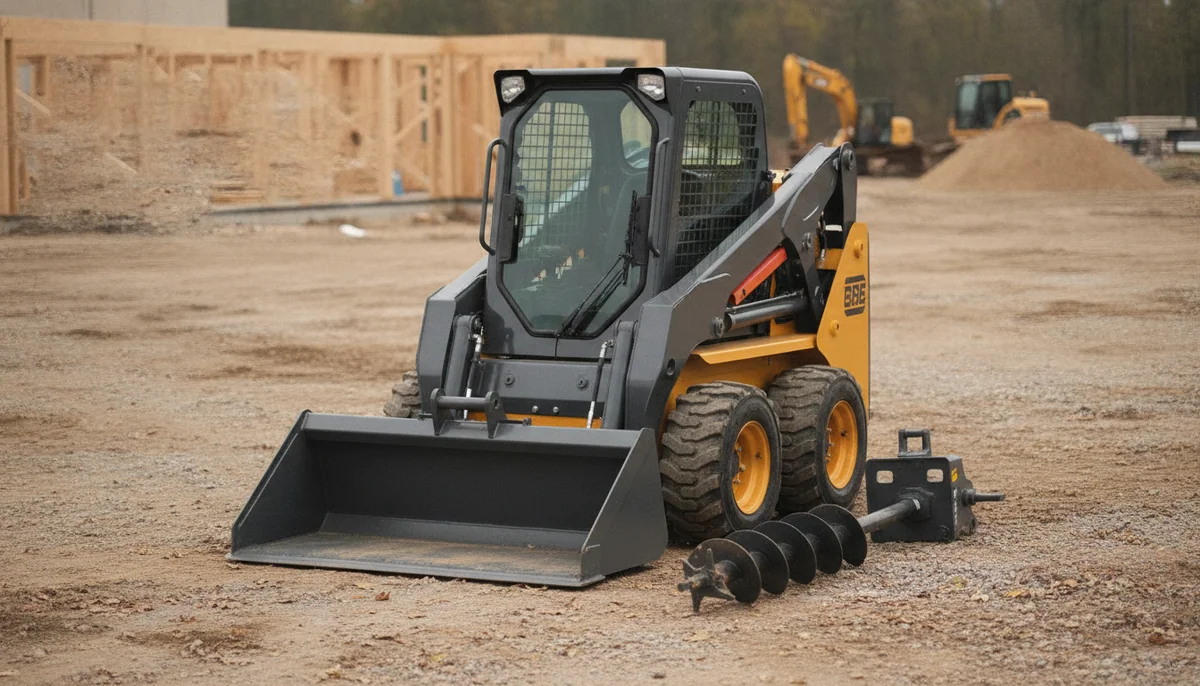
An attachment can lock onto the plate, accept the couplers and still make a terrible machine. A motor may spin while stealing oil from one track, a grapple may leave too little capacity for its load, or a hose may reach at ground level and tear tight when the boom rolls back. Compatibility is not one successful click; it is a chain in which the weakest match decides whether the tool will work.
The hydraulic trap is the easiest to miss. Testing on a separate two-pump mini loader showed that its rotary cutter could spin and the machine could drive normally, but not at the same time in a useful straight pass. A trencher became a repeated stop, cut and reposition exercise. That result does not describe every two-pump machine, but it proves why an attachment demonstration must include the movement the job actually requires.
- Fit
- The plate, upper lip, locks and couplers physically mate.
- Run
- Flow, pressure, return plumbing and control behavior suit the tool.
- Carry
- The carrier remains stable after attachment weight and load center are counted.
- Survive
- Cooling, hose routing, guarding, parts and duty cycle support the planned work.
Start with the job, then prove the complete machine-and-tool combination; choosing an attachment first and trying to justify the carrier afterward reverses the decision.
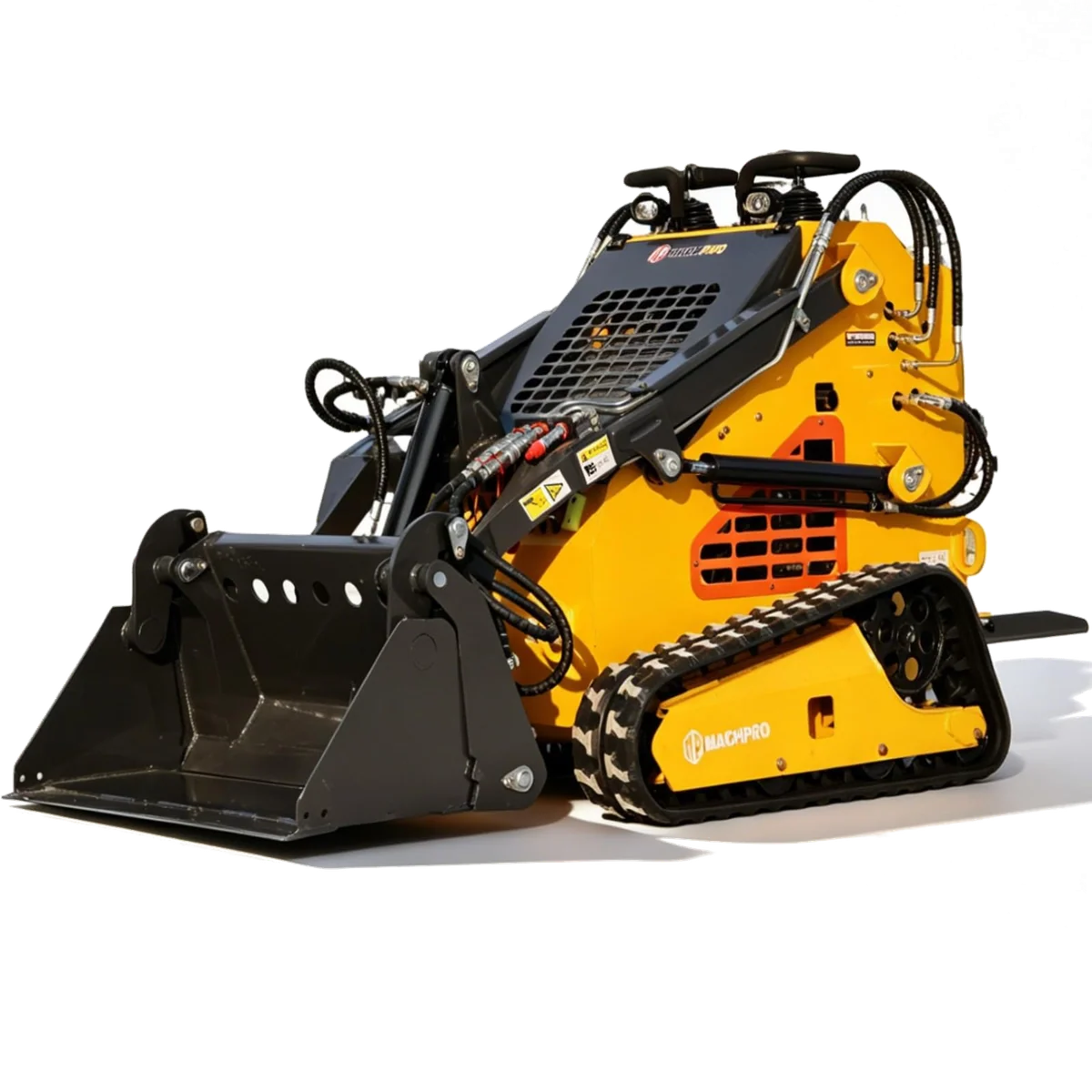
Compatibility has five gates, and the plate is only one
The sensible buying sequence is mechanical fit, hydraulic fit, capacity, operating geometry and exact-machine documentation. A failure at any gate ends the match. An adapter, hose fitting or counterweight should not be used to conceal a failed test farther down the list.
Gate one: identify the attachment interface by dimensions
The supplied products already contain two materially different attachment families. An HY480C owner identifies its compact interface as Toro Dingo style, while the LandHonor articulating cutter and Titan 72-inch grapple use full-size skid-steer quick attach. A mini plate and SSQA plate can look similar in a product photograph without sharing width, upper-hook geometry or locking-pin location.
Even a published rectangle does not name a standard. DigSwift gives the DS-SS50 a 635 by 375 millimeter connecting plate and 364 millimeters between pin-hole shafts, yet it does not identify a recognized interface or show the upper lip and locks in a dimensioned drawing. Those missing shapes are where a nominally close plate can sit too high, fail to latch or hold an attachment at the wrong working angle.
| Interface detail | What to record | What a mismatch causes |
|---|---|---|
| Plate envelope | Overall width, height and plate thickness. | The attachment may not enter the carrier frame or may rock under load. |
| Upper engagement | Lip depth, angle, opening height and the distance to the lower locks. | The tool can appear seated while carrying load through only a narrow edge. |
| Locking points | Pin diameter, spacing, travel, keeper design and full-extension clearance. | One or both locks may stop short of positive engagement. |
| Working attitude | Attachment angle at level boom, full dump and full rollback. | A bucket may not grade flat, an auger may hang crooked or a mower may contact the ground incorrectly. |
| Hydraulic connections | Coupler series, body size, sex, hose length and port identification. | The fittings may not connect, may restrict flow or may collide during movement. |
| Clearance envelope | Hoses, cylinders, guards and structure through every approved boom and curl position. | A line can stretch, fold, rub, snag or enter a pinch point after an apparently successful hookup. |
Gate two: match the tool’s demand to the hydraulic circuit
Sort the attachment by how it uses oil before looking at engine horsepower. A passive attachment needs no auxiliary flow. A cylinder tool takes short bursts. A hydraulic motor can demand continuous flow while the carrier travels, which is where pump architecture, oil temperature and return plumbing become decisive.
| Attachment class | Typical examples | What must be proved | Default call when data is missing |
|---|---|---|---|
| Passive | Plain bucket, forks, land plane, trailer mover and fixed blade. | Plate fit, attachment mass, load center, visibility and structural limits. | Consider |
| Intermittent cylinder | Grapple, four-in-one bucket and hydraulic-angle blade. | Pressure, couplers, hose path, cylinder protection and the effect of added weight. | Verify |
| Stationary motor | Post-hole auger and some mixers. | Flow, pressure, reverse operation, motor match, attachment mass and return requirements. | Verify |
| Traveling motor | Trencher, cutter, tiller, sweeper, power rake and snow blower. | Continuous auxiliary output while both drive sides remain controllable, plus cooling and return limits. | Do not assume |
| High-demand motor | Mulcher, stump grinder and other heavy rotary tools. | Measured flow at working pressure, hydraulic horsepower, case drain, mass, balance, heat rejection and written approval. | No without proof |
Two pumps are not automatically useless, and three pumps are not automatically sufficient. The important question is which pump feeds the front couplers and what happens to travel, lift and curl while auxiliary flow is engaged. Exact owners identify the MMS MS380L and MS360L as two-pump machines, while the HY360C listing advertises a dual-pump system without publishing auxiliary flow.
A system-total number is not a front-coupler number. MACHPRO advertises 72 liters per minute by adding circuits of 36, 18 and 18 liters per minute, but does not identify which circuit serves the attachment or publish measured continuous flow at working pressure. Calling that total 19 GPM does not give a cutter 19 GPM.
The HY480C has the strongest attachment evidence in this group because its listing specifies three pumps and exact owners report operating a brush cutter, power rake, concrete mixer and trencher. The limit also appears in those same owner records: a direct-motor stump grinder performed poorly, one machine’s hydraulic-temperature display kept climbing with its factory fluid, and no independent flow-meter result establishes sustained output at pressure.
The HY480D likewise advertises three pumps, but its exact listing still omits auxiliary flow and a confirmed case-drain arrangement. Pump count improves the architecture; it does not document the motor, oil and cooling match for a particular tool.
Gate three: count attachment mass before payload
A loader does not begin a lift with an empty balance sheet. The bucket, grapple, fork frame, blades, adapter, hoses and any approved ballast are already part of the operating condition. Their center of gravity matters as much as their scale weight because a load farther ahead of the plate creates more overturning leverage.
Rated operating capacity, tipping load, breakout force and maximum lifting force are not interchangeable. Several supplied listings place a larger maximum-force claim beside a smaller operating-capacity figure. The larger number may describe what the cylinders can raise at one point in the arc, while stability, structure or full-height geometry sets the useful limit.
Begin the load budget here
Documented capacity at the actual load center and height, minus the complete attachment condition, with a stability margin left unused.
Simple subtraction is only a warning screen because the load center, surface, boom position, operator and travel direction still change the limit.
The LandHonor articulating cutter demonstrates why a plate cannot decide compatibility. Its manual calls for a carrier weighing at least 6,500 pounds, at least 1,800 pounds of rated lift, continuous auxiliary flow from 14 to 20 GPM and protective front and side panels. The listing says the attachment weighs 1,100 pounds, while the manual gives 860 pounds, so even the tool’s operating mass needs written revision control.
Titan’s 72-inch grapple is another full-size case. The listing gives a 1,050-pound attachment weight, 74-inch outside width, 49-inch depth and an SSQA interface before the grapple picks up a root, rock or log. That tool can consume more than the complete published capacity of several mini loaders on this page.
Gate four: cycle the complete geometry before working
Hoses must be checked through combinations, not one function at a time. Fully roll back while lifting, dump while lowering, open and close a grapple at both extremes, and watch the route near shields, cylinder rods, edges and carrier fittings. The attachment should be rejected until every line has enough length, controlled slack and protection without entering a crush zone.
This is not a theoretical concern. Three retained Titan owners describe hoses that caught guards, became pinched at full rollback or allowed fittings to collide; another severe report connects lost hose protection with burst lines during forestry work. Good hose material cannot survive bad geometry.
Control behavior can create a separate operating hazard. The LandHonor articulating cutter’s positioning valves use the cutter’s hydraulic supply, so its blades must be turning before the operator can swing or tilt the head. That characteristic affects familiarization, storage positioning, guarding and the size of the cleared test area even on a carrier that passes the hydraulic test.
The carrier’s own safety system matters too. A close Wolf Equip owner walkthrough reported that the controls remained active with nobody on the operator platform. That account is not serial-specific proof about every Wolfequip listing, but it makes a documented operator-presence interlock, neutral-start protection and hydraulic lock a purchase condition rather than an assumption.
- Confirm what happens to drive, lift, curl and auxiliary flow when the operator leaves the station.
- Identify the parking or hydraulic lock, neutral-start logic, emergency stop and attachment lockout.
- Use the attachment maker’s guarding and enclosure requirements rather than treating an open stand-on platform as equivalent to a cab.
- Verify visibility, stopping access and safe disconnection before accepting a tool whose blades or chain coast after flow stops.
- Obtain the approved slope, load-height and travel-direction limits for the complete attachment condition.
Gate five: match the machine that will ship, not the family name
Similar model strings do not establish shared hardware. The supplied records include Wolfequip T460S1 and T460S1WH packages, an ATS T460, MMS L and T suffixes, and several HUAYEE 360 and 480 variants with different engines, undercarriages, operator stations and pump claims. A familiar silhouette is not a bill of materials.
Require current photographs of the machine plate, engine tag, pump stack, cooler, control panel, attachment plate, locks, couplers and undercarriage. Put the production revision and included attachment on the order. A seller’s confirmation that a tool is suitable should name the exact carrier ASIN, machine model and attachment model rather than promising broad compatibility across a brand.
What Skid Steer Mulch would actually attach to these machines
The table is deliberately conservative. “Bucket-first” does not mean the machine can never operate another tool; it means the exact record supports simple loader work better than it supports the hydraulic, thermal and stability demands of a continuously powered attachment.
| Carrier | Attachment call | Honest limitation | What would change the call |
|---|---|---|---|
| MACHPRO MP-380-YE | Bucket-first yes Use the included four-in-one bucket, passive tools and a carefully matched intermittent grapple function. | The advertised 19 GPM is aggregate system flow, while exact auxiliary flow, case drain and sustained heat remain unproved. | A serial-specific circuit diagram, flow at pressure and a demonstration of the exact powered tool while both tracks travel normally. |
| MMS MS380L | Simple tools Bucket, leveling, forks and intermittent cylinder tools suit the evidence. | An exact owner identifies two pumps, and the longest disclosed exact-page use reaches only 10 hours. | Written auxiliary data and a current-machine test proving simultaneous powered-tool operation. |
| MMS MS360T | Wait Do not buy an attachment around this listing. | Pump count, auxiliary output, plate dimensions, capacity and even meaningful exact-owner work remain undocumented. | Current-unit identity photographs, a complete hydraulic sheet and dimensioned interface documentation. |
| HUAYEE HY480C | Best documented candidate Bucket, forks, grapple and selected powered tools have exact-owner use behind them. | A stump grinder performed poorly, hydraulic heat rose sharply on one machine and no independent flow test establishes universal motor compatibility. | A written match for the exact tool, including flow at pressure, case drain, attachment mass and continuous-duty temperature. |
| Wolfequip T460S1 | No for now Limit consideration to basic bucket work after the machine itself is documented. | Hydraulic architecture is vague, durability evidence is extremely short and a close walkthrough raises an operator-presence concern. | A current safety demonstration, pump specification, load definition, mount drawing and parts path. |
| ATS Power T460 | Intermittent only A bucket, forks, grapple or stationary auger is more defensible than a traveling motor tool. | The listing’s 25-liter-per-minute claim is undefined, lift claims conflict and one brief owner report cannot establish durability. | Measured auxiliary output, pump layout, case-drain status and an exact simultaneous-operation demonstration. |
| MMS MS360L | Bucket-first yes Choose it for firm-ground bucket, grading and passive-tool work. | The two-pump layout is a poor default for cutters, sweepers, tillers and power rakes, while exact dimensions and flow are missing. | Model-specific hydraulic data and proof that a named powered attachment works without sacrificing useful travel. |
| DigSwift DS-S40 | Do not order around a tool Even passive attachments wait for a documented plate and capacity basis. | The listing omits pump count, flow, pressure, couplers, case drain, safety systems and a meaningful owner work record. | A complete build sheet, load chart, interface drawing, manuals and written support terms. |
| HUAYEE HY360C | Light bucket work Use the supplied bucket on firm ground, with conservative passive-tool consideration. | The listing identifies dual pumps but no auxiliary flow, and the exact ownership record stops at 16 hours. | Flow, pressure, travel interaction, load-center guidance and approval for the named attachment. |
| TYPHON STOMP gasoline model | Promising, not proved Treat powered attachments as conditional until the exact pump block is confirmed. | The exact listing says three valves rather than three pumps, while the closest tracked triple-pump evidence is not a serial-specific flow test. | Photographs of the allocated pump stack, flow at pressure, case drain, cooling limit and an approved tool list. |
| DigSwift DS-SS50 | Walk away pending proof Do not use the attachment claims to justify the carrier. | Hydraulic architecture, usable lift, safety systems and delivery obligations remain unresolved, while its two written reviews supply no dependable operating evidence. | Exact configuration, complete hydraulic data, load chart, manuals, warranty and documented parts supply. |
| HUAYEE HY480D | Pass as an attachment carrier Its bucket is the least uncertain tool if the wider ownership risk is accepted. | The listing omits auxiliary flow, and one owner reports severe power loss and oil burning in the first engine followed by another very early replacement-engine failure. | A credible engine remedy, written labor and freight terms, exact hydraulic output and a verified tool match. |
| Wolfequip T460S1WH | No until documented The included bucket and forks are more plausible than any powered tool. | The fork assembly consumes scarce capacity, hydraulic output is absent and the close family safety concern remains unresolved. | A complete fork load chart, machine dimensions, hydraulic sheet and exact off-platform control demonstration. |
The narrow recommendations
The HY480C is the closest thing in this group to an evidence-backed powered-attachment candidate. Its three-pump architecture and exact-owner tool use earn that position; the poor stump-grinder result, hydraulic-temperature concern and unresolved measured flow keep the recommendation conditional. Read the full HY480C assessment before matching a tool.
The MACHPRO MP-380-YE makes more sense when its included four-in-one bucket is the reason for buying. Exact owners report useful digging, dozing and grabbing, but its summed flow headline and unidentified case-drain provision are not a brush-cutter specification. The MP-380-YE review keeps that narrow yes beside the short durability record.
For firm-ground bucket and passive-tool work, the MMS MS380L, MMS MS360L and HUAYEE HY360C have more coherent use cases than their broad attachment marketing suggests. Their drawbacks remain short exact-owner histories, missing capacity details and either known or advertised dual-pump layouts, so compare the MS380L, MS360L and HY360C around the work they have actually supported.
The gasoline TYPHON STOMP may have the more desirable pump architecture, but the exact listing does not prove it. Its rational path is verification followed by modest property work, not an attachment shopping spree; the TYPHON STOMP review identifies the missing documents.
ATS Power and Wolfequip buyers should be stricter. ATS leaves auxiliary performance behind contradictory specifications, while the close Wolfequip safety report prevents a recommendation even before hydraulics are considered. The ATS T460 review and Wolfequip assessment explain why familiar T460 proportions do not establish an interchangeable machine.
HY480D’s triple-pump claim cannot rescue its ownership record. One buyer’s two very early engine failures and the lack of exact auxiliary flow make it a pass for attachment-led work; see the HY480D review before treating the seat and pump count as an upgrade.
If the machine is being purchased mainly to mow, trench, sweep, till, grind or mulch, stop comparing engine decals and use the site’s powered-attachment shortlist to begin with verified hydraulic needs.
Two “universal” attachments that are not mini-skid tools
LandHonor 42-inch articulating cutter
The manual rules out these mini carriers
Its right-swinging head can reach fence lines, banks and overhead growth, but the manual’s 6,500-pound carrier minimum, 1,800-pound lift requirement, 14 to 20 GPM demand and enclosure requirements place it in full-size territory. The product documents also disagree materially about attachment weight.
Exact reviews add weld-quality warnings, and the blades must be turning before the head can articulate. That is a specialty full-size-carrier gamble, not a cutter to rescue with a mini-plate adapter; the LandHonor cutter review covers the complete carrier test.
Titan 72-inch skeleton rock grapple
The attachment can outweigh the useful load
Titan lists 1,050 pounds of attachment, a 74-inch outside width, 49 inches of depth and an SSQA hookup. Several mini loaders here advertise lower complete operating capacities, and none gains full-size plate geometry merely because a marketplace result places the products nearby.
Exact owners validate coarse root-and-soil separation, but they also report hose-routing problems, cracks, structural separation and inconsistent support. Use the Titan grapple review only for a properly matched full-size carrier with substantial capacity margin.
Choose the attachment by the movement the job requires
Carrying and rough grading
Begin with the supplied bucket, a correctly fitted plain bucket, a land plane or another passive tool. These avoid the hydraulic unknowns, although attachment weight, working angle, cutting edge and capacity still matter.
Clamping brush or mixed debris
A compact grapple or four-in-one bucket is often the next reasonable step because the cylinders can be actuated intermittently. Confirm the added weight, hose path, pressure, plate geometry and stability with the jaw open and closed.
Drilling while stationary
An auger can avoid the simultaneous-travel problem, but motor displacement, bit diameter, soil, reverse flow, pressure, case drain and boom stability still decide whether it drills usefully or merely turns.
Cutting while creeping
A trencher, brush cutter, tiller, sweeper or power rake must work while the loader advances predictably. Require a demonstration of the exact attachment cutting under load while both drive sides remain controllable, then continue long enough to reveal hydraulic temperature behavior.
Grinding and mulching
These are not ordinary quick-attach purchases for an underspecified mini. Attachment mass, continuous hydraulic horsepower, cooling, case drain, flying-debris protection and recovery from a stalled rotor all need written approval for the complete combination.
The distinction between a shared travel circuit and a genuinely independent attachment circuit is explained in the site’s two-pump and three-pump guide. Capacity and access should be checked separately with the lift-rating guide and gate-planning method.
The seller sheet that turns “compatible” into evidence
Send one request covering the machine, attachment and planned job, then keep the response with the order. The answers should apply to the production revision that will ship, not a similar model in a demonstration video.
| Topic | Ask for | Reject this substitute |
|---|---|---|
| Identity | Current machine and attachment model numbers, production revision, serial format and photographs of both data plates. | A family brochure or an assurance that all versions are basically the same. |
| Mechanical interface | Dimensioned drawings of the plates, upper hooks, locking pins, couplers and approved engagement. | The words universal, Dingo style or skid-steer compatible without measurements. |
| Hydraulic output | Auxiliary flow at working pressure, relief setting, pump function, detent, reverse capability and return limits. | Total system flow, engine horsepower or reservoir volume. |
| Plumbing | Pressure, return and case-drain identification, coupler series and permitted return back pressure. | A photograph of three connectors with no port labels. |
| Simultaneous operation | Written confirmation and video of the exact tool working under load while both drive sides perform the required movement. | A stationary free-spin clip or an attachment turning above the ground. |
| Capacity | Operating weight, attachment weight, rated capacity, tipping load, load center, lift height and approved ballast condition. | Maximum lifting force or a fork-frame component rating. |
| Geometry | Dump, rollback, lift and hose-clearance drawings with the intended attachment installed. | A single overall height or a claim that the hoses supplied will fit. |
| Duty cycle | Approved continuous runtime, hydraulic-temperature limit, cooler control and required fluid. | A claim that a large cooler or three pumps permits every attachment. |
| Safety | Operator-presence behavior, neutral-start logic, parking lock, emergency stop, guarding and attachment-specific enclosure requirements. | A generic statement that the machine is easy for beginners. |
| Support | Manuals, diagrams, part numbers, warranty coverage, labor, freight, diagnostic process and component lead times. | A promise of lifetime help without written remedies or parts identification. |
How this guide reached its calls
Skid Steer Mulch did not own, operate, weigh, flow-test or load-test these machines or attachments. Exact listings and exact-product reviews received the most weight. Close models and category demonstrations were used only to explain a mechanical risk, such as shared two-pump travel flow or a missing operator-presence interlock, without transferring another machine’s dimensions, capacity or failure history.
Seller flow and lift figures remain claims where no independent measurement was supplied. An owner’s successful tool use establishes that the combination worked in that reported job, not that every attachment of the same category will work or that the duty cycle is safe indefinitely. Historical prices, stock claims and delivery timing do not decide this compatibility verdict.
Frequently Asked Questions
Does “universal” mean an attachment will fit every mini skid steer?
No, because the term may describe a broad plate family while upper-hook geometry, locks, couplers, attachment angle, weight and hydraulic requirements still differ.
Are Toro Dingo-style and full-size SSQA plates the same?
No, they are different interface families, so a tool built for full-size skid-steer quick attach should not be ordered for a mini plate without an engineered complete-system assessment.
Can a two-pump mini skid steer run a brush cutter?
It may spin the cutter, but do not buy on that basis unless the exact combination can cut under load while both drive sides remain controllable and hydraulic temperature stays within the maker’s limit.
Does a three-pump system guarantee good powered-attachment performance?
No, because auxiliary flow at pressure, circuit assignment, engine reserve, cooling, return restriction, case drain, attachment mass and control behavior still have to match.
Does a third coupler prove that the machine has a case drain?
No, because the port could serve another return arrangement, so the machine and attachment documentation must identify every connection and its permitted pressure.
Can the Titan 72-inch grapple be used on one of these mini loaders?
No responsible match is supported because it uses full-size SSQA and is listed at 1,050 pounds, 74 inches wide and 49 inches deep before carrying material.
Can the LandHonor 42-inch articulating cutter be adapted to one of these minis?
No supplied mini clears the manual’s 6,500-pound carrier, 1,800-pound lift, 14-to-20-GPM flow and protective-enclosure requirements.
What is the safest first attachment after the supplied bucket?
A correctly fitted passive tool is usually the lowest-uncertainty step because it avoids continuous auxiliary demand, although attachment weight, load center and visibility still require verification.
What proof matters most for a continuously powered attachment?
Require the exact tool to work under load through the job’s real travel and loader movements while flow, pressure, return plumbing, hydraulic temperature and stability remain within written limits.
Sources (3)
- Amazon listings and customer reviews
- Owner and reviewer video, 3 channels
- Landhonorindustrial — Article — www.landhonorindustrial.com