A mini skid steer is a powered wheelbarrow with a hydraulic tool carrier.
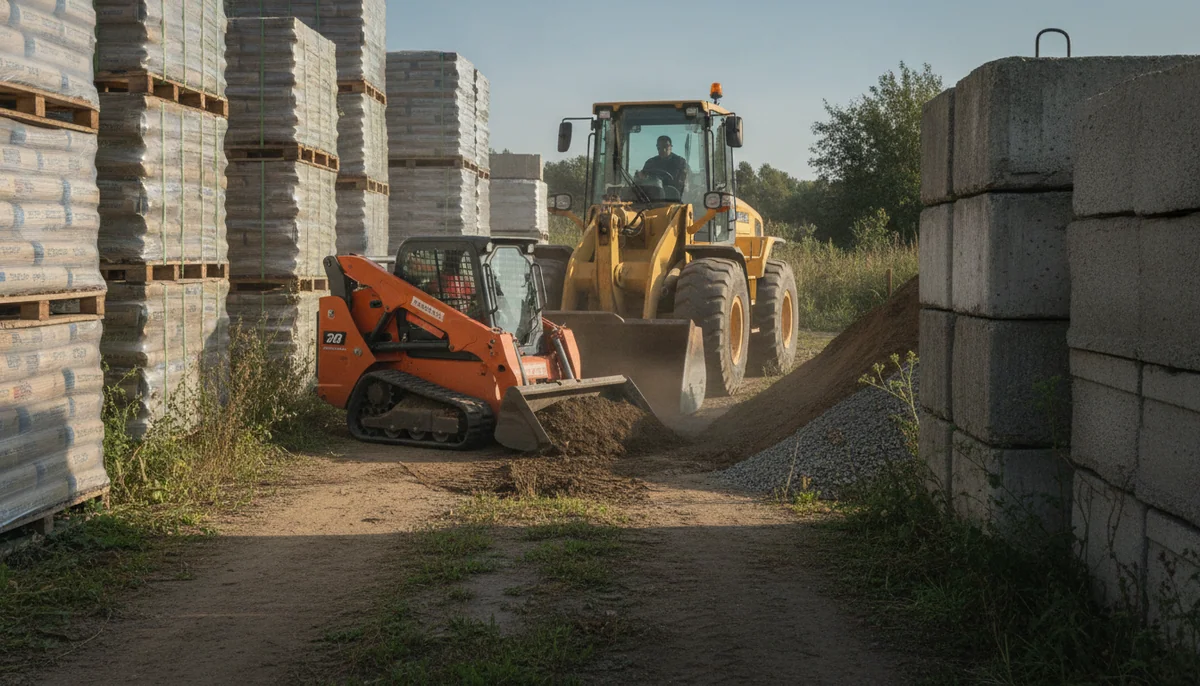
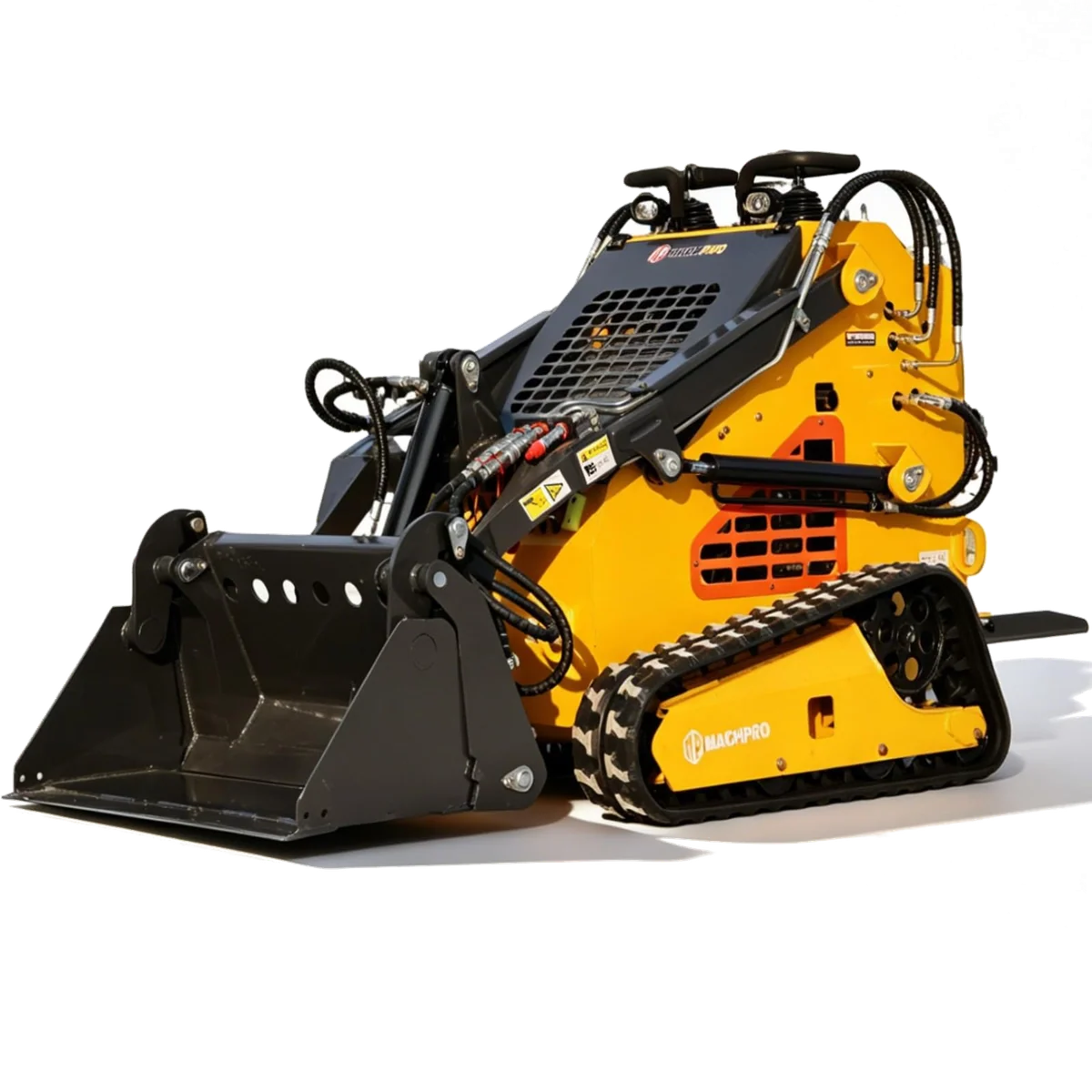
A mini skid steer is a compact hydraulic loader that turns by varying the speed and direction of its left and right wheels or tracks. Many place the operator on a rear stand-on platform, while some use a seat and overhead canopy. At the front, lift arms and a quick-attach interface carry a bucket, forks, grapple, auger, or another compatible tool.
Its most convincing work is unglamorous. Exact-product records show compact loaders moving road rock, dirt, logs, bedding, firewood, concrete bags, and landscaping material; they also show owners rough-grading yards, greenhouse sites, drives, and small property projects. That makes the plain bucket more important than the longest attachment list in a product description.
The machine is not a conventional skid steer reduced without consequence. A shorter and lighter chassis reaches narrow work, but it also reacts more sharply to rocks, drops, slopes, raised loads, and heavy attachments. Access is the advantage; stability and capacity are the price, which is why the site treats lift capacity and slope safety as separate decisions rather than footnotes.
The machine is small; the job list is not
Start with the material and the motion, not the attachment catalogue. Mini skid steers are strongest when they carry modest loads over short routes, work with the load low, and use tools whose weight and hydraulic appetite fit the carrier. The farther a job moves from that pattern, the more specifications the seller must prove.
| Job | Practical verdict | Where it works | What stops it |
|---|---|---|---|
| Carry loose material | Core job | Mulch, bedding, loose soil, gravel, firewood, debris, and similar short-haul loads. | Dense material can reach the machine’s weight or stability limit before the bucket looks full. |
| Rough grade and backfill | Well suited | Spreading loose fill, back-dragging, smoothing disturbed ground, and maintaining small property areas. | Control feel, traction, cutting-edge visibility, and the absence of boom float can limit finish quality. |
| Dig and scrape | Conditional | Shallow excavation and scraping in loose, previously disturbed, or reasonably workable soil. | A broad smooth bucket can skate over hardpan, baked clay, roots, and rock that need teeth or a narrower breaking tool. |
| Lift with forks | Verify the load | Low, short-distance movement of conservative loads whose weight and center are known. | Fork weight, forward reach, raised height, slope, and missing load charts can make a headline lift number useless. |
| Clamp with a grapple or 4-in-1 bucket | Good architectural fit | Brush, logs, debris, loose material, and dozing work that needs intermittent cylinder movement. | The attachment’s own weight reduces usable payload and moves the center of gravity forward. |
| Drill with an auger | Verify first | Stationary drilling with a bit, motor, soil condition, flow requirement, and pressure range matched to the machine. | Unknown auxiliary output, excessive bit size, attachment weight, and difficult spoil clearing can turn a plausible tool into a slow one. |
| Trench, sweep, rake, mow, grind, or mulch | No assumption allowed | Only when the machine can power the exact tool continuously while retaining controlled travel and acceptable hydraulic temperature. | Shared travel flow, insufficient hydraulic power, heat, return restriction, missing case drain, and excessive attachment mass are common deal-breakers. |
Bucket work leads because it asks the least mysterious question of the machine. An exact MACHPRO owner used an included 4-in-1 bucket to dig, doze, and grab, while other exact records support ordinary grading and material movement. That evidence does not turn every smooth bucket into an excavator, but it does show why a useful bucket can replace more hand labor than a poorly matched powered tool.
Grading is similarly honest when the ground has already been loosened and the goal is to spread, back-drag, or shape material rather than cut a compacted site from scratch. Readers whose workload starts there can continue with the site’s grading-focused mini skid steer guide.
The attachment plate is only the first yes
An attachment works only after three separate locks close. A tool can latch securely and still be hydraulically useless, or it can spin convincingly while making the carrier unstable. The word “universal” settles none of those questions.
First lock
Mechanical fit
Match plate width, upper-hook geometry, latch-pin position, clearance, couplers, hose length, and hose routing through the full lift and curl range.
Second lock
Hydraulic fit
Match auxiliary flow at working pressure, relief setting, continuous-duty allowance, return restriction, flow direction, detent behavior, and case-drain requirements.
Third lock
Stability fit
Count the attachment’s mass, how far it carries the load forward, the operator’s position, any approved ballast, lift height, terrain, and the machine’s documented load limit.
Pump count matters because a basic two-pump machine may route auxiliary oil through a circuit that normally propels one side. The exact MMS MS380L record identifies a two-pump configuration and preserves an owner’s wish for three pumps, while a separate two-pump attachment test showed the practical consequence: a brush cutter could spin or the loader could travel normally, but not both in a useful straight pass.
A third pump is meaningful, not magical. The HUAYEE HY480C record supports a three-section system and exact-owner use of a cutter, power rake, trencher, mixer, grapple, and forks. The same evidence also includes a direct-motor stump grinder that performed poorly, disagreement over mulcher suitability, and one machine whose displayed hydraulic temperature kept climbing on the factory fluid until the owner stopped it.
The site’s attachment compatibility guide covers the complete match, and the two-pump versus three-pump guide explains why a third circuit matters. If mowing, trenching, sweeping, grinding, or power raking is the main reason for buying the carrier, start instead with the shortlist built around powered attachments.
Five figures matter more than horsepower
Horsepower is easy to print in a title and hard to turn into a complete work plan. These five figures decide whether a mini skid steer can reach the job, move the load, empty it where required, and power the intended tool.
-
Working width
Ask for chassis width, width over every protrusion, supplied-bucket width, attachment width, and the turning envelope with the operator platform deployed. Seller-listed examples in this record range from a claimed 39.4 inches for the DigSwift DS-S40 to 45 inches for the seated HY480D, while the MACHPRO MP-380-YE is advertised at 43.3 inches. None should be promised to an opening of equal size.
-
Operating and transport weight
Confirm whether the figure includes fluids, fuel, bucket, forks, ballast, canopy, and operator, then use the complete transported package to select the tow vehicle, trailer, ramps, tie-downs, floor, and recovery plan.
-
Rated operating capacity
Require the tipping load, rating method, load center, attachment, lift height, surface, operator condition, and approved ballast. Maximum lifting force describes what the hydraulics can exert at some point; it does not establish what the chassis can carry safely.
The HY480C listing, for example, advertises a 1,234-pound rated operating capacity and 1,765 pounds of maximum lifting force, while exact owners quantified close fork loads of 600 and 640 pounds and also documented that enough forward load could raise the rear of the machine. Those owner loads show useful work in specific conditions, not validation of the larger rating.
-
Dump clearance and reach
Hinge-pin height, maximum raised height, bucket-edge clearance at full dump, dump angle, and forward reach are different measurements. Match the relevant one to the actual trailer wall, truck bed, spreader, bin, or pile rather than assuming a single “dump height” settles the geometry.
-
Auxiliary flow at working pressure
Ask for continuous auxiliary gallons per minute at the pressure the attachment needs, then confirm return limits, case drain, cooling, and whether both drive sides remain controllable while the tool runs. Aggregate flow from several pumps is not the same as flow available to one attachment.
A seller who cannot define those figures has not supplied a complete machine specification. The buyer should not fill the blanks with numbers from a similar badge, a nearby model suffix, or a loader that happens to share the same engine.
Access deserves its own route survey because a nominal gate size is not clear width. Measure between hinges, latches, posts, trim, and anything that narrows the opening; then account for the approach, immediate turn, ground slope, bucket, and room needed to steer without rubbing. The site’s gate-width guide turns the catalogue dimension into a usable clearance plan.
Tracks and wheels answer different ground questions
Choose wheels for firm routes
Wheels make sense on pavement, barn floors, established drives, warehouse surfaces, and firm yards where quick repositioning matters more than flotation. They also remove rubber-track tension, idlers, rollers, and derailment from the maintenance list.
Their limits are lower soft-ground traction, tire damage or punctures, modest ground clearance on some machines, and the same turf-scrubbing skid turns that define the class.
Choose tracks for soft routes
Tracks spread the contact patch and generally provide the better starting point for mud, loose soil, and slippery approaches. They can also keep a compact loader moving when a wheeled version would spin.
Their limits are slower travel, track-tension work, trapped debris, roller and idler wear, possible derailment, and aggressive lawn damage during tight turns.
Tracks do not convert rough ground into safe ground. A documented category example shows a compact tracked loader pitching sharply when short tracks met small embedded rocks, even though the operator otherwise valued the machine. Traction helped it reach the obstacle; the short footprint determined what happened next.
Neither undercarriage gets a turf exemption. Straight travel can be relatively gentle, but skid steering turns by dragging wheels or tracks sideways. Wide arcs, dry conditions, low loads, and fewer corrections reduce damage; a zero-radius pivot on a finished lawn does not become delicate because the machine is called mini.
The complete terrain choice is covered in the wheeled versus tracked guide. The honest shortcut is firm and clean for wheels, soft and slippery for tracks, and caution for either one when the route contains cross-slopes, ledges, roots, rubble, or abrupt changes in elevation.
Stand-on and sit-down machines change more than comfort
A stand-on platform keeps the machine compact, gives the operator a direct view of the attachment, and can fold for transport on some models. A seated format can reduce fatigue and provide a more familiar operating position, but the seat, canopy, added height, and longer body may cost access. Operator position also changes the machine’s balance, so capacity and slope guidance must belong to the exact configuration rather than the model family.
An overhead canopy should not be called a rollover or falling-object protective structure unless the manufacturer supplies the applicable certification. Readers deciding between the two formats can use the site’s stand-on versus sit-down guide.
The bargain moves part of the dealership into your shed
The exact-product evidence in this record is young. The strongest disclosed MMS MS380L interval reaches 10 hours, the MACHPRO MP-380-YE reaches about 15, the HUAYEE HY360C reaches 16, and the HY480C reaches 36. Those accounts establish that real owners completed useful early work; they do not establish track life, pump life, wiring durability, parts response, or dependable commercial uptime after a season.
Thin evidence does not mean every machine is bad, but a severe exact report still matters. One HY480D owner describes the original engine losing power and burning oil between roughly 11 and 20 hours, followed by a replacement engine that reportedly lasted no more than 12 hours. That single purchase cannot produce a failure rate, yet it is enough to make commercial dependence and vague warranty remedies unacceptable for that model.
Less dramatic problems show what owner-maintained equipment means in practice. The MMS record includes dead batteries, broken hand levers, a bad pallet, shipping damage, and an inadequate manual alongside machines that arrived ready to work. The HY480C record includes track adjustment, a full-tank fuel-cap leak on an incline, and one owner’s rising hydraulic-temperature display alongside substantial early utility.
Safety documentation deserves the same skepticism as a lift claim. A close Wolf Equip walkthrough reported that the controls remained active with nobody on the operator platform. That account does not prove the behavior of every Wolfequip configuration, but it makes a demonstrated operator-presence system, neutral-start protection, parking or hydraulic lock, emergency stop, and lift-arm service restraint mandatory questions before purchase.
Treat delivery day as the first service appointment
- Match the machine plate, engine label, undercarriage, pump arrangement, bucket, couplers, and serial number to the written order before use.
- Photograph the freight packaging, hour meter, machine, attachments, loose parts, and visible damage before signing or discarding anything.
- Verify operating and shipping weight, unloading equipment, ground placement, truck access, and failed-delivery responsibility before dispatch.
- Use the exact manuals to check engine oil, hydraulic fluid, fuel controls, battery isolation, grease points, track tension or wheel fasteners, and service intervals.
- Inspect hoses, fittings, wiring, cylinders, cooler, fan, attachment locks, guards, and the ground beneath the machine for leaks, rubbing, looseness, or shipping damage.
- Identify and test the documented operator-presence, neutral-start, parking, emergency-stop, auxiliary-lockout, and other safety functions in a clear level area.
- Run travel, lift, curl, and auxiliary functions gently at low engine speed, then repeat the leak, heat, fastener, hose, and undercarriage checks after a short session.
- Record filter, belt, track, tire, idler, seal, pump, valve, motor, electrical, and attachment-lock part numbers before an unidentified component stops a real job.
The wider ownership bargain is examined in the guide to lower-cost Chinese mini skid steers, while the first-use inspection and common-problems guide expands the commissioning routine without assuming that every machine will arrive faulty.
The machine earns ownership only when the jobs repeat
Ownership fits
The same useful work keeps returning
- The property repeatedly produces bucket, grading, cleanup, fork, or carefully matched attachment jobs.
- Tight access makes a larger loader impractical, and every opening and turn has been measured.
- The owner can perform routine service, inspect freight, identify parts, and communicate with remote support.
- Storage, transport, fuel, attachments, and a safe work area are already part of the plan.
- Several days of downtime would delay private work rather than stop a crew or break a customer promise.
Renting fits
The project is concentrated or the specification is uncertain
- The work is one large cleanup, trench, grading project, or attachment-intensive job.
- The real capacity, access, control preference, or terrain behavior is not yet known.
- A larger or dealer-supported machine could finish the task much faster.
- The owner does not want responsibility for commissioning, maintenance, storage, transport, and parts.
- Uptime matters more than keeping a machine available between occasional jobs.
Renting the intended size and attachment on the real property is not wasted money; it is a site survey with controls. The trial reveals whether the machine reaches the work, whether the operator can place material accurately, whether the ground supports it, and whether enough jobs remain to justify ownership. The site’s rent-versus-buy guide turns those observations into a fuller cost decision.
If ownership survives that test, choose the next page by the work. The main mini skid steer roundup is the broad starting point, the value-focused guide accounts for more than acquisition cost, the farm and barn guide prioritizes recurring property chores, and the narrow-access guide begins with the opening rather than the horsepower badge.
For most homeowners, renting first remains the right answer; buy only when the machine’s ordinary work already has a recurring place on the property and the owner is prepared to support the machine as well as operate it.
Frequently Asked Questions
Is a mini skid steer just a smaller full-size skid steer?
It uses the same basic loader and skid-steering ideas, but its stand-on or compact seated format, lighter chassis, smaller attachment interface, lower capacity, and sharper reaction to terrain make it a distinct operating proposition.
Is Bobcat another name for every mini skid steer?
No, Bobcat is a manufacturer while mini skid steer describes an equipment class sold under many brands.
Can a mini skid steer dig hard ground?
It can scrape and perform shallow digging, but hardpan, roots, baked clay, and rock often require a narrow toothed tool or scarifier before a broad bucket can carry the loosened material.
How much can a mini skid steer lift?
There is no class-wide answer because safe capacity depends on the exact machine, attachment, load center, lift height, tipping load, operator or ballast condition, surface, and manufacturer rating method.
Will a mini skid steer fit through a garden gate?
Only if the measured clear opening, approach, turn, machine width, attachment width, and working clearance all agree, because the seller-listed examples here span several inches before clearance is added.
Can a mini skid steer run a brush cutter or trencher?
Some can, but the exact attachment must match the carrier’s auxiliary flow at pressure, pump architecture, travel interaction, return plumbing, case drain, cooling, weight limit, and continuous-duty rating.
Are tracks always better than wheels?
No, tracks usually favor soft or slippery ground while wheels favor firm surfaces and simpler maintenance, and neither format makes rough slopes or tight turf turns harmless.
What is the smallest mini skid steer?
There is no useful universal winner because the narrowest chassis may carry a wider bucket, omit needed capacity, or belong to a different walk-behind, stand-on, or seated category.
Should a homeowner rent or buy a mini skid steer?
A homeowner should usually rent first and buy only when recurring work, measured access, self-service ability, storage, transport, and downtime tolerance make ownership more useful than occasional rental.
Sources (2)
- Amazon listings and customer reviews
- Owner and reviewer video, 3 channels