The HY480C is the only powered-tool pick here, and even it comes with conditions.
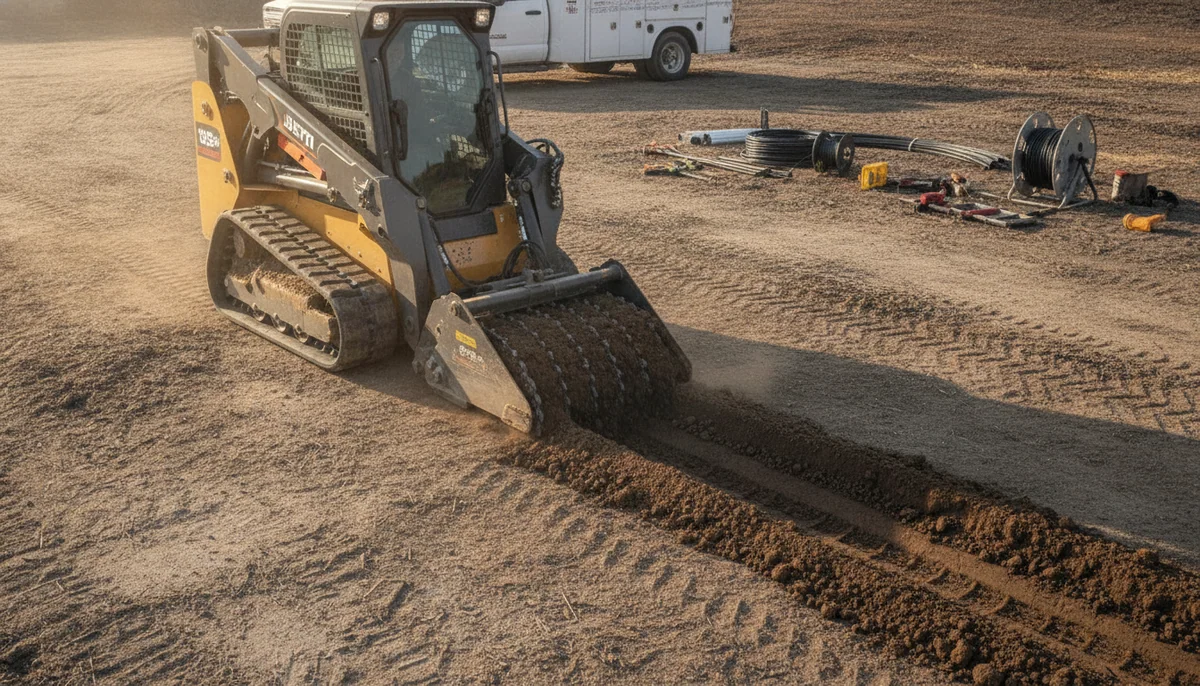
Quick couplers are easy to photograph. The harder test is whether a loader can send enough oil to a motor at working pressure, keep both tracks moving, return that oil without excessive back pressure, control heat for the full pass, and remain stable under the attachment’s own weight. Most machines in this field fail the decision before an attachment reaches the plate because their listings do not answer those questions.
The HY480C gets farther than the rest. Its three-section hydraulic architecture is supported by the listing and exact-owner evidence, and owners report using a brush cutter, power rake, trencher, grapple, concrete mixer, and forks rather than merely admiring those tools in a catalogue. One owner also says a direct-motor stump grinder performed poorly, which is exactly the kind of boundary a useful recommendation needs.
Pump count explains why that evidence matters. On a basic two-pump mini loader, continuous auxiliary flow can consume the circuit that normally drives one side, leaving the tool spinning while the carrier arcs or stops. A separate third section can preserve travel during attachment work, but it still does not reveal flow under pressure, cooling capacity, case-drain requirements, or the attachment weight the chassis can safely carry.
The winner’s drawbacks are not bookkeeping. One HY480C owner watched hydraulic temperature continue beyond 71 °C on the factory fluid and stopped the machine, while another documented fuel escaping around the cap with a full tank when the loader pointed uphill. The longest clearly stated exact-owner interval is 36 hours, so this remains an encouraging commissioning record rather than proof of commercial durability.
Skid Steer Mulch did not operate, flow-test, temperature-log, weigh, or load-test these machines. Exact listings and exact-owner records received the most weight; close-family evidence was used only to expose a mechanical question that the exact record leaves open.
The narrow yes
Keep the HY480C on the list for recurring property work that mixes bucket use with a correctly sized cutter, rake, trencher, grapple, mixer, or similar tool, provided you can monitor temperature, maintain tracks, inspect fluids, and park the machine when a fault appears.
The wider no
Stop if the primary job is mulching, stump grinding, continuous commercial mowing, heavy fork work, full-tank operation on inclines, or any schedule where a delayed part leaves a crew standing.
The attachment sets the rules, not the horsepower decal
Engine output is only the beginning of hydraulic performance. Before a motorized tool is purchased, the carrier and attachment need to clear six separate gates, and a seller’s use of the word “universal” clears none of them.
| Buying gate | Evidence to require | What goes wrong without it |
|---|---|---|
| Independent travel | A circuit diagram or live demonstration showing the selected tool powered while both drive sides creep straight. | A shared two-pump circuit may spin the tool but starve one side of travel. |
| Flow at pressure | Auxiliary gallons per minute at the attachment couplers and at the stated working pressure. | Total pump flow, reservoir volume, or engine horsepower can exaggerate the oil actually available to the motor. |
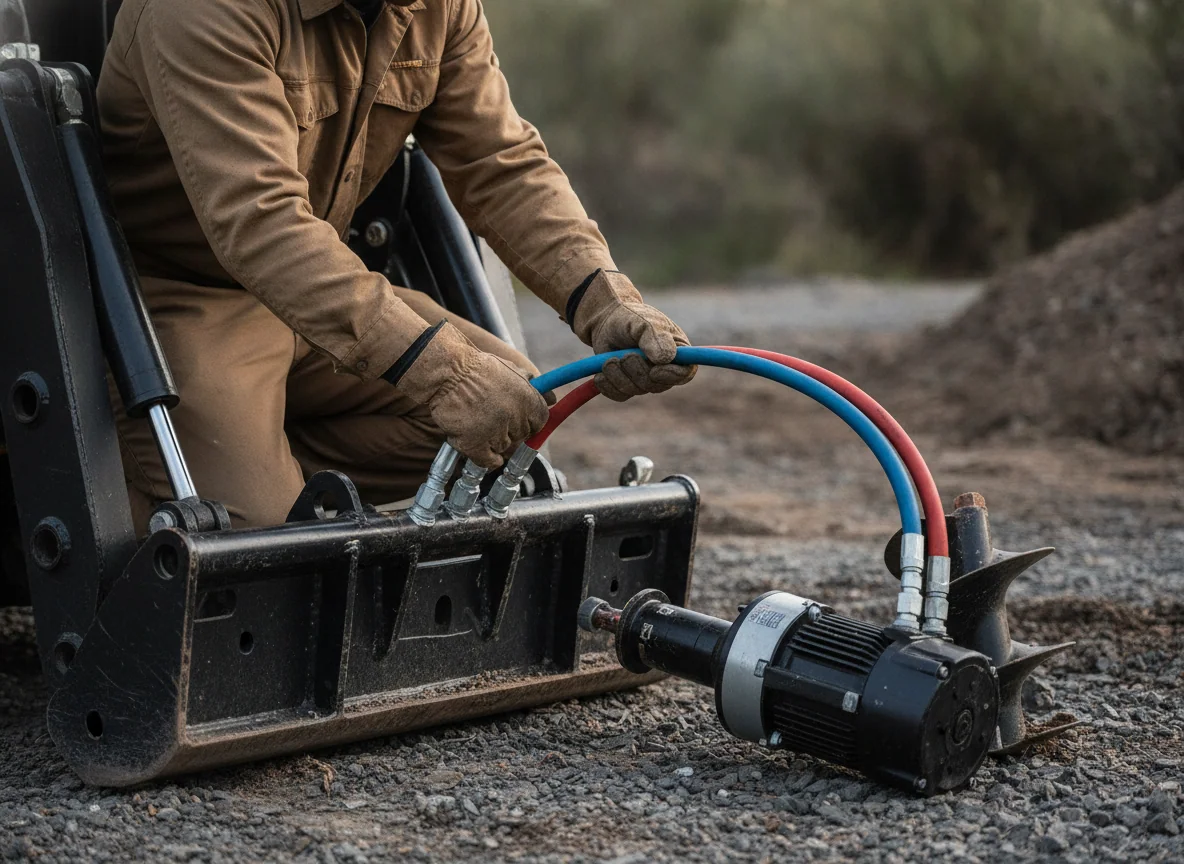
| Return path | Coupler type and size, permitted return back pressure, bidirectional-flow behavior, and case-drain provision. | A motor may overheat, damage seals, or fail even though its pressure and return hoses connect. |
| Thermal duty | Approved continuous-duty time, hydraulic-temperature limit, cooler specification, fan control, and warning procedure. | A brief demonstration can look successful while the oil continues heating during a real cutting or trenching pass. |
| Mechanical interface | A dimensioned plate drawing, latch geometry, pin engagement, attachment weight, hose sweep, and full-range clearance. | A tool can latch crookedly, bind the locks, pull on its hoses, or consume too much of the loader’s capacity. |
| Stability | A defined load rating, tipping load, attachment allowance, approved ballast, operating-weight figure, and slope limits. | A heavy motorized tool moves the center of gravity forward before it cuts, carries, or lifts anything. |
Passive tools are more forgiving. A plain bucket, land plane, or fork frame does not need continuous auxiliary oil, while a grapple or 4-in-1 bucket uses its cylinders intermittently. A brush cutter, sweeper, power rake, tiller, trencher, snow blower, grinder, or mulcher normally needs sustained power while the loader advances, so circuit independence and heat control become purchase requirements rather than upgrades.
The site’s guide to two-pump and three-pump hydraulic layouts explains the circuit problem, while the attachment compatibility checklist covers the plate, couplers, plumbing, mass, and stability checks that still remain after a third pump is found.
Pump count narrows the field but does not finish the choice. The TYPHON STOMP has close-model evidence of a triple-pump arrangement, yet the exact listing publishes no auxiliary-flow figure. MACHPRO advertises three pumps and 19 GPM in aggregate, but exact owners document the included 4-in-1 bucket rather than a continuously driven motor. The HY480D also advertises three pumps, but its thin owner record contains a report of two very early engine failures.
Those distinctions are why the HY480C wins conditionally rather than by default. Its record answers more of the powered-tool question than the alternatives, but the buyer still needs the specific tool match, fuel-system remedy, temperature limit, load guidance, and parts path in writing.
What each machine earns from the record
Every card applies the same standard: identify the work the evidence supports, name the limitation that changes the decision, and refuse to turn a coupler, engine badge, or pump total into attachment performance that nobody measured.
The unnamed B0GS listing is not a buyable recommendation.
There is no product title, brand, specification, rating, description, or owner evidence here from which to judge a powered tool.
The machine is effectively unidentified, so mount fit, hydraulic output, safety equipment, parts, and even the delivered configuration are unknown.
The MACHPRO MP-380-YE is a bucket-first machine with promising plumbing.
Its claimed three-pump system and included 4-in-1 bucket make it the strongest alternative for intermittent cylinder work, grading, grabbing, and ordinary loading.
The published 19 GPM is aggregate system flow, the auxiliary circuit and case drain are not identified, and exact owner use stops around 15 hours without a powered-motor test.
The MMS MS380L belongs with buckets, not continuously powered tools.
Exact owners support wheeled property work with dirt, road rock, grading, and landscaping, which suits passive tools on firm ground.
An exact owner identifies a two-pump layout and says a three-pump machine would offer more flexibility, while auxiliary flow and pressure remain unpublished.
The DIGMIGHT MP310 is too lightly documented for attachment-led buying.
A Briggs & Stratton engine, tracks, a quick-attach claim, and a stated 660-pound unloading figure describe a plausible small bucket loader.
The listing contradicts its own 45.3-inch width with a claim that it fits 36-inch gates, and it supplies no pump count, auxiliary flow, pressure, case drain, or meaningful owner task record.
The MMS MS360T has the right kind of tracks and the wrong amount of proof.
Its Briggs & Stratton engine and triangular undercarriage could suit light bucket work on fairly level private ground.
Two arrival-day reviews do not establish the exact machine’s long-term behavior, and the listing omits pump count, auxiliary flow, pressure, case drain, capacity, and attachment dimensions.
The HUAYEE HY480C is the conditional winner for powered tools.
Its genuine three-section hydraulic architecture and exact-owner reports with a brush cutter, power rake, trencher, grapple, mixer, and forks give it the deepest relevant evidence in this field.
One owner reported hydraulic temperature climbing beyond 71 °C on the factory fluid; another documented fuel leaking from the cap uphill with a full tank; and exact evidence still stops at 36 hours.
The Wolfequip T460S1 cannot be chosen around a hydraulic motor.
Its 23-horsepower tracked format and included bucket may suit intermittent property loading after the exact configuration is documented.
The listing omits auxiliary flow, pressure, pump layout, and case-drain identity, while a close owner walkthrough suggests the controls remained live off the platform.
The LUROFAN crawler is a bucket listing, not an attachment platform.
The listing and two brief owner comments support only a tracked machine supplied with a bucket for basic digging and material handling.
No engine, pump, pressure, flow, capacity method, attachment interface, case drain, warranty, or useful operating history is disclosed.
The ATS Power T460 is the wrong T460 for continuous hydraulic work.
Direct evidence supports loose-material bucket work and mechanically simple service access for a self-reliant property owner.
The standard T460 is documented as a two-pump platform, the listing conflicts on lift figures, and the sole retained review says the owner’s manual was missing.
The MMS MS360L is a firm-ground bucket loader with a two-pump ceiling.
Exact owners support landscaping, light grading, and moving loose material, and wheels remove track tension and derailment from the maintenance list.
An exact owner identifies two pumps, the longest stated use is 10 hours, and arrival reports include batteries, pallet trouble, shipping damage, and broken hand levers.
The DigSwift DS-S40 is narrow enough to interest gate-limited buyers but not documented enough to power their tools.
Its claimed 39.4-inch width, Briggs & Stratton engine, and 661-pound rated operating capacity describe a plausible compact material handler.
One vague owner comment cannot validate stability or durability, and the listing provides no pump count, auxiliary output, case drain, cooling duty, named mount standard, safety system, or support terms.
The HUAYEE HY360C is a credible barn loader and a poor powered-tool carrier.
Exact owners support light bucket work in stalls and small properties, while the Briggs & Stratton engine and wheeled layout suit firm, mostly level routes.
Its dual-pump system has no published auxiliary flow, exact evidence ends at 16 hours, and the listing’s 1,323-pound maximum-lift claim is not a usable payload rating.
The TYPHON STOMP is the runner-up only after a serial-specific hydraulic audit.
A close tracked GX690 machine visibly showed three pumps and more substantial hardware than bare auction designs, which makes this the most plausible alternative to the HY480C.
The exact listing says only three valves, publishes no auxiliary flow or case-drain details, conflicts on machine weight, and had no ratings when captured.
The DigSwift DS-SS50 asks the buyer to solve its specification sheet.
Its stated 39.4-inch width, 23-horsepower engine, and tracked stance could make a useful short-haul bucket machine for a mechanically capable owner.
The listing never gives pump count, auxiliary flow, pressure, case drain, operating weight, safety logic, or a defined lift rating, and its two reviews offer only unexplained one-star and five-star extremes.
The HUAYEE HY480D has three pumps and still earns a pass.
Its seated wheeled format and exact three-pump hardware could serve light bucket and grading work on firm ground.
One owner reported the original engine losing power and burning oil by roughly 20 hours and a replacement lasting no more than 12 hours, while exact auxiliary flow remains unpublished.
The unnamed B0FP listing cannot be evaluated.
The supplied record contains no product identity or evidence from which to assess any job.
Without even a title or specification, the hydraulic system, mount, safety equipment, service path, and delivered machine are all unknown.
The Wolfequip T460S1WH bundles useful forks with an unresolved carrier.
The included bucket and pallet forks suit passive material handling better than a continuously driven tool, provided the loader’s real load chart and fork weight are obtained.
The listing omits pump output, pressure, machine width, operating weight, and safety logic, while the closest Wolf walkthrough raises an operator-presence concern.
The generic T460 is sales copy without a supportable powered-attachment case.
Its listing describes a 23-horsepower tracked loader with a 43.8-inch bucket for basic material movement.
There are no owner ratings, the copy conflicts on lift figures and even mentions tires on a tracked machine, and no hydraulic architecture, auxiliary output, case drain, parts path, or defined warranty is supplied.
Frequently Asked Questions
How much usable auxiliary flow has been verified on the HY480C?
No flow-meter result under working pressure was supplied, so the pump-marking estimate of roughly 11.4 GPM remains a calculation rather than measured attachment output.
Does the HY480C have a case-return connection for hydraulic motors?
The detailed exact-model record shows pressure, return, and a third case-return line, but the chosen motor’s drainage and back-pressure limits still need to match that plumbing.
Is this gasoline TYPHON STOMP the Kubota diesel model?
No, the exact Amazon machine covered here is the gasoline GX690 listing rather than a larger TYPHON configuration using a Kubota D1105 diesel.
Is MACHPRO’s advertised 19 GPM the attachment flow?
No, the seller reaches 19 GPM by adding three circuits rated at 36, 18, and 18 liters per minute without identifying which circuit feeds the front couplers.
Will the DigSwift DS-S40 clear a 40-inch gate?
Not safely from the supplied 39.4-inch figure alone because the listing does not define the widest delivered point, bucket width, manufacturing allowance, gate hardware, approach angle, or steering clearance.
What is the prudent choice when a crew’s schedule depends on the machine?
None of these records proves production-grade powered-tool uptime, so renting a documented carrier or buying through a service channel is safer than assigning paid work to an imported machine with unresolved flow, parts, or warranty terms.
Sources (2)
- Amazon listings and customer reviews
- Owner and reviewer video, 5 channels