The MMS MS380L makes sense with a bucket, not a brush cutter
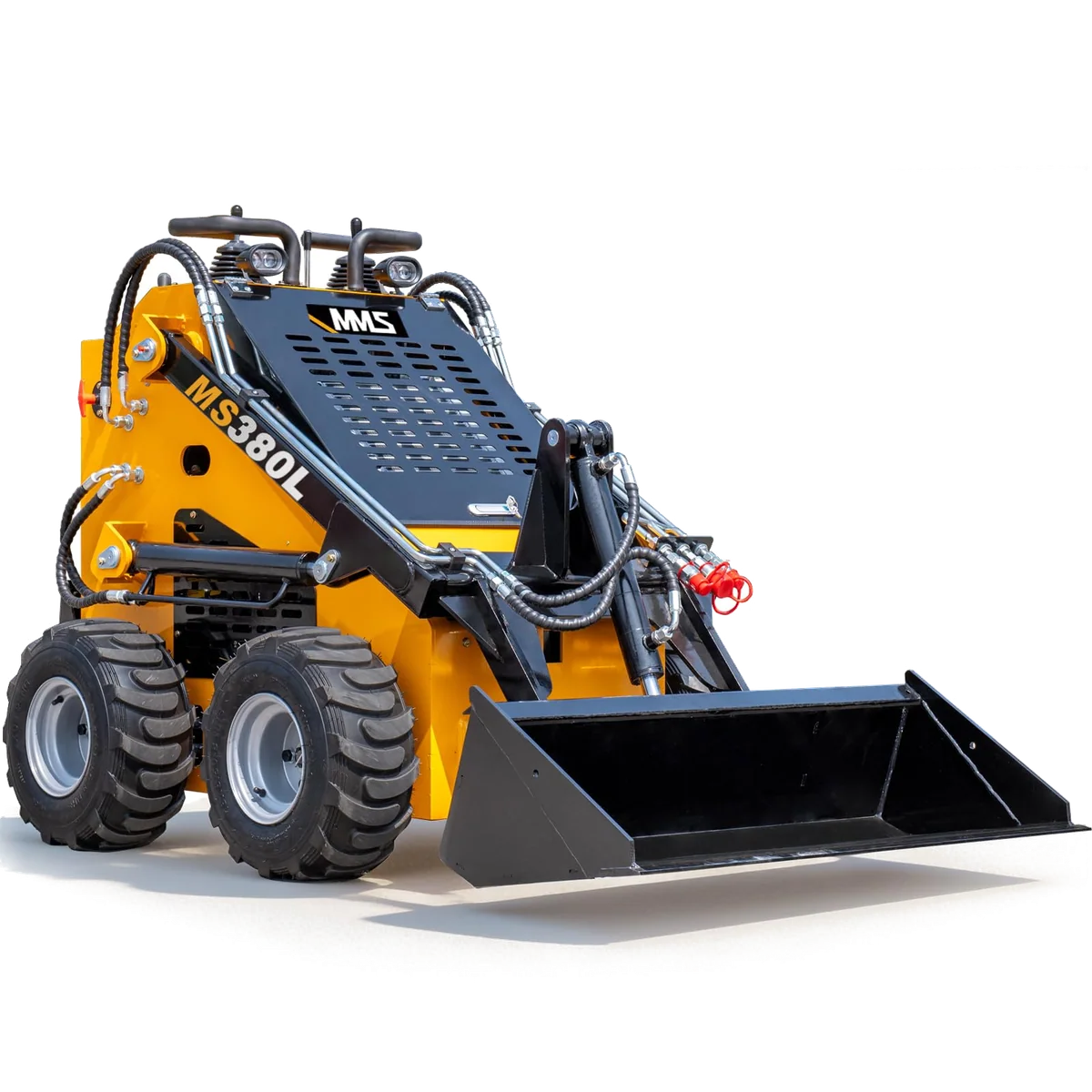
Buy the MMS MS380L for occasional bucket work, rough grading and intermittent auxiliary jobs on firm ground if you can inspect and maintain it yourself; skip it for daily commercial work or a mulcher because the record supports a two-pump homeowner machine, not a turnkey production tool.
Based on 5 owner ratings and 2 other sources. We have not tested this machine ourselves.
We earn a commission if you buy through our links, which does not affect what we say.
Read how this site works →
The final call
The MMS MS380L earns a narrow recommendation for a mechanically capable property owner who wants a wheeled stand-on loader for buckets, rough grading, forks, leveling and carefully matched intermittent auxiliary tools. The exact record shows that it can perform those modest jobs, and seller response has been good enough to resolve several small delivery problems.
Skid Steer Mulch would still walk away if the machine had to earn commercial revenue every day, if soft ground made tracks essential, or if a continuously powered attachment was the main reason for buying. The MS380L’s attraction is honest when it is treated as an affordable homeowner loader with support; it becomes a bad bet when 23 horsepower is asked to hide two pumps, missing specifications and a durability story that ends after 10 hours.
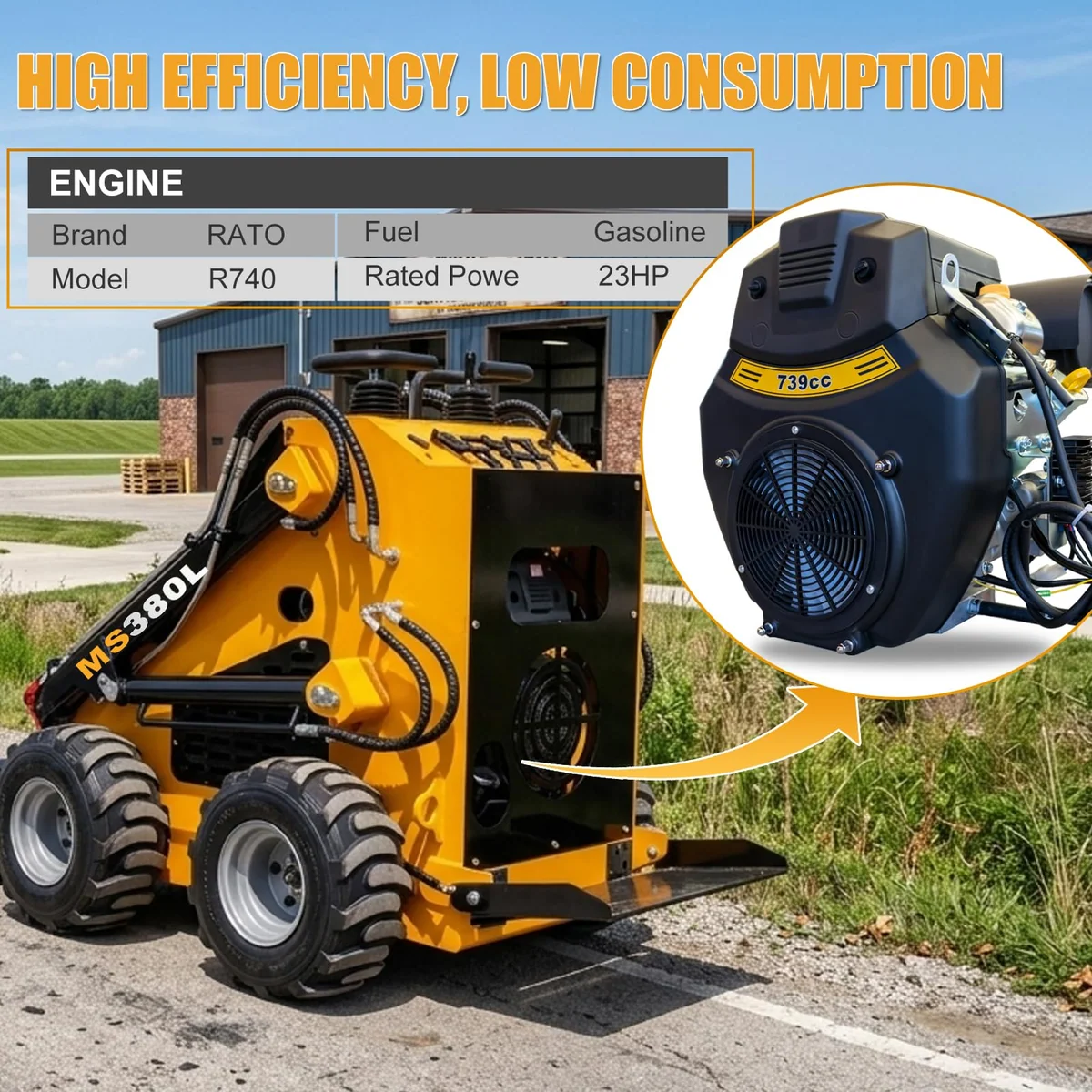
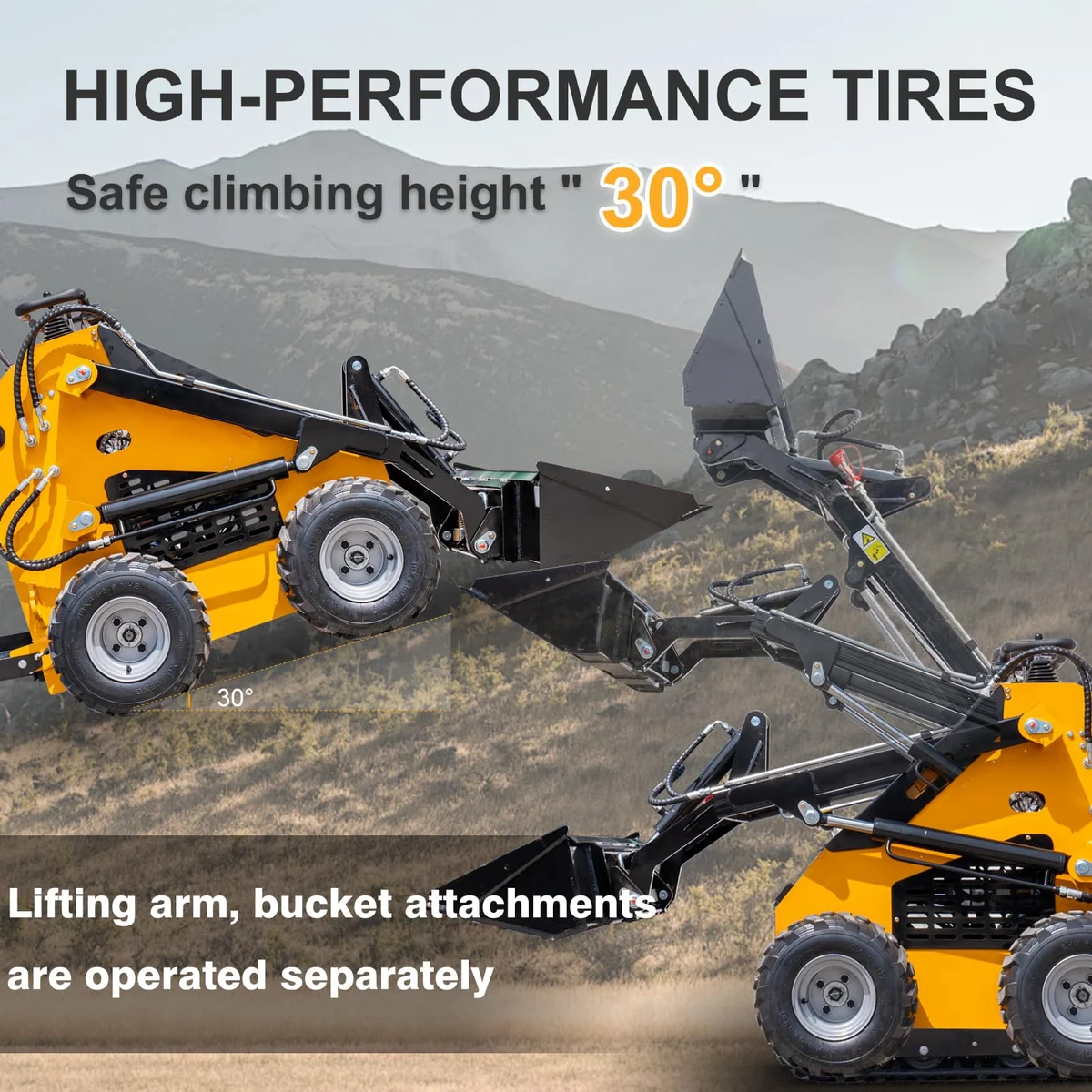
The MS380L combines an advertised 23 HP RATO gasoline engine, four wheels, a stand-on platform and a detachable bucket. MMS also advertises scheduled truck delivery and unloading, an important part of the proposition when the machine is too large to arrive like an ordinary parcel. Those basics are real; the listing’s broader promises about attachment versatility, turf protection and 30-degree climbing need much more restraint.
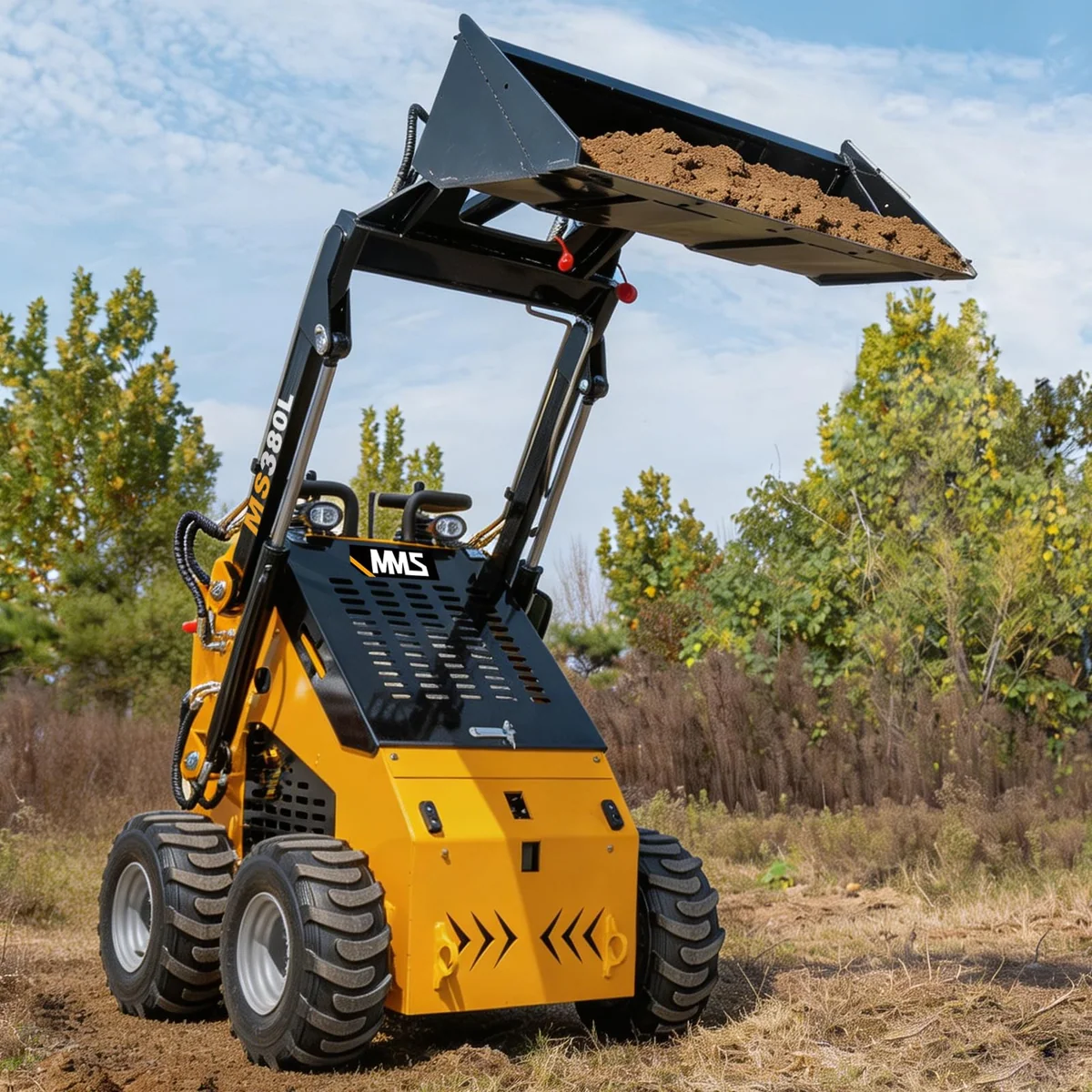
The exact-page owner evidence clears a modest but useful bar. The strongest report waited until 10 hours of moderate-to-heavy home use that included moving road rock and dirt for patio and landscaping projects. Other retained accounts describe grading a greenhouse area, working around a small garden and handling residential landscaping. This is credible evidence that the machine can save labor on small-property material work, not merely sit photogenically beside its bucket.
It does not clear the reliability bar. Ten hours is the only stated operating interval in the exact-page record, and the rest of the positive reports are measured in days or do not give a timeline at all. The same page-level review pool includes dead batteries, broken hand levers, a bad pallet and minor freight damage, although other machines arrived ready to start and one owner found every bolt and hydraulic line secure.
That split is the whole review in miniature. The MS380L appears capable enough to reward a practical owner, while its preparation, documentation and long-term certainty remain well below what a local commercial-equipment dealer normally removes from the buyer’s workload. Anyone considering this wider class should read our guide to what makes an inexpensive imported mini skid steer a bargain or a burden, because the answer depends as much on the owner’s tools and downtime tolerance as it does on engine power.
Key Specifications
Four wheels give the L model a narrower, useful job
This MS380L is the wheel model. One exact-page buyer specifically chose wheels rather than tracks, and a wheeled MMS-family owner made the same choice to avoid thrown-track problems. General Chinese-machine guidance favors wheels for faster travel and firm surfaces, while tracks usually provide better flotation and traction in soft or slippery ground.
The trade suits pavement, established driveways, warehouse floors and reasonably firm yards better than a property dominated by mud. It can also remove track tension, roller and derailment work from the ownership list. Wheels bring their own tire, traction and wheel-drive questions, however, and skid steering can still mark turf despite the listing’s absolute claim about avoiding ground damage.
An exact-page owner also found the ground clearance a little low. No retained MS380L report documents mud, snow, tire wear, punctures or slope work, so this is not the wheel machine to buy on an assumption that it will behave like a tracked loader in every condition. The full trade is covered in our wheeled-versus-tracked mini skid steer guide.
Searches for replacement tracks lead to the wrong version here. The L listing has wheels; the MS380T is the tracked sibling, and track size, tension and replacement advice from that machine should not be transplanted into an MS380L maintenance plan.
| Decision point | What is established | What remains missing |
|---|---|---|
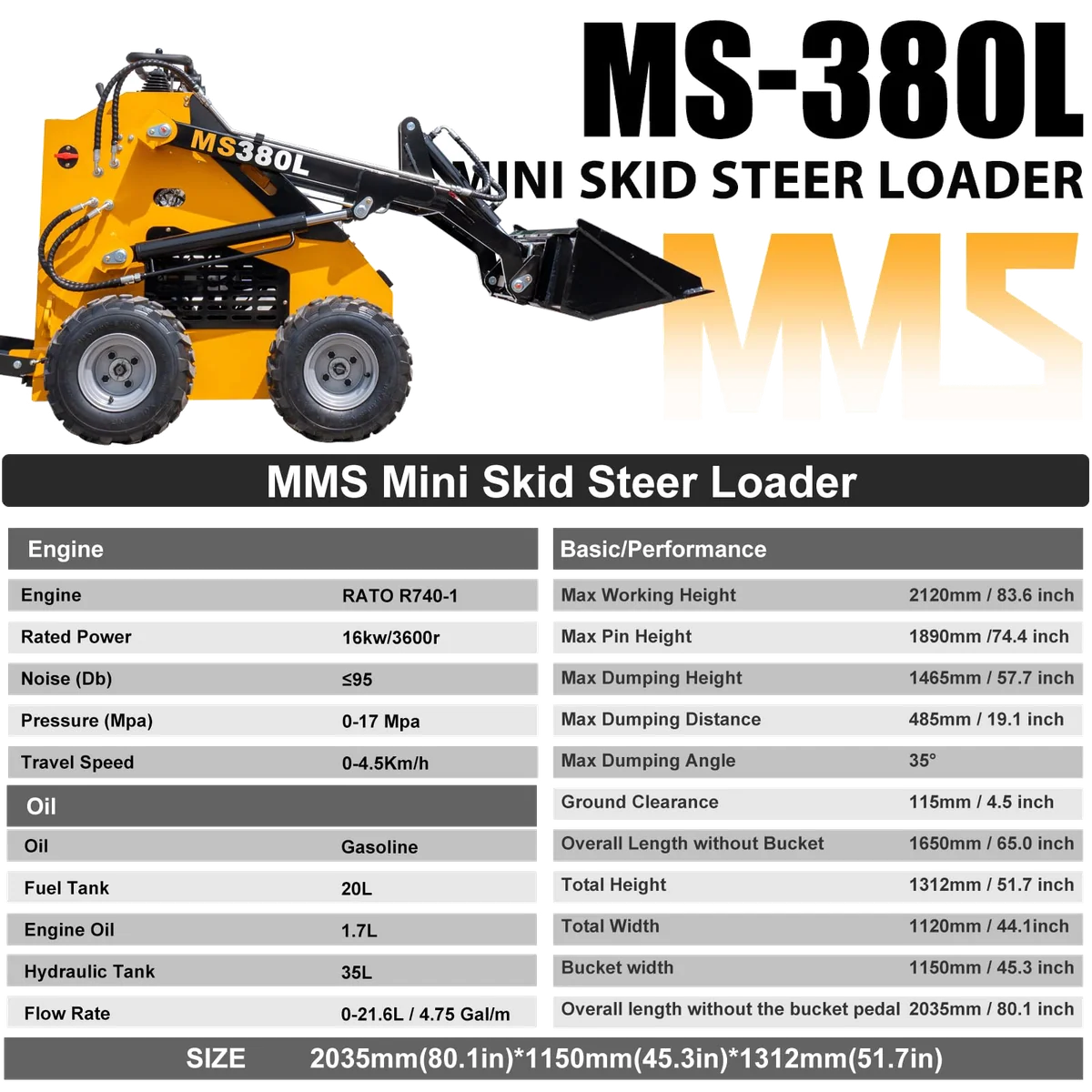
| Engine | The exact listing advertises a 23 HP RATO gasoline engine. | Exact engine model, displacement, rated speed, oil capacity and service part numbers. |
| Undercarriage | This is the wheeled L version, and one exact-page owner deliberately chose wheels. | Tire size, construction, pressure, load rating, replacement number and internal wheel-drive design. |
| Hydraulics | The listing claims dual circuits, and an exact-page owner describes the machine as two-pump. | Auxiliary flow, pressure, pump displacement, case drain, oil specification and continuous-duty limit. |
| Lift and stability | The retained owners report useful home material work. | Operating weight, rated operating capacity, tipping load, lift height, dump reach, breakout force and maximum attachment weight. |
| Dimensions | The listing describes a compact machine with a folding operator platform. | Overall width, height, ground clearance, turning envelope and length with the platform open or folded. |
| Attachment interface | The bucket is detachable and the seller advertises multiple attachments. | Exact plate dimensions, latch-pin geometry, coupler size and model-by-model compatibility. |
| Slope use | The seller advertises a 30-degree climbing angle. | Independent verification, direction of travel, surface, load state, tire pressure and a safe working limit. |
| Delivery and parts policy | The listing promises scheduled truck unloading and replacement parts for qualifying failures within one year. | Crated weight, unload equipment, labor coverage, freight responsibility, exclusions and component lead times. |
That missing data blocks three common promises. “Compact” does not prove the machine will clear a particular gate. Engine horsepower does not reveal a safe pallet load. A seller-stated climbing angle does not establish that a loaded stand-on machine is safe on a 30-degree side slope. Ask for the current dimension sheet and load chart rather than filling those blanks with numbers from another MMS suffix.
An attachment plate that looks familiar can still be wrong
Close MMS demonstrations describe a mini or Toro Dingo-style interface, but the exact MS380L dimensions were not captured. A purchased MS380T owner returned a Titan adapter because it used a full-size skid-steer plate rather than the smaller mini interface; that owner also reported half-inch flat-face couplers on the T model, while the implement he wanted to use had quarter-inch connections. Neither size should be assigned automatically to this L model, but the failed fit shows why the word “universal” is not enough.
Before ordering an implement, verify plate width and height, upper-lip geometry, latch-pin spacing, coupler style, hose clearance, attachment weight, auxiliary flow, pressure and case-drain needs on both sides of the match. Our mini skid steer attachment compatibility guide explains why a plate that latches is only the first gate.
The controls are simple only after the setup makes sense
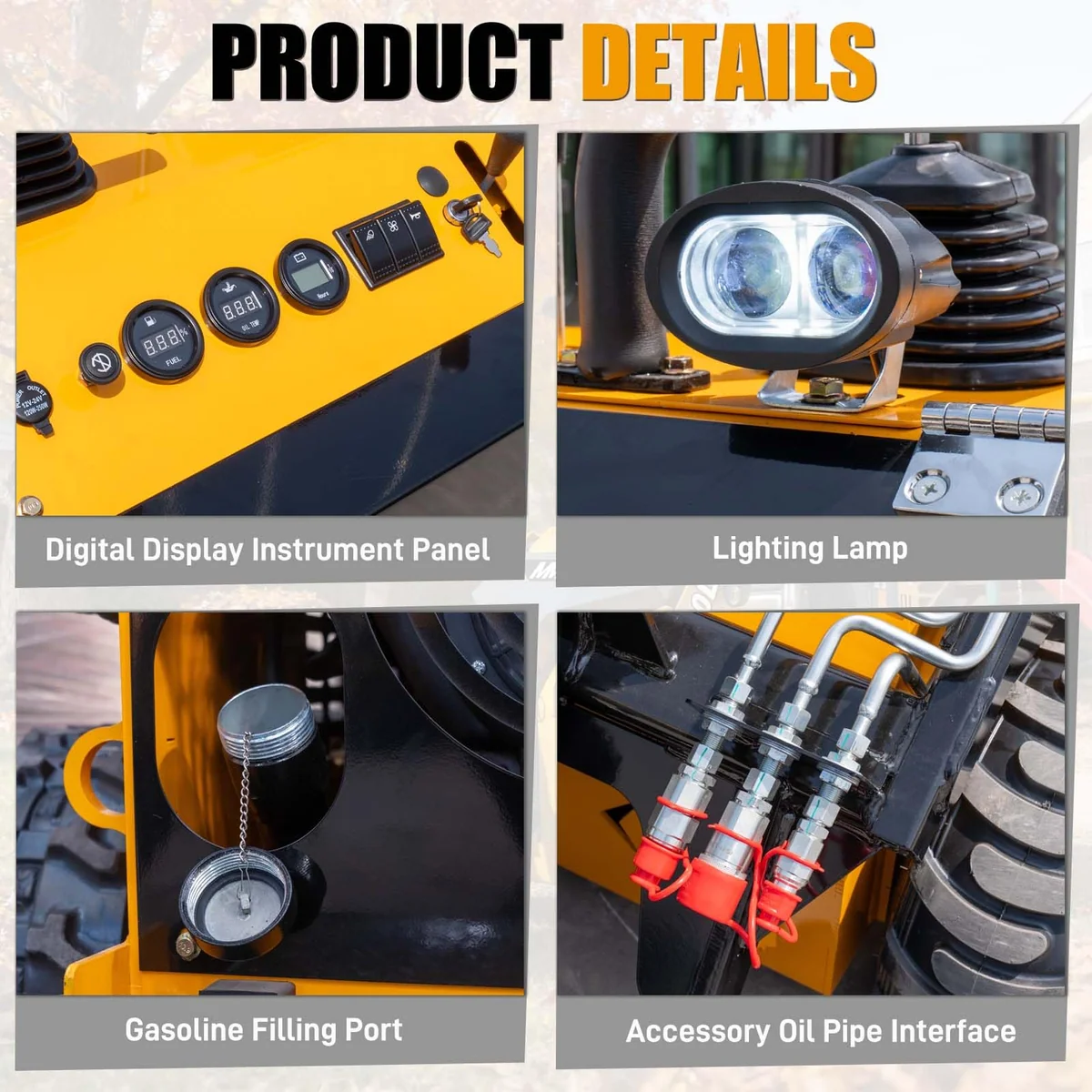
Exact owners disagreed about the learning curve. Some found the controls easy to learn, while others described them as difficult at first. The most informative account repeatedly thought the machine had a starting problem before tracing each incident to setup, including leaving the auxiliary control engaged and mishandling the fuel control; that owner’s real complaint was the inadequate manual.
A wheeled MS320L and MS360L family owner likewise emphasized deliberate use of the fuel control, battery disconnect, throttle and choke, and found that leaving master power on could add hours while the engine was stopped. That is a sibling observation rather than proof of identical MS380L behavior, but it is reason enough to request the current manual before delivery and record the meter reading before the first start.
The engine has more ambition than the hydraulics
The 23 HP headline can send buyers toward the wrong question. The decisive exact-product clue comes from the owner with 10 hours on the machine, who identified it as a two-pump unit and said a three-pump machine would have offered more flexibility when operating equipment. That owner still liked the MS380L for its intended property work, but the qualification is not small print; it separates a useful loader from a convincing powered-attachment carrier.
MMS describes an independent dual hydraulic circuit that permits normal travel while the boom lifts or the bucket curls. That supports ordinary composite loader movements. It does not establish a dedicated third circuit for an attachment motor, and it does not prove that both drive sides remain fully usable while a cutter, rake or sweeper consumes continuous auxiliary flow.
A detailed review of an MMS-supplied MS380T found two gear pumps, two suction lines and auxiliary hydraulics routed through the left travel valve body. That is a tracked sibling, not undercarriage evidence for this wheeled MS380L, and the free-machine disclosure limits what it can establish about independent durability. Its engine-bay inspection is still valuable because it shows the mechanical reason the pump count matters: continuous auxiliary demand can take flow that one side of travel would otherwise use.
A separate attachment test on a smaller 14 HP two-pump Chinese mini skid makes the consequence visible without becoming an MS380L performance test. Its bucket, land leveler, grapple, trailer hitch and stationary auger all did useful work. The brush cutter could spin or the machine could drive normally, but not both in a practical straight cutting pass; trenching became a stop, move and restart routine that also generated enough heat to concern the operator.
More horsepower may provide better reserve than that 14 HP machine, but it cannot create a missing hydraulic path. Until MMS supplies the current MS380L’s exact auxiliary flow, pressure and circuit diagram, Skid Steer Mulch would choose attachments according to how they use oil rather than how impressive they look in a catalogue.
| Attachment or job | Our call | Why |
|---|---|---|
| Standard bucket and rough grading | Best-supported use | Exact-page owners moved rock and dirt and graded residential areas with the machine. |
| Toothed or stump bucket | Promising | The tool is passive and can improve penetration, but exact mount geometry, attachment weight and lift limits still need confirmation. |
| Pallet forks, land leveler or trailer hitch | Good hydraulic fit | These tools do not demand continuous auxiliary flow, although the absent rated capacity prevents any safe load claim. |
| Grapple or four-in-one bucket | Conditional yes | The jaw can be opened or closed intermittently before normal travel, provided plate fit, hose routing, weight and couplers all match. |
| Stationary auger | Conditional yes | Drilling can occur while the machine is stopped, but bit size, attachment mass, flow, pressure and soil conditions remain unresolved. |
| Hydraulic-angle blade | Reasonable in principle | The operator can set the angle with auxiliary flow and then travel, subject to traction, weight and exact compatibility. |
| Trencher or stump grinder | Poor match until proven | Both need powered cutting plus controlled repositioning, which turns a shared travel circuit into a slow stop-start compromise. |
| Brush cutter, mulcher, power rake, tiller or sweeper | Do not buy around it | These tools normally need continuous auxiliary power while both drive sides remain available, and the exact MS380L record does not show that capability. |
Our guide to two-pump and three-pump mini skid steers explains this circuit difference in full, while the roundup of machines for powered attachments is the better next stop when continuous hydraulic work drives the purchase.
Value depends on what the bucket replaces
The captured Amazon price for the MS380L was only a historical measurement, not a current offer, and it should not be carried into a buying decision without checking the actual terms shown at checkout. What survives changes in price is the structure of the bargain: a new wheeled loader, scheduled unloading, a seller who has resolved small arrival problems and a stated parts policy, but no proven commercial lifespan or local labor network.
The value case is strongest when the work already looks like the exact owner record: moving loose material, grading a greenhouse pad, maintaining a drive, handling landscaping soil and reducing lifting around a small property. A buyer doing those jobs with the included bucket can use the machine’s demonstrated strengths without betting the purchase on missing hydraulic specifications.
The calculation gets worse as downtime becomes more expensive. A landscaping business that schedules the machine every day needs a longer durability record, known wear-part lead times and clear labor coverage. A buyer whose main task is brush cutting, tilling, power raking or mulching needs a dedicated auxiliary circuit more than a larger horsepower decal.
If those gates do not clear, do not rationalize the MS380L merely because a name-brand commercial machine costs more. Renting can place maintenance and downtime elsewhere, and our rent-versus-buy guide helps compare that choice without pretending purchase price is the whole cost.
Buyers also considering the smaller wheeled sibling should use the MMS MS360L and MS380L comparison rather than infer capacity or hydraulics from model numbers. The captured family price difference does not, by itself, explain what additional capability the MS380L provides.
The durability record stops at 10 hours
The only timed exact-page report says the MS380L held up well through 10 hours of moderate-to-heavy residential work, with its bolts and hydraulic lines still secure. That is useful early evidence. It is not a 50-hour service report, a season of ownership or a commercial duty cycle, and the owner’s decision to remain on the original fluids is a description rather than maintenance advice.
The page-level reviews become much more informative at delivery than they are after break-in. Two retained texts report a dead or bad battery, one reports broken hand-control levers, another describes a pallet that could not be moved with the planned pallet jack, and one notes minor shipping damage. Counterexamples matter too: another unit arrived early and started immediately, while the 10-hour owner found the incoming fasteners and lines in good order.
These reports cannot support a defect rate because the pool appears to mix MMS variants and the captured rating count does not agree with the number of retained review texts. They do support a clear buying habit: treat freight day as the first mechanical inspection, not as a ceremony before the first job.
Support has passed small tests, not a major one
Seller response is the strongest repeated positive outside basic loader work. Owners report that MMS honored doorstep delivery, supplied frequent updates, offered or reimbursed batteries, addressed the bad pallet and responded quickly to minor shipping damage. One owner also warns that time-zone and translation differences can prevent an immediate answer, so “responsive” should not be mistaken for a local service desk answering in real time.
The captured Amazon policy is narrower than a blanket full-machine warranty. It promises replacement parts within one year for damage attributed to “non-human factors,” but it does not state that labor, diagnostics, travel, return freight, fluids or local-shop reimbursement are covered. Those omissions matter much more when the failed item is a pump or wheel motor than when it is a battery.
MMS’s own site promises a one-year warranty, lifetime technical support, spare-parts inventory and multiple United States warehouse locations. Those are useful commitments to put in writing, not independent proof that a particular wheel motor, valve body, cylinder, lever, tire or RATO component will reach an owner quickly. The exact record shows that MMS can resolve modest arrival problems; it does not document a major mechanical claim or post-warranty wear-part order.
A purchased MS380T owner did receive a requested maintenance manual from MMS’s China team on the same day. That improves the support picture, although it still does not establish repair-document quality or parts lead time for the MS380L. Ask for the current operator manual, parts book, hydraulic schematic, filter numbers and major component part numbers before purchase, when unanswered questions can still change the decision.
This is owner-maintenance equipment
The 10-hour exact-page owner says the machine suits someone comfortable changing engine oil, hydraulic fluid and filters. A broader Chinese-machine buying guide adds the ordinary realities of checking fasteners, using basic hand tools and diagnosing simple faults. Neither source proves that the MS380L will require constant repair; together they define the buyer who is least likely to be stranded by a modest problem.
Close wheeled-family evidence supplies a sensible watch list rather than an exact defect list. An MS320L and MS360L owner found awkward engine-oil access, hoses exposed to branches, fragile operator padding and an hour meter that accumulated time with master power left on. Inspect those areas on the delivered MS380L, but do not claim they are faulty until the exact unit shows the same condition.
Our guide to common mini skid steer problems and first-use inspections provides the wider maintenance context. The essential MS380L question is not whether the machine is simple enough to repair; it is whether the buyer has documentation, parts and time when simplicity still produces downtime.
Sources (3)
- Amazon listings and customer reviews — Mms Ms380l
- Owner and reviewer video, 5 channels
- Mmsindustry — Article — mmsindustry.com