A mini skid steer can lift more than it can safely carry.
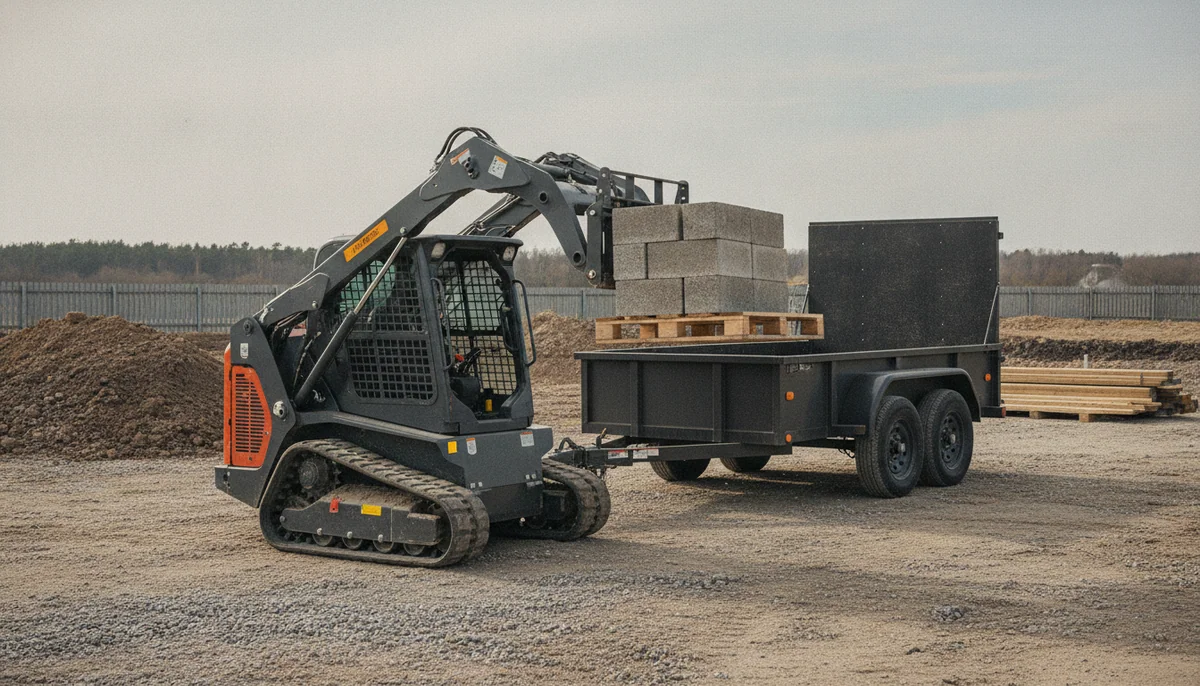
Lift capacity is not the moment the boom stops rising. A compact loader can have enough hydraulic force to raise a load after its short chassis has run out of stability, which is why the largest number in a product title is often the least useful number on the page.
The distinction becomes obvious in exact owner evidence. One HUAYEE HY480C owner reported carrying 600- and 640-pound fork loads when they were kept close to the machine, yet also said an excessive forward load could raise the rear of the loader. Those successful lifts document useful work in that owner’s conditions; they do not validate the seller’s much larger rated-capacity claim or turn rear lift into a weighing method.
A capacity number earns attention only after four questions have answers.
- What is it? Rated operating capacity, tipping load, hydraulic force, or an undefined maximum?
- Where is the load? At the attachment plate, bucket edge, fork load center, or some unstated point?
- How high is it? Near the ground, at truck-bed height, or at full lift?
- What is installed? The standard bucket, forks, grapple, ballast, and operator position all change the configuration.
If a seller supplies only pounds and enthusiasm, the machine does not yet have a capacity you can plan around.
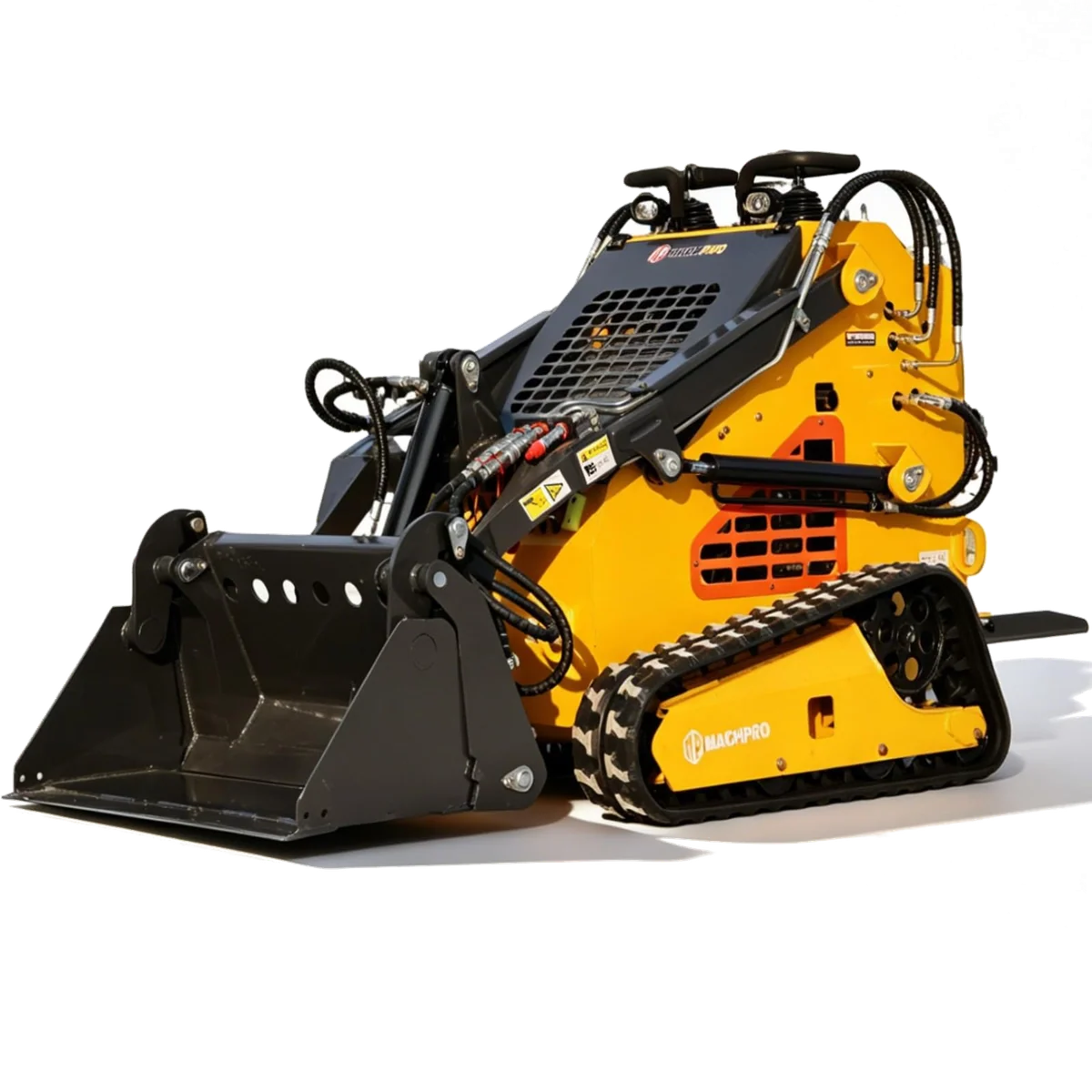
The number is useful only when you know what it names
Mini skid steer listings routinely place operating weight, rated load, maximum lift, bucket volume, and dump height beside one another as though they describe the same ability. They do not. Each number belongs to a different part of the work plan, and some seller labels are too vague to use at all.
| Term | What it describes | What it does not prove | How to use it |
|---|---|---|---|
| Operating weight | The weight of the loader in a stated working configuration. | It is not lift capacity, even when the number appears prominently in the product title. | Use it for trailer payload, ramp, floor, recovery, tie-down, and unloading decisions after confirming whether fluids and attachments are included. |
| Rated operating capacity | A manufacturer’s stated working-load figure for a defined configuration and test basis. | It does not automatically apply to different attachments, load centers, heights, ballast, slopes, or production revisions. | Use it as a first screen, then obtain the definition and load chart for the exact machine. |
| Tipping load | The load and configuration associated with a stability boundary under stated test conditions. | It is not a normal working target and does not authorize travel with the machine close to tipping. | Use it to understand how the maker derived the working rating, never as cargo capacity by itself. |
| Maximum lifting force | A peak hydraulic or geometric claim whose meaning depends on where and how it was measured. | It does not establish stable payload, rated fork capacity, full-height ability, or permission to travel. | Ignore it for load planning unless the maker defines the measurement and connects it to an approved load chart. |
| Breakout force | The force available to pry, curl, or penetrate at a stated part of the attachment geometry. | It is not the amount the loader can carry or raise to dumping height. | Use it to compare digging or bucket-curl behavior only when test conditions are comparable. |
| Full-height capacity | The load allowed or achieved at a defined raised position. | It does not describe the same leverage or stability as a load held just above the ground. | Require it when the job involves stacking, truck loading, high pallets, or clearing a receiving edge. |
| Lift height | A vertical dimension measured to a stated point such as the hinge pin, bucket lip, or top of the raised assembly. | It does not prove dump clearance, forward reach, dump angle, or capacity at that height. | Match a dimensioned drawing to the actual trailer, bin, spreader, or truck. |
| Dump height | The seller’s stated clearance at a dumping position, provided the measurement point is defined. | It does not establish how far the bucket reaches forward or how much it can hold at that position. | Verify clearance and reach with the exact bucket rather than substituting maximum boom height. |
A load gets harder to carry as it moves forward and upward
Load weight is only one coordinate. A pallet held close to the attachment plate gives the machine better leverage than the same pallet near the fork tips, while raising either load moves the combined center of gravity and reduces the room available for bumps, braking, steering, and uneven ground.
That is why a capacity claim without a load center is incomplete. Fork blades invite cargo farther forward than a bucket load piled against the back of the shell. A grapple, four-in-one bucket, backhoe, or heavy fork frame also adds dead weight before it picks up anything.
The first screening rule
Documented allowance at the actual load center and height must exceed the complete suspended load.
The complete suspended load includes the attachment and cargo, but the maker must state whether its published rating already includes the standard bucket so that weight is not counted twice.
The wolfequip T460S1WH listing illustrates the problem. It advertises 770 pounds as standard lift and 840 pounds as maximum lift, then lists the bare pallet-fork frame at 210 pounds before the blades are fitted. Subtracting the frame from either lift claim may reveal how quickly an attachment consumes the headline number, but the remainder is not a safe pallet rating because the listing never defines its lift method, blade weight, load center, tipping load, or height.
An independent HY480D owner reached the stability boundary from the other direction. The machine lifted an unweighed truck-mounted assembly on forks, but its rear rose before the owner added a fabricated carriage and used the removed bucket as ballast. That proves the hydraulics could raise something substantial; it also proves that hydraulic ability survived after the stock stability margin did not, and the homemade carriage later fell off during an abrupt movement.
Thirteen listings produce no clean capacity leaderboard
The products covered on this site use several incompatible descriptions of lift. Four listings at least identify a rated operating capacity, although none supplies an independently verified standardized load chart in the collected record. The rest omit the rating, contradict themselves, or offer a maximum whose meaning cannot be recovered from the wording.
| Machine | Seller’s capacity language | What survives scrutiny | Capacity verdict |
|---|---|---|---|
| MACHPRO MP-380-YE | 881 lb rated operating load and 827 lb maximum lifting force. | The supposedly maximum figure is lower than the stated working figure, and the listing supplies no definitions that reconcile them. | Do not buy for a known lift |
| MMS MS380L | No operating weight, rated capacity, tipping load, load center, or lift geometry in the captured exact listing. | Owner evidence supports modest home material work, not a safe capacity number. | Capacity unknown |
| MMS MS360T | No rated capacity, tipping load, operating weight, or load chart in the captured exact listing. | The engine and tracked format do not fill the missing load information. | Do not order around a load |
| HUAYEE HY480C | 1,234 lb rated operating capacity, 1,765 lb maximum lifting force, and 2,050 lb operating weight. | The labels are separated correctly, but the working rating remains a seller claim without an independent load test or published test basis in this record. | Conditional first look |
| wolfequip T460S1 | 840 lb lifting capacity. | No load center, height, attachment, tipping load, or rating method accompanies the number. | Undefined maximum |
| ATS Power T460 | 840 lb lifting capacity in one bullet and 770 lb standard lifting capacity in another. | The two figures are not defined, and no controlled exact-model load test resolves them. | No capacity-led purchase |
| MMS MS360L | No rated operating capacity, tipping load, operating weight, or load center in the captured exact listing. | The owner record supports light bucket and grading chores without establishing a weighed load. | Bucket evidence only |
| DigSwift DS-S40 | 661 lb rated operating capacity, 826 lb maximum lifting force, and 87.8 in lift height. | The conversions are coherent, but the load center, tipping load, test standard, attachment condition, and meaning of the height remain absent. | No until documented |
| HUAYEE HY360C | 525 lb rated operating capacity, 1,323 lb maximum lifting capacity, and 1,510 lb operating weight. | Only the 525-pound figure is framed as an operating rating, and even it needs a definition before planning a lift. | Conditional light-duty start |
| TYPHON STOMP TYPH-0501H | More than 830 lb of lifting capacity, plus conflicting 1,830- and 2,000-pound machine-weight claims. | The lift method is undefined and the machine-weight conflict complicates transport and stability planning. | Not a capacity pick |
| DigSwift DS-SS50 | 727.5 lb maximum lift unload capacity. | The phrase does not identify rated operating capacity, tipping load, hydraulic force, load center, or height. | Walk away until defined |
| HUAYEE HY480D | 772 lb rated operating capacity, 1,764 lb maximum lifting force, and 2,050 lb operating weight. | The 772-pound figure is the only seller-stated working rating, while the exact owner record raises a separate and serious reliability problem. | Pass for most buyers |
| wolfequip T460S1WH | 770 lb standard lift and 840 lb maximum lift with a fork package whose bare frame is listed at 210 lb. | The attachment consumes part of the machine’s ability before cargo is added, while load center and complete fork weight remain missing. | No verified pallet capacity |
The HY480C has the strongest disclosed case, with a serious asterisk
The HY480C is the only machine here that combines a clearly labeled four-figure rated operating capacity with exact owners reporting quantified fork work. That makes it the most defensible machine to investigate when lift matters. It does not make 1,234 pounds a verified payload: the longest clearly stated exact-owner interval reaches 36 hours, one machine shed tracks before its owner corrected the tension, and another owner stopped after the displayed hydraulic temperature climbed beyond 71 °C with the factory fluid.
Skid Steer Mulch therefore gives the HY480C a conditional first look for an owner-maintained property machine, not a capacity crown; the full HY480C assessment covers its heat, track, fuel-system, attachment, and support risks before any buying action appears.
The HY360C makes the more believable light-work promise
The HY360C’s seller-stated 525-pound operating rating is modest beside the larger claims, which is not a defect. Exact owners describe livestock-stall access, sawdust handling, smooth controls, and useful early property work, but the record ends at 16 hours and contains no independent lift test or auxiliary-flow measurement.
That earns a narrow yes for recurring bucket work on firm ground, with the missing hydraulic and long-term evidence kept in view; the HY360C review explains why its 1,323-pound maximum claim must not replace the lower working figure.
The HY480D’s capacity label cannot outrun its engine record
The HY480D at least separates rated operating capacity from maximum lifting force, but one exact owner reported power loss and oil burning somewhere between roughly 11 and 20 hours, followed by a replacement engine that reportedly lasted no more than 12 hours. A tiny sample cannot establish a failure rate, yet two extremely early engine failures on one purchase are enough to make the machine a no for most buyers regardless of its lift claim.
The full HY480D review is the right next page for a buyer who still values its seated layout and accepts that reliability, labor coverage, and freight remedies matter more than the larger number.
Task reports establish usefulness, not ratings
MACHPRO owners report grading, log movement, and work with the included four-in-one bucket, but the longest disclosed exact interval is about 15 hours and nobody supplied a measured lift. The MMS MS380L record similarly reaches 10 hours of road-rock and dirt work without a weighed load. Both machines may be useful loaders in their intended niche, yet neither owner record repairs the missing or contradictory capacity documentation.
The evidence becomes thinner still for the DigSwift models. The DS-S40 has one preserved written review with no hours, load, attachment, or task, while the DS-SS50 has two unexplained one-line extremes that cannot validate or refute its lift claim.
Horsepower, pumps, tracks, and ballast answer different questions
Horsepower can support work without defining payload
Engine output may affect how well the hydraulic system maintains pressure and flow under demand, but it does not reveal the tipping boundary, load center, attachment allowance, or safe capacity at full height.
Pump count matters most when a tool must spin and travel
A dedicated auxiliary circuit can make a brush cutter, trencher, sweeper, or other motorized attachment more usable while the loader moves, but a third pump does not lengthen the chassis or move a forward load closer to the machine.
Tracks improve contact without rewriting the load chart
Tracks can improve traction and flotation in soft conditions, yet a short tracked machine can still pitch over an embedded rock, turn harshly on turf, or become unstable with a raised load.
Counterweight changes the machine rather than correcting a typo
Approved ballast may belong to a manufacturer-rated configuration, but improvised rear weight changes steering, braking, transport mass, drivetrain loads, slope behavior, and the consequences of an abrupt stop.
Testing on a different two-pump mini loader showed the hydraulic distinction clearly: the attachment could spin or the machine could travel normally, but it could not perform both functions in a useful straight pass. That result explains why pump architecture matters for attachment productivity; it does not provide a lift rating for any product in the table.
Rough-terrain evidence deserves the same boundary. A stand-on mini loader that its owner otherwise valued pitched sharply when its short tracks met small embedded rocks, demonstrating that traction and fore-and-aft composure are separate qualities. The site’s slope-safety guide covers that geometry, while the wheel-versus-track guide separates ground performance from lift marketing.
If a cutter, trencher, grinder, or other powered implement is central to the purchase, verify its hydraulic match through the two-pump and three-pump guide before capacity enters the conversation. Attachment power and stable carrying ability are two different gates, and the machine must clear both.
Build a load plan before building a shopping list
A useful load plan starts with the job rather than the machine title. “Move pallets” is too broad. The deciding version names the heaviest pallet, its dimensions, the fork frame, the load center, the height it must reach, the route it must cross, and the consequence of stopping midway.
- Identify the exact production configuration. Record the model, serial number when assigned, engine, undercarriage, bucket, fork frame, ballast, operator position, and any seller-specific revision.
- Obtain a defined rating. Require rated operating capacity, tipping load, the method connecting them, measurement point, attachment, height, operator condition, and approved ballast.
- Know the cargo weight. Use a reliable supplier weight, scale ticket, or other defensible measurement rather than estimating from appearance or how easily another machine moved it.
- Count the complete attachment. Include the frame, blades, grapple, hydraulic jaw, adapter, hoses, and anything else carried ahead of the lift arms.
- Locate the load center. A deep pallet, long log, boulder, or bucketful piled near the lip creates more leverage than the same weight held close to the plate.
- Match the required height and reach. Ask for capacity at the actual position and for dump clearance, forward reach, and angle when the job involves a truck, trailer, bin, or spreader.
- Map the route. Include slopes, cross-slope, holes, rocks, curbs, soft ground, tight turns, overhead obstacles, gate hardware, and the room needed to lower the load safely.
- Plan the failure case. Know how the load will be made safe if the engine stops, a hose fails, traction disappears, or the route proves rougher than expected.
| Job | What can fool the buyer | Proof needed before work |
|---|---|---|
| Moving mulch or bedding | A large-looking bucket may remain within the machine’s limit with light material, encouraging the owner to assume every full bucket is equally safe. | Bucket weight, material weight, documented working rating, route, and enough margin for imperfect loading. |
| Moving gravel, wet soil, or concrete | Dense material can consume the load allowance before the bucket appears full. | A defensible load estimate or measurement, the bucket’s own weight, and a conservative fill plan that keeps the load close and low. |
| Handling a pallet | The capacity stamped on the fork components may be many times greater than the loader’s ability to carry the frame and cargo. | Complete fork weight, pallet weight, actual load center, approved fork chart, required height, and stable travel conditions. |
| Moving a log or boulder | Irregular cargo can roll, swing, shift in a grapple, or sit much farther forward than its apparent center. | Attachment approval, complete weight, secure retention, center-of-gravity estimate, low route, and a safe place to set the load down. |
| Loading a truck or trailer | Maximum boom height can be mistaken for clearance beneath a dumped bucket. | Capacity at height, bucket-edge dump clearance, forward reach, dump angle, receiving-edge height, and approach room. |
| Crossing uneven ground | Good traction can move the loader into a position where its short base and raised load leave little recovery margin. | The maker’s approved limits, a route inspection, a low load position, and a different plan when side-slope or abrupt terrain cannot be avoided. |
Attachment fit must be verified alongside capacity. Plate geometry, latch engagement, couplers, pressure, flow, case drain, hose routing, tool weight, and the manufacturer’s approval all belong in the same check; the site’s attachment compatibility guide covers that entire match.
Access can invalidate a correct load plan before the first lift. Measure the machine and attachment through the whole route using the gate-width method, because a narrow chassis does not help when the bucket, tires, hoses, latch, or turn beyond the opening needs more room.
Make the seller finish the specification sheet
Ask before payment, when an incomplete answer can still prevent a bad order. The reply should describe the exact production unit that will ship, not a related model, a generic platform, or the most flattering configuration in a video.
Identity and weight
- Current machine and engine-plate photographs tied to the order.
- Operating weight with fluids and the supplied attachment.
- Shipping weight, crate dimensions, tie-down points, and unloading method.
- Chassis, track or tire, bucket, platform, and widest working dimensions.
Capacity and geometry
- Rated operating capacity and the standard used to establish it.
- Tipping load, rating percentage, measurement point, and load center.
- Capacity at full height and any separate fork chart.
- Hinge-pin height, bucket-edge dump clearance, reach, and dump angle.
Attachments and ballast
- Standard bucket weight and the complete weight of every optional attachment.
- Approved attachment-mass limit and exact mount dimensions.
- Manufacturer-approved counterweight options and the ratings that apply with them.
- Written approval for the exact forks, grapple, auger, cutter, trencher, or other intended tool.
Hydraulics and safety
- Pump count, auxiliary flow at working pressure, relief setting, and continuous-duty limit.
- Coupler specification, case-drain arrangement, and interaction between auxiliary flow and travel.
- Operator-presence, neutral-start, parking, emergency-stop, and lift-arm support systems.
- Approved slopes, loading instructions, transport procedure, and current operator manual.
Support after delivery
- Warranty duration, exclusions, commercial-use terms, and legal warranty administrator.
- Responsibility for diagnosis, labor, fluids, parts freight, and return freight.
- Serial-specific parts book, hydraulic diagram, electrical diagram, and service schedule.
- Current identifiers and lead times for tracks, tires, motors, pumps, valves, cylinders, filters, seals, and controls.
A request worth sending
Please provide the serial-specific operating weight, rated operating capacity, tipping load, load center, test basis, capacity at full height, attachment weights, approved ballast, complete lift and dump geometry, and a load chart for the exact machine and attachment combination that will ship.
If the answer repeats horsepower, maximum force, or a photograph of a raised bucket without supplying those definitions, the capacity question remains unanswered.
The same standard should apply to the rest of the ownership record. A lower-cost imported loader can be rational for an owner who performs inspection and basic service, but missing documentation should never be disguised as mechanical simplicity. The guide to evaluating inexpensive imported mini skid steers explains that bargain, and the first-use inspection guide covers the machine that eventually arrives.
The final answer for capacity shoppers
There is no responsible winner based solely on the lift numbers in these listings. The HY480C has the strongest combination of a clearly labeled seller rating and exact owner work, but its rating remains unverified and its short record includes track setup and heat concerns. The HY360C makes a smaller, more believable light-bucket case. The HY480D is disqualified for most buyers by its severe exact-owner engine account, while the remaining products either omit a working rating or describe lift too loosely to plan a known load.
If a particular pallet, stone, log, attachment, truck, or route is the reason for buying, require the documents before choosing the machine. If the seller cannot supply them, rent a supported loader with a published chart for the real job and use the experience to refine the purchase; the site’s rent-or-buy guide helps put transport, service, downtime, and recurring workload into that decision.
Buyers whose work is less capacity-sensitive can restart with the broader mini skid steer shortlist or the value-focused comparison. A machine chosen for light bucket work does not need to win a lifting contest, but it still needs an honest operating envelope.
Frequently Asked Questions
How much can a mini skid steer safely lift?
There is no class-wide safe number, so use the exact machine’s defined rated operating capacity or load chart for the installed attachment, load center, lift height, and approved operating condition.
Is maximum lifting force the same as rated operating capacity?
No, maximum lifting force describes an undefined or peak force unless the maker says otherwise, while rated operating capacity is intended to describe a working load under stated conditions.
Does the weight of pallet forks reduce usable capacity?
Yes, the complete fork assembly becomes part of the suspended load, and its forward load center can reduce the allowed cargo by more than simple subtraction alone suggests.
Does a more powerful engine increase safe lift capacity?
Not by itself, because horsepower can support hydraulic performance without changing the chassis geometry, tipping boundary, attachment weight, or load center.
Can a tracked mini skid steer lift more than a wheeled model?
Tracks may change traction and ground contact, but safe capacity still depends on the exact machine’s weight distribution, geometry, rating method, attachment, and operating conditions.
Can I add counterweight to raise the lift limit?
Use only a manufacturer-approved ballast configuration with a revised documented rating, because improvised weight changes steering, braking, transport mass, drivetrain loads, and slope behavior.
Why can a partial bucket be too heavy?
Dense or wet material can consume the loader’s weight allowance before the bucket appears full, so bucket volume cannot substitute for load weight.
What should I do when a seller gives no tipping load or load chart?
Do not plan a known lift from that listing; request the missing model-specific documents in writing or choose a machine whose operating envelope can be verified.
Sources (2)
- Amazon listings and customer reviews
- Owner and reviewer video, 3 channels