Titan’s 72-inch skeleton rock grapple works, but it asks too much trust of its buyer
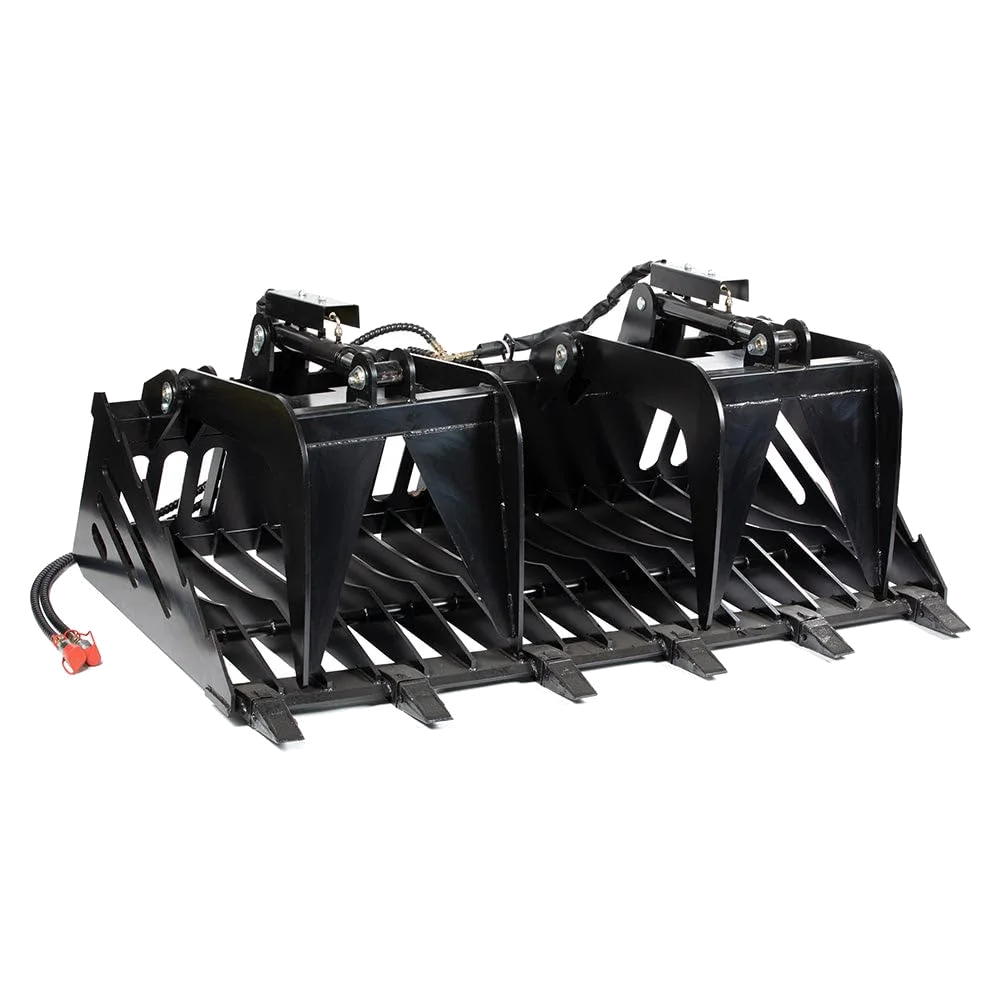
Skip this grapple for revenue-critical work or any carrier near its lift limit; consider it only when your SSQA machine has ample capacity and you are prepared to inspect, reroute, and possibly repair the attachment yourself.
Based on 49 owner ratings and 1 other source. We have not tested this machine ourselves.
We earn a commission if you buy through our links, which does not affect what we say.
Read how this site works →
The final call
The Titan 72-inch Skeleton Rock Grapple earns a narrow yes for a self-reliant owner with a strong SSQA carrier and a recurring need to separate roots, brush, and debris from loose soil. Its productive idea is validated by exact owners, and successful orchard and lot-clearing reports show that the attachment can do serious work.
The broader answer is no. Skid Steer Mulch would not choose it for revenue-critical work without a documented replacement-parts path, would not trust the factory hose arrangement without a full-motion clearance test, and would not place it on a carrier whose useful lift disappears under a 1,050-pound attachment. A grapple this heavy should reduce uncertainty; the retained weld, cylinder, hose, and support reports leave too much of it with the buyer.
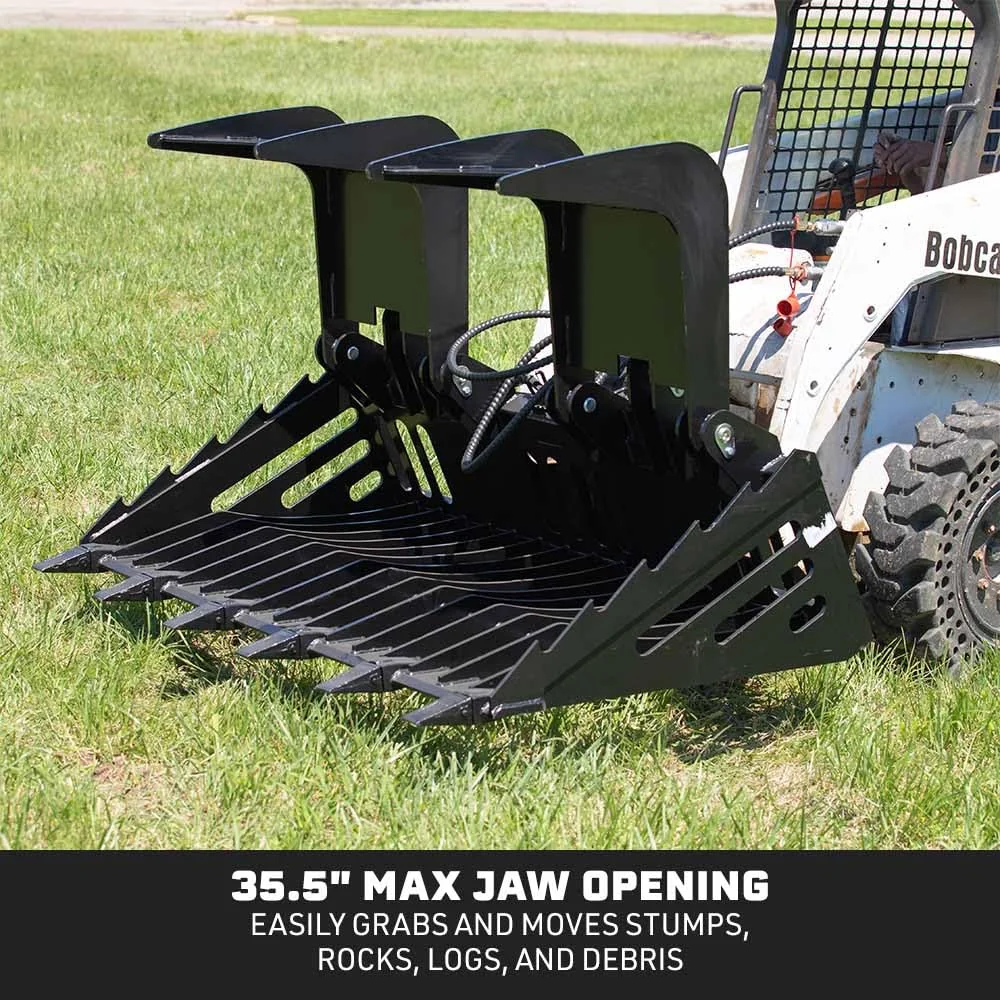
Titan’s 72-inch Skeleton Rock Grapple is not a bad idea buried under bad marketing. Its open floor, four-inch tine spacing, two hydraulic cylinders, and deep frame form a useful tool for clamping roots, brush, and bulky debris while shaking loose soil back onto the ground. The problem is that the attachment demands nearly as much scrutiny as the load it is supposed to carry.
The owner evidence splits in a way that matters. One operator used the dual grapples to keep roots and woody material contained while shaking dirt free, and another reported pulling an almond orchard without trouble. Against that, an exact-product owner described a grapple tearing away at its welds during the first week of forestry work, a bending mounting plate, cylinder trouble from initial use, and costly downtime. Two more owners reported a crack or later structural separation. Those accounts do not prove that every unit will fail, but they make an unconditional recommendation impossible.
This is therefore a narrow, capability-first purchase. It suits a mechanically self-reliant owner who needs coarse separation, has a genuinely strong carrier, and can correct hose routing before work begins. It is a poor wager for anyone who expects dealer-level preparation, cannot tolerate a delayed replacement part, or needs every pound of the carrier’s rated lift.
Key Specifications
The machine-match math is harsher than the attachment name
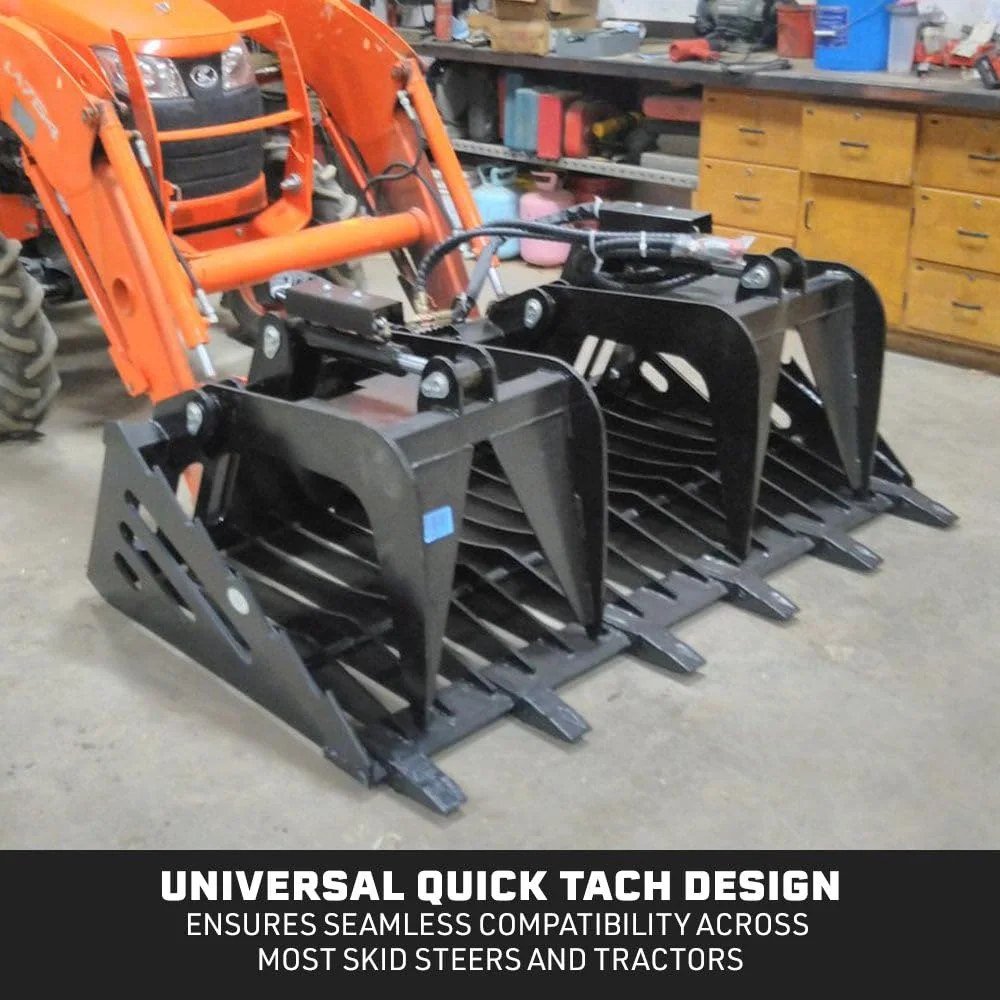
“72-inch” is the product class, not the attachment’s maximum exterior width. The captured listing specifies 73 inches inside, 74 inches outside, 49 inches of depth, and 1,050 pounds before a rock, root ball, or log enters the grapple. That outside width affects gates, trees, trailers, tire clearance, and transport, while the depth pushes the payload’s center farther ahead of the loader pins.
| Captured specification | What the buyer should do with it |
|---|---|
| Nominal 72-inch size | Plan around the listing’s 74-inch outside width rather than the name on the product. |
| 1,050-pound listed weight | Account for attachment mass, forward load center, carrier stability, axle limits, and any required counterweight before estimating usable payload. |
| 49-inch depth | Use the carrier’s capacity at the relevant forward load point, not merely a lift figure measured at the pivot pins. |
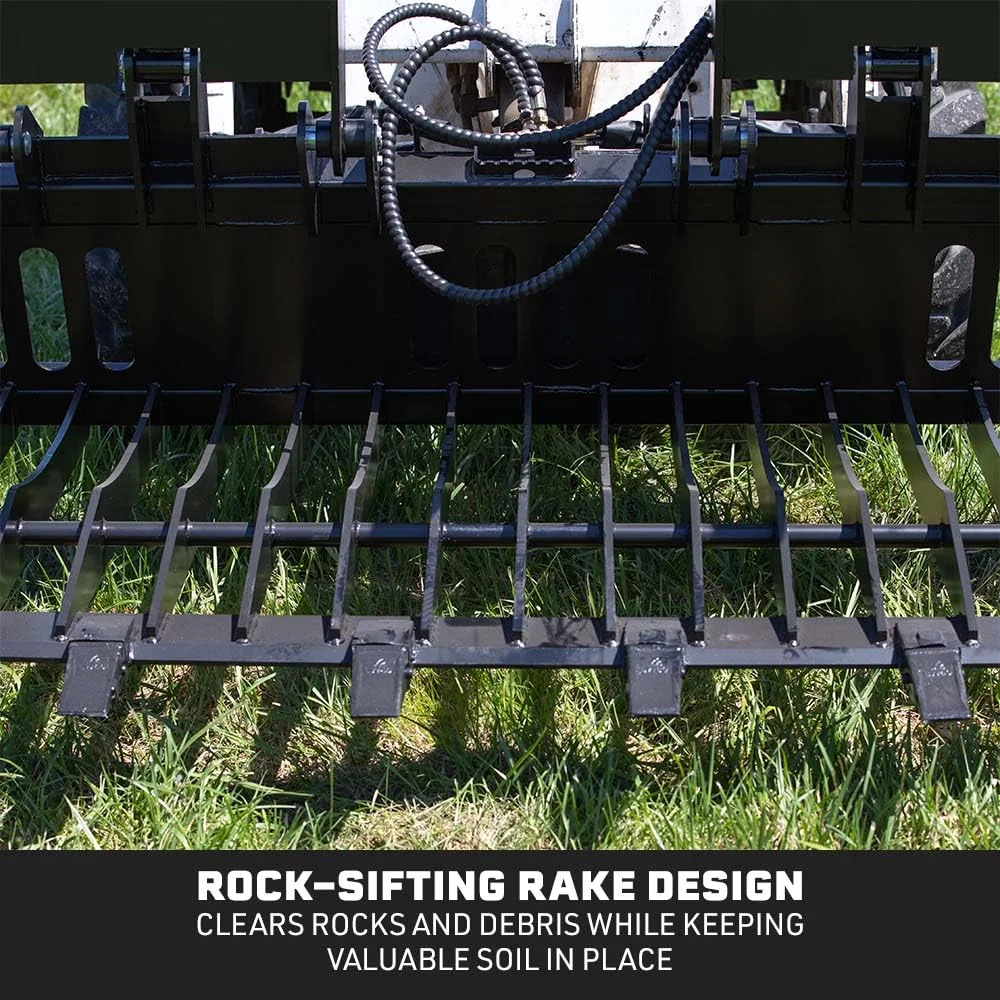
| Four-inch tine spacing | Expect coarse dirt shedding rather than retention of small stones or finish-screened soil. |
| Half-inch steel teeth | Treat the dimension as a seller specification because the exact teeth were not independently measured. |
| Three-by-three-inch steel tubing | Do not confuse visible material mass with proof of consistent weld quality. |
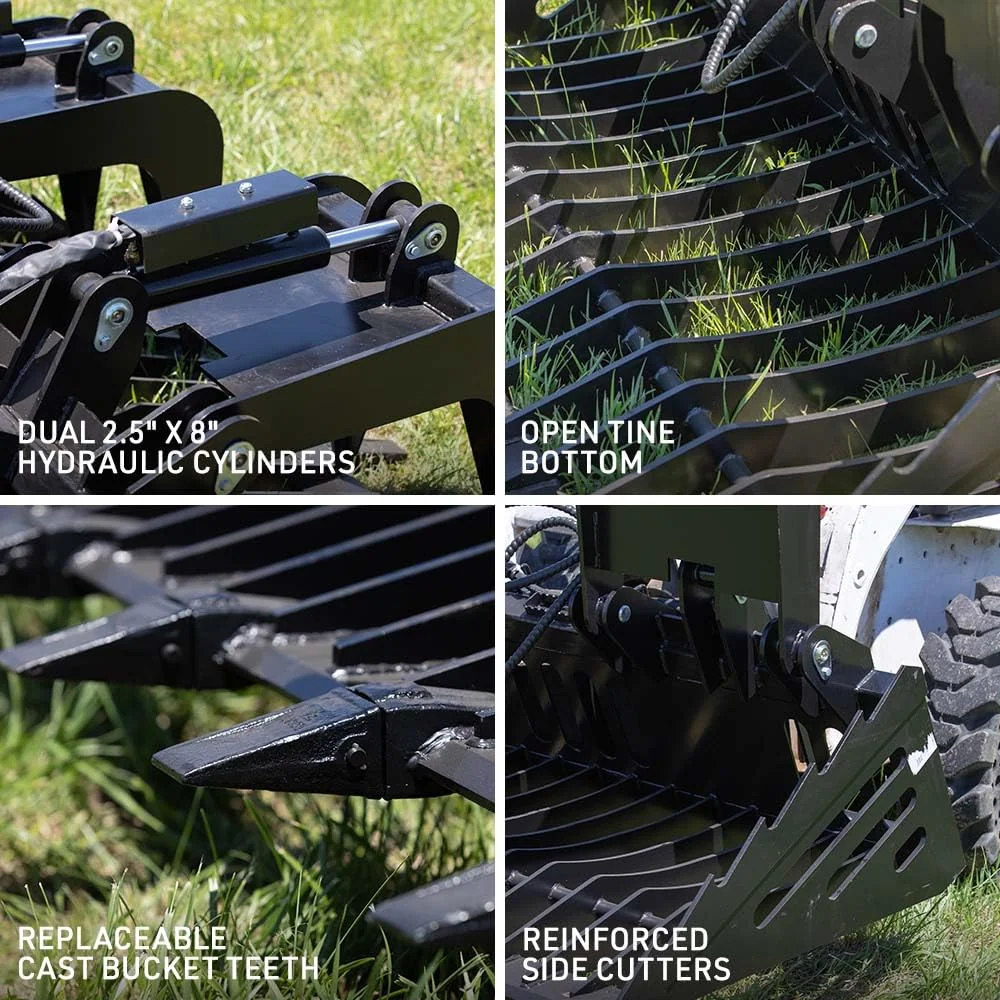
| Dual 2.5-by-8-inch cylinders rated at 3,000 PSI | Confirm that the carrier’s auxiliary circuit, control arrangement, couplers, hoses, and operating limits are compatible. |
| Flat-faced couplers and hoses included | Verify coupler style, hose reach, fitting clearance, and the entire moving hose path on the actual carrier. |
| Cutting edge listed as both 73 and 74 inches | Ask the seller to resolve the listing’s internal conflict if exact edge length matters. |
Owner reports reinforce the weight warning rather than settle it. One exact owner estimated the attachment at more than 1,200 pounds and said it noticeably reduced a 70-horsepower tractor’s remaining lift, while a Case 1840 owner thought the grapple was almost too large for that machine. The current captured specification remains 1,050 pounds, but the disagreement is a reason to verify delivered configuration and carrier capacity rather than substitute an owner estimate for the listing.
A closely related six-foot Titan grapple owner supplied a useful load-center example. His tractor was rated around 2,300 pounds at the pivot but about 1,700 pounds at 500 millimeters forward; after allowing for a grapple he described as nearly 1,000 pounds, he estimated roughly 700 pounds remained at that load point. That video does not verify this ASIN’s exact weight, but it demonstrates why subtracting attachment mass from the most flattering loader number can produce a dangerously optimistic answer.
The listing’s 3,500-pound wording does not solve the calculation. It alternately describes a maximum capacity and machines with lifting capacity up to 3,500 pounds, leaving the intended meaning unclear. It is neither proof that the grapple can safely carry a 3,500-pound payload nor a complete specification for the machine required to operate it.
A plate that latches is only the first layer of compatibility. Our guide to attachment compatibility explains why mount geometry, auxiliary hydraulics, couplers, hose routing, carrier capacity, and operating clearance must all agree before a powered attachment is genuinely usable.
What it does well: hold the wood, lose the dirt
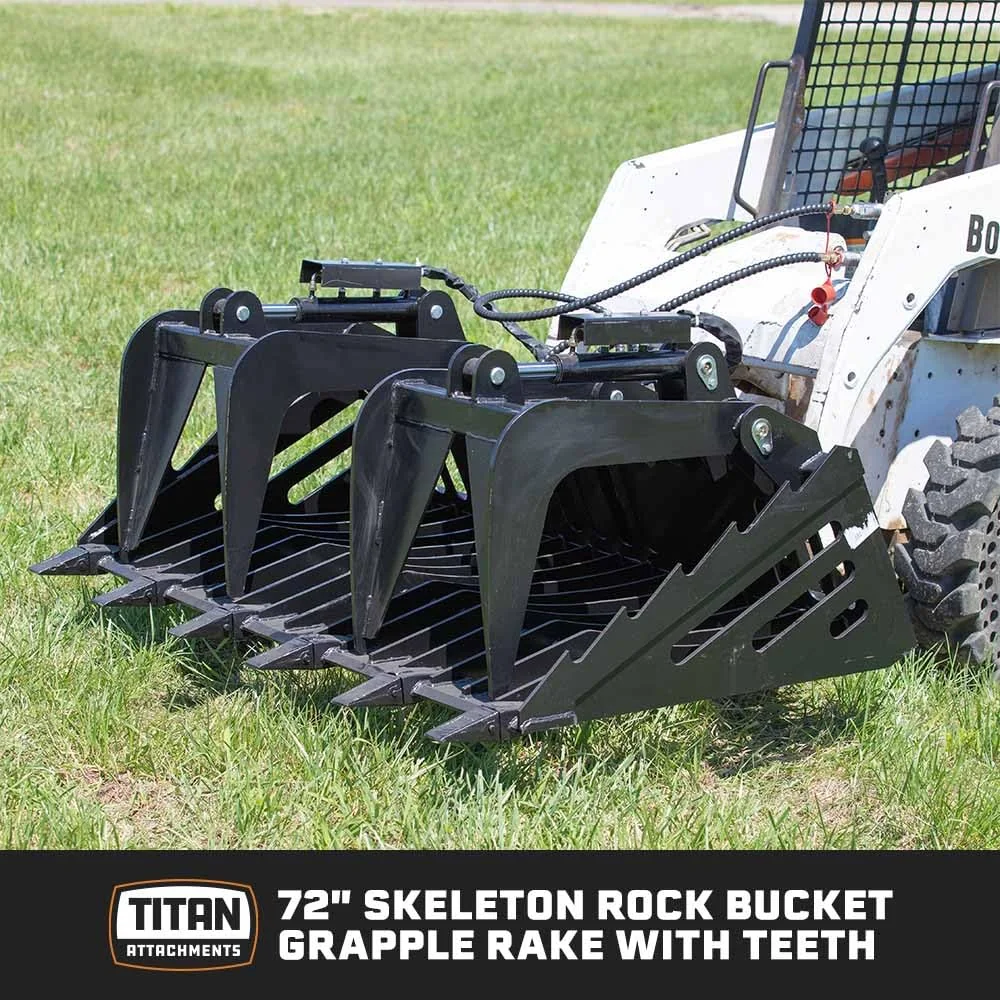
The most convincing performance report is also the least glamorous. A Kubota SVL95-2 owner scooped a mixture of roots, wood, and soil, closed both grapples to stop the woody load from bouncing out, and shook the attachment until the dirt fell through. That is exactly the job an open skeleton should simplify, and it is stronger evidence than a clean grapple posing beside a tidy rock pile.
Four-inch spacing makes this a coarse separator, not a soil screen. It should release loose dirt and undersized material while retaining larger roots, rocks, and debris, but calling those openings “fine grade” overstates the precision. Small stones can pass through, and the open floor cannot carry loose soil like a conventional bucket.
| Job | What the record shows | Skid Steer Mulch’s reading |
|---|---|---|
| Separating roots and wood from soil | An exact owner describes scooping, clamping, and vigorously shaking the load while dirt falls away. | Best-supported use. |
| Orchard and lot cleanup | Exact owners report successful almond-orchard removal and lot clearing. | Credible, although hours and total workload were not recorded. |
| Logs and aggressive forestry work | One owner liked the grapple after light early use, while another reported a first-week weld failure during log handling. | Capability is plausible, but durability under this work is disputed. |
| Rock clearing | The seller advertises rock handling, but the retained exact-product reviews do not document a measured rock-clearing job. | Reasonable by design, not independently demonstrated here. |
| Fine screening or finish grading | The floor has four-inch openings and no exact owner reports precision screening or a finished grade. | Wrong tool for the task. |
| Lifting a 3,500-pound payload | The listing uses 3,500-pound capacity language, but no retained owner verifies such a load. | Do not treat the figure as net payload permission. |
The pair of grapples is useful because a broad, irregular load needs containment across more than one point. The supplied evidence confirms that practical clamping benefit, but it does not establish that the two lids always articulate independently against uneven objects. The listing confirms two cylinders; it does not explain the hydraulic relationship between them in enough detail to promise independent motion.
The seller also advertises replaceable teeth, side cutters, a cutting edge, and a maximum opening of 35.5 inches. No retained exact-product owner isolates the side cutters or reports replacing a tooth, so those remain specifications rather than proven ownership advantages. The opening is adequate for many roots, logs, and loose debris loads, but it is not a substitute for choosing the right loading approach or grapple geometry.
Value here is a tolerance for uncertainty, not a price
No current price was captured for this review, so a live dollar figure cannot rescue or condemn the grapple. The durable value question is whether its coarse-separation productivity outweighs the capacity it consumes, the setup attention it demands, and the downtime risk revealed by the retained reports.
For an owner clearing roots, brush, orchard debris, and soil-contaminated piles with a well-matched full-size carrier, the answer can be yes. The dual-lid skeleton design addresses a specific nuisance: retaining bulky material while unwanted dirt drops back onto the property. An owner who can inspect welds, alter hose management, source ordinary hydraulic hardware, and repair steel has more ways to contain the risk.
A commercial crew should judge the same product more harshly. The severe exact review ties a cylinder and structural failure to revenue-producing forestry work, where the owner said downtime was especially costly. If a replacement-cylinder path and support response cannot be established before purchase, any apparent saving can disappear during the first interrupted job.
A compact tractor or marginal carrier faces a different problem. The hitch may accept an SSQA attachment while the loader has too little practical capacity left to carry useful material at the grapple’s forward load center. If the calculation only works when the ambiguous 3,500-pound listing language is treated as permission, it does not work.
Task choice matters just as much as brand choice. An experienced operator’s four-in-one comparison favors that bucket style for leveling, dozing, back-dragging, loose dirt, gravel, and loading, while rejecting it as the preferred tool for gripping forestry logs. If the weekly work is mostly soil and finish cleanup, an open skeleton grapple gives away too much bucket function; if it is mostly roots, brush, and coarse separation, this Titan’s geometry is the more natural fit.
The hydraulic hoses are not a footnote
Three of the eight retained exact-product reviews describe a consequential hose-routing, fitting-clearance, or hose-protection problem. On a Kubota SVL95-2, the included hoses were barely long enough and wanted either to catch the cylinder shields or become crushed at full rollback; the owner added springs and 45-degree fittings. Another owner tied the hoses back with a bungee because the attachment fittings could collide with the loader connections when curled too far. In the severe failure report, limbs removed guard hardware, the exposed hoses caught, and lines burst.
That pattern points more strongly to geometry and protection than to inherently poor hose material. The Kubota owner explicitly considered the hoses and spiral wrap good quality. Good hose cannot survive a bad path, however, and “hoses and couplers included” should not be read as permission to connect them and immediately work a brush pile.
A related 82-inch Titan skeleton grapple adds corroboration without proving an identical defect on this 72-inch model. Its owner found a hose scuffed near a moving pinch point after roughly four hours, initially managed the slack with a bungee, and later welded guides that kept the hoses above the danger area. The sibling evidence matters because it mirrors the exact owners’ concern, but the modification and dimensions belong to that 82-inch unit.
Steel mass does not settle the durability argument
The exact reviews are polarized. Several owners described substantial steel and successful work, including one account of hard orchard removal without problems and another of effective lot clearing. The negative record includes a small crack in one grapple, a first-week weld separation followed by mounting-plate bending, and an attachment reportedly coming apart after two years and only a few uses. The supplied evidence cannot determine whether production variation, machine force, task severity, technique, or some combination explains the difference.
Calling the product indestructible would ignore the failures; calling every unit defective would ignore the successful work. The more defensible description is a very heavy, seller-classified medium-duty grapple with useful core geometry and inconsistent retained reports about fabrication durability.
Parts and support decide whether a repair is an inconvenience or a shutdown
Customer-service reports conflict as sharply as the durability reports. One owner said Titan promptly resolved freight damage and later helped after a hydraulic line broke. Another repeatedly sought replacement of a cracked grapple, gave up, and arranged a repair; the forestry owner said a promised cylinder never arrived and that a later call involved an extended hold.
The listing advertises replaceable teeth, but none of the retained exact owners confirms a current tooth part number, a successful tooth purchase, or availability of cylinders, seal kits, pins, guards, and other repair items. Before putting this grapple into paid work, ask for written warranty terms, current part numbers, stock status, lead times, and the process for resolving a defect on a 1,050-pound freight item. A product with repairable steel can still be commercially impractical when a proprietary hydraulic part has no dependable path to the jobsite.
The supplied exact-product record also does not establish where this grapple is manufactured. It does not support a confident United States or China origin claim, and it does not establish current warranty coverage. Those unknowns should remain unknown until the seller supplies product-specific documentation.
Sources (2)
- Amazon listings and customer reviews — Titan 72 Skeleton Rock
- Owner and reviewer video, 3 channels