The Wolfequip T460S1 looks useful, but the evidence says wait.
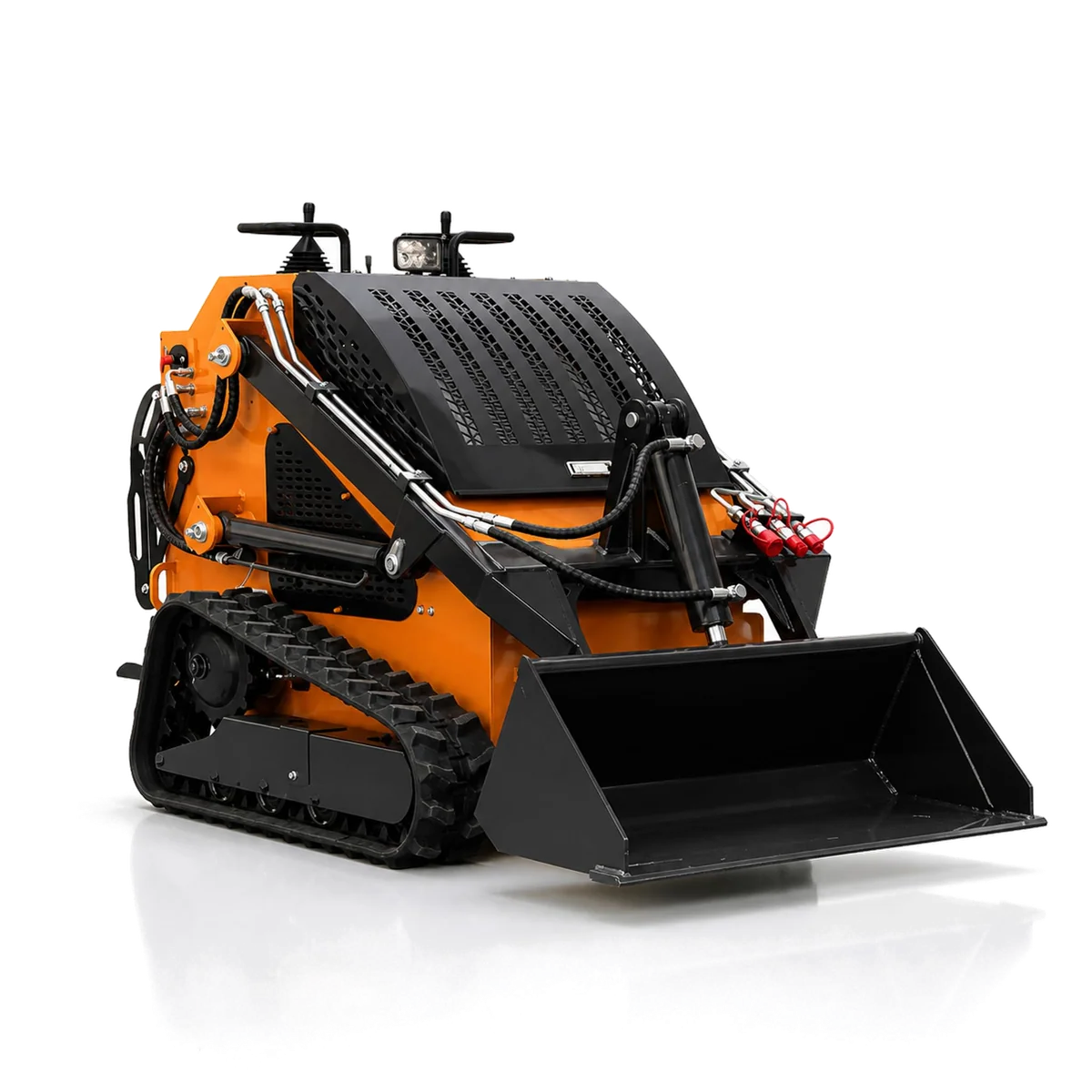
Do not buy the Wolfequip T460S1 for commercial production or any job that cannot absorb downtime; a mechanically capable property owner can keep it on the shortlist only after the seller documents its safety system, hydraulics, dimensions, parts and warranty.
Based on 1 owner ratings, 2 owner discussions and 3 other sources. We have not tested this machine ourselves.
We earn a commission if you buy through our links, which does not affect what we say.
Read how this site works →
Our answer stays no until the paperwork becomes real
The Wolfequip T460S1 has the outline of a useful property machine: compact tracked running gear, accessible service points, a folding platform, an included bucket and auxiliary connections on the close owner example. What it lacks is the evidence that turns initial utility into a responsible purchase. Safety logic, hydraulic architecture, lift methodology, exact dimensions and chassis-specific parts are the substance of the machine, not administrative details.
So the verdict remains no for crews, novices, uneven sites and powered-attachment plans. For a skilled private owner, it becomes a conditional maybe only after the seller answers the inspection list in writing, confirms the current interlock configuration and names a credible parts and warranty path. If those answers do not arrive, do not let a low entry cost recruit you as the factory’s quality-control department.
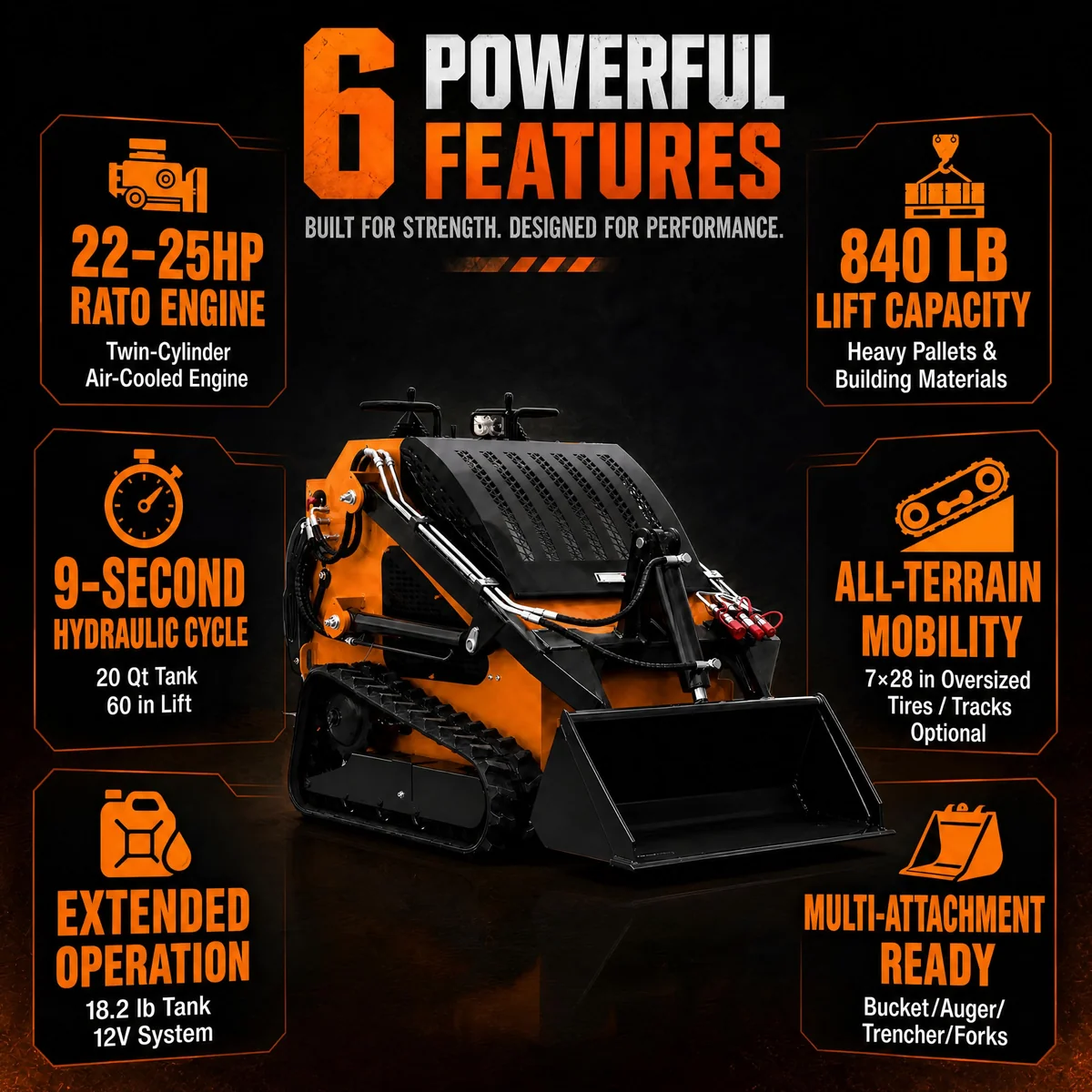
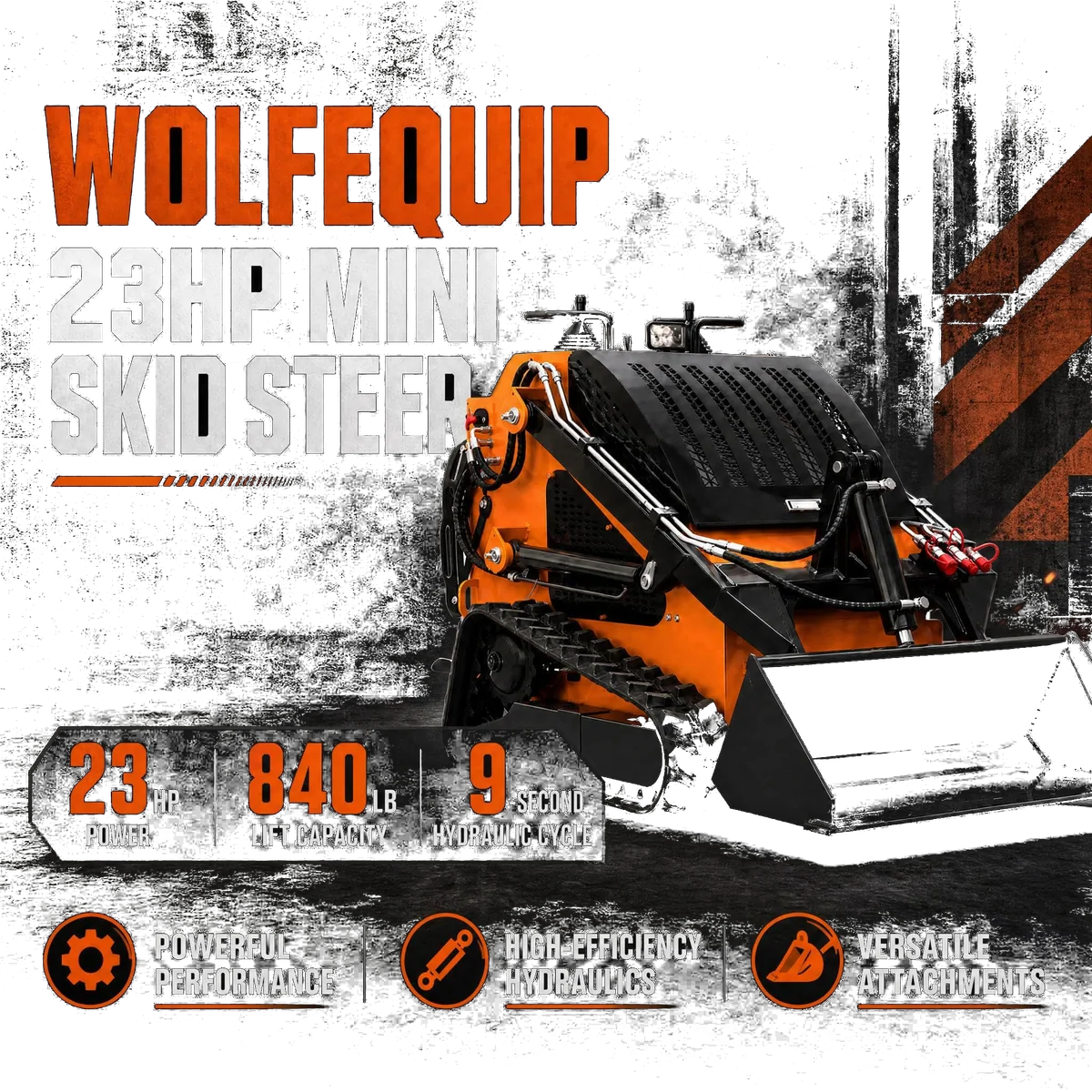
The appeal is easy to understand. The listing puts a tracked stand-on loader, a 46-inch bucket and a claimed 23 HP engine into one compact package, then adds an 840-pound lift figure and a list of jobs long enough to retire a wheelbarrow. The machine may well be useful. The evidence supplied for those promises is not yet useful enough to justify the risk.
Skid Steer Mulch found one close Wolf Equip owner walkthrough with enough narration to matter. It was filmed after roughly a week of ownership, when the machine started promptly, the tracks appeared sensibly tensioned and the open mechanical layout made a favorable first impression. That is encouraging commissioning evidence, not a durability record.
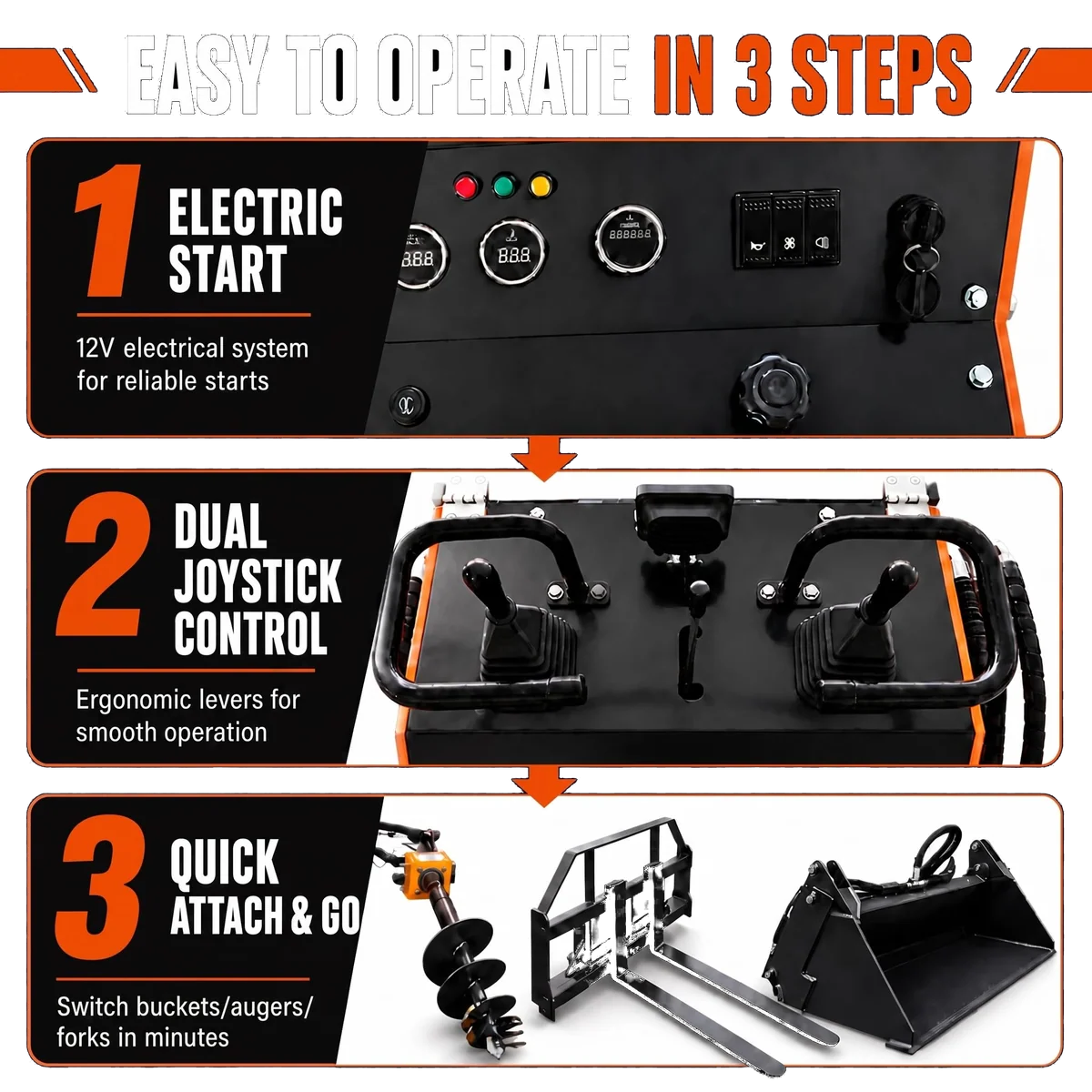
Then the owner said, “There’s no safety on there at all,” and explained that the controls remained operable with nobody standing on the platform. That suggests the machine shown had no operator-presence interlock. On a loader controlled by exposed hand levers, that is not a convenience feature omitted from a brochure; it changes the risk of every startup, dismount and attachment swap.
You maintain your own equipment, work mainly on prepared and reasonably level ground, need intermittent bucket or grapple help, and can park the loader without stopping a crew.
You need documented lift performance, narrow-gate certainty, continuous powered attachments, local service, predictable uptime or a machine a novice can safely learn without close supervision.
Everything that follows is about whether you genuinely fit the exception.
Key Specifications
The hardware looks approachable; the specification sheet does not
The encouraging details are physical rather than promotional. The close Wolf machine had a fold-up operator platform, battery disconnect, keyed hood, manual choke, visible fuel and hydraulic-fluid gauges, an hour meter with oil-temperature display, and a cooler that swung away for service access. The fuel filter, dipstick, battery, tank, pump and hoses were easy to see. Those choices shorten the path from a symptom to a diagnosis, although they do not reduce the chance of a symptom appearing.
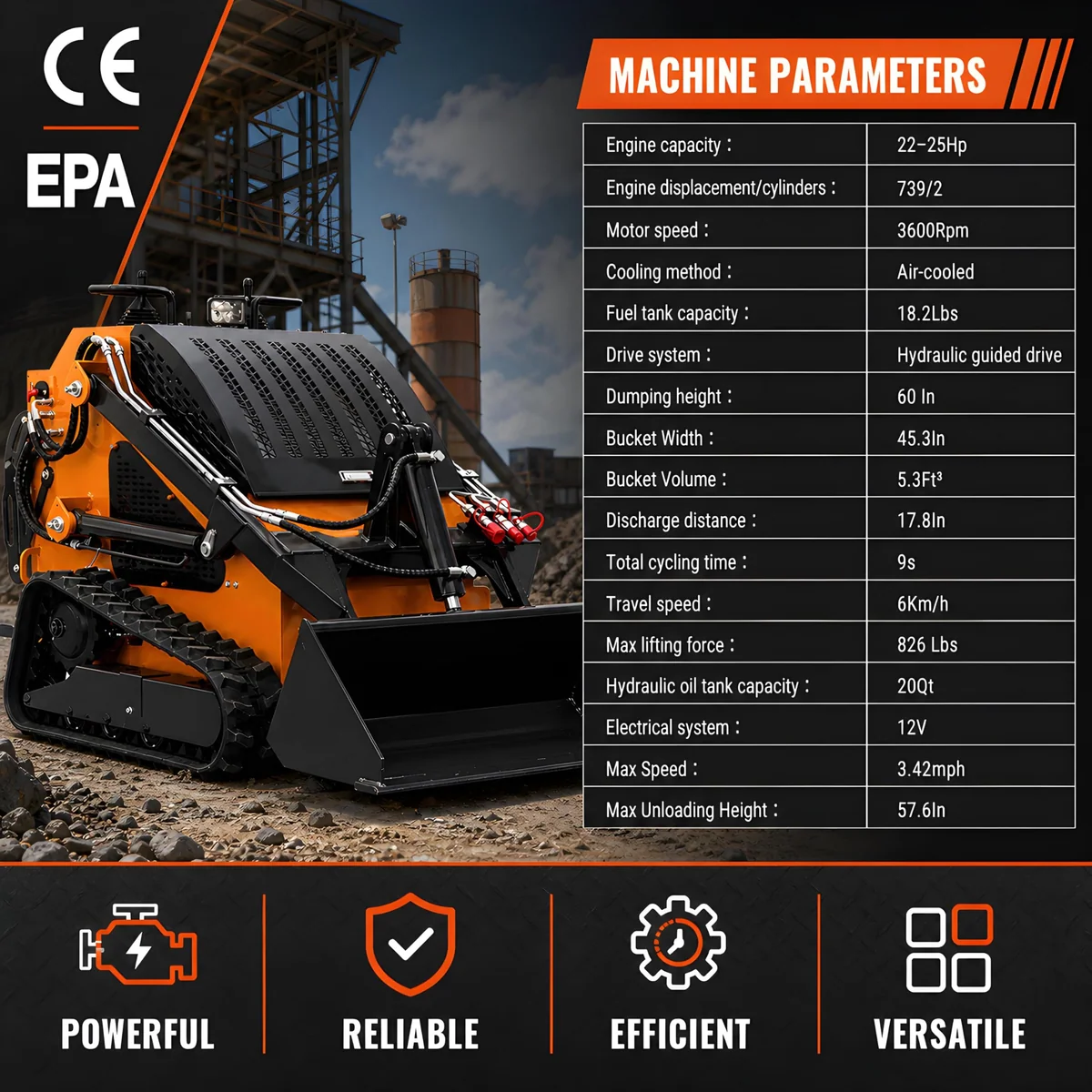
The Amazon copy deserves much less trust. Its title calls the machine both 23 HP and 22 to 25 HP, while a bullet for the tracked loader praises 7 × 28-inch tires. Fuel capacity is expressed as 18.2 pounds, a nine-second “full cycle” is never defined, and the stated 60-inch dumping height is not identified as hinge-pin height, bucket-edge clearance or clearance at full dump. These are not harmless typos when the same copy is the only support for the lift and hydraulic numbers.
| Claim | What survives scrutiny | Buying consequence |
|---|---|---|
| 23 HP RATO engine | The title also says 22 to 25 HP, and the exact engine plate was not captured. | Get a current plate photograph and engine model before planning filters, starters or other parts. |
| 840-pound lift | No rating method, load center, tipping load, lift height or counterweight condition is supplied. | Do not schedule an 840-pound carried load from this number. |
| Compact access | The included bucket is advertised at 46 inches, but machine-only width and platform-up length are missing. | Measure the narrowest opening and get both chassis and attachment dimensions in writing. |
| 60-inch dumping height | The listing gives one height without defining the measuring point or showing a verified loading test. | Match actual dump clearance and approach geometry to the trailer, truck or bin you intend to use. |
| Multi-attachment ready | The close machine had auxiliary connections and accepted an optional Wolf grapple, but mount standard, flow, pressure and case drain remain unidentified. | Confirm interface and hydraulics for each attachment rather than shopping by the word “universal.” |
Horsepower is the least useful number here
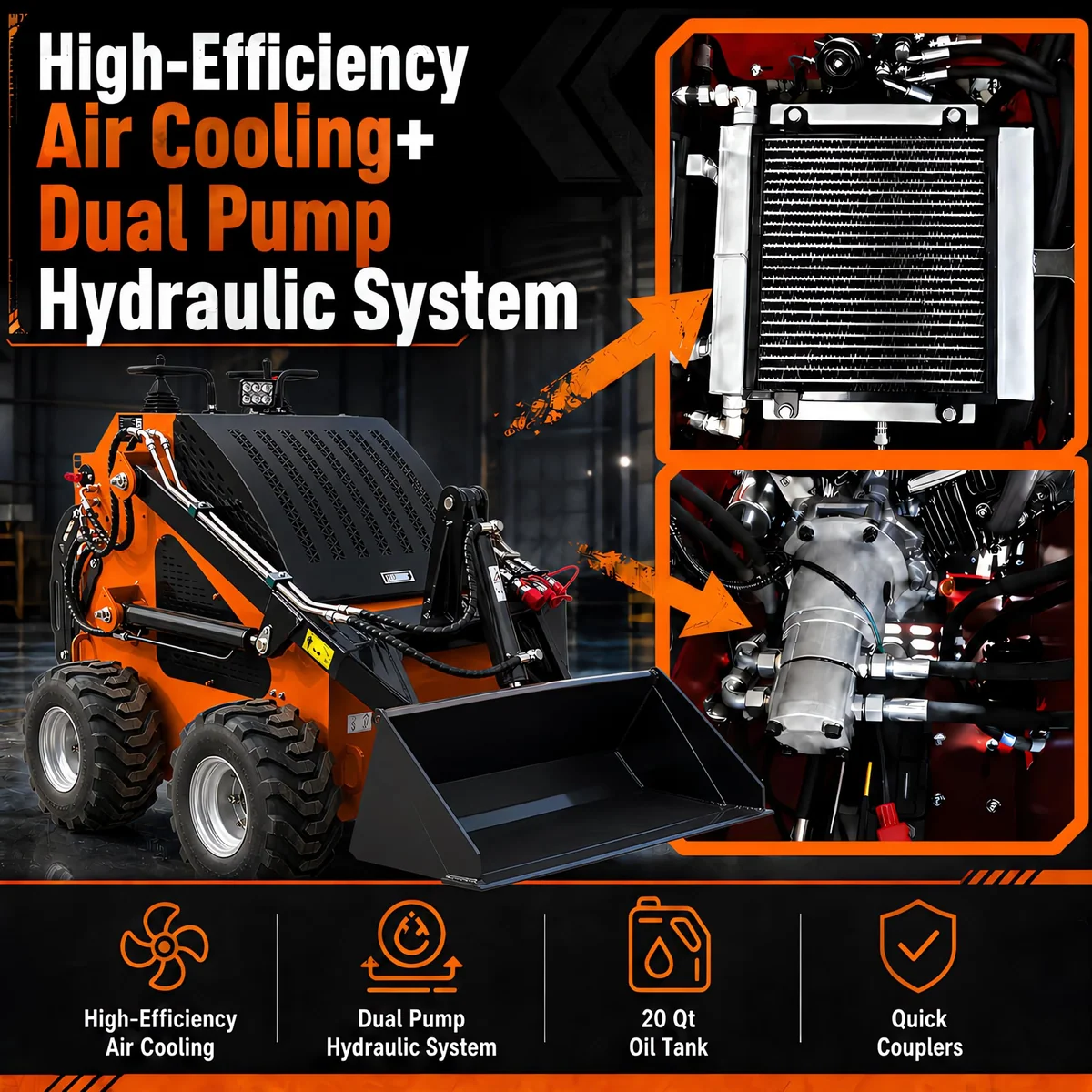
Engine output does not reveal usable hydraulic power. A buyer who wants more than bucket work needs auxiliary flow at working pressure, pump type and displacement, relief setting, cooler capacity, continuous detent behavior, coupler details and case-drain status. The listing supplies none of them.
The pump layout matters because a basic two-pump system can feed the auxiliary circuit through one track circuit. Engage a powered tool and one side may lose drive flow, so the loader arcs instead of traveling straight. A dedicated third pump can separate travel from attachment flow, although pump count alone still does not establish pressure, cooling or performance. A related RATO-powered MMS review unit, supplied free to its reviewer, was documented as a two-pump design, but that is a warning to inspect the Wolfequip pump stack, not proof that the T460S1 is built the same way.
The close Wolf walkthrough shows three connections at the front and calls them PTO hydraulics. The footage establishes auxiliary plumbing, not a mechanical PTO, and it does not identify the third connection as a case drain. No one in the collected record measured flow or pressure, locked an attachment on while traveling, or ran the hydraulics long enough to establish temperature control.
The 840-pound claim is not an 840-pound payload
Amazon never says whether that figure is rated operating capacity, static lift at the pins, full-height capacity or something else. The optional Wolf stump grapple in the close follow-up weighed 240 pounds and sat forward of the chassis before it held any material. Even subtracting 240 from 840 would be false precision because attachment geometry, load center, travel direction, lift height, operator weight and slope all alter stability.
Digging depends on the edge that meets the ground
A wide smooth bucket is a carrier and finishing tool, not a promise of excavation in hard ground. In a different 23 HP LRT23 test, the factory smooth bucket barely opened baked, rocky soil; a narrow toothed bucket broke the surface, then the smooth bucket carried and shaped the loosened material. That does not transfer performance to the Wolfequip, but it does explain why “digging” on a light mini usually means loose or previously disturbed soil unless a tooth or scarifier first creates penetration.
Readers planning finish work rather than excavation can compare the machine requirements in our grading-focused shortlist.
Turf needs the same skepticism. Tracks spread static weight across a larger contact patch, but skid steering drags that patch sideways. Contractors disagree about whether tracks or wheels do less damage, yet the discussion repeatedly warns that tight pivots can tear a lawn; without machine weight, contact area or ground pressure, the Wolfequip cannot promise a gentle footprint.
The bargain belongs to the owner who can stop working
At the research snapshot, the machine sat in the low-thousands budget class, and the close Wolf owner remembered a delivered total in the same neighborhood. Those are historical reference points, not a current quote. The useful number is the delivered, commissioned cost after the required attachment, any approved counterweight, a spare track, filters, fluids, an unloading plan and a downtime allowance are included.
A published market overview placed new established-brand mini loaders far above this captured price band, so the gap is real. The more expensive side generally buys documented dimensions and flow, an attachment ecosystem, dealer diagnostics, parts channels and resale history along with the machine. It does not buy immunity from faults, but it changes who must solve them and how long the machine is likely to wait.
The low-cost case is strongest for modest annual use and an owner with tools, hydraulic literacy and patience. That pattern runs through the positive forum accounts: the machines are handy precisely because their owners can tighten, grease, cross-reference and improvise. The same proposition is poor value for a crew that invoices by the hour, because one unidentified track or fitting can erase the purchase saving without ever appearing on the receipt.
The conditional buyer
A mechanically capable property owner with flat, prepared work areas, a strong need to replace hand labor, mostly low-demand attachments and no penalty for parking the machine can rationally accept this risk after the missing facts arrive.
The wrong buyer
A commercial operator, first-time equipment owner, slope-heavy site, narrow-gate job, continuous-flow attachment plan or one-loader business needs better documentation and support than this record provides.
If this price class still makes sense, read our Wolfequip T460S1 and MMS MS380L comparison before choosing. It keeps the unknowns beside the specifications, where horsepower and paint cannot hide them.
The first ten hours are part of the purchase
There is no long-term T460S1 record in the material available to this review. The closest narrated Wolf source stops at about one week, and the Amazon page had one rating when captured. Adjacent Chinese mini-loader accounts range from dead controls and violent modulation at an auction to owners reporting useful work at roughly 20 and 300 hours. That spread is a warning against calling the category either junk or proven; preparation, component batch, seller support and owner skill can dominate the badge on the hood.
One modified CRT23 owner was strongly positive near 190 to 200 hours, but he also said it took about 120 hours to understand and sort the machine. He described added bracing, batteries, charging, protection, counterweights, grease fittings and seal work. That is a credible path to satisfaction for a determined mechanic, not evidence that a stock Wolfequip will deliver 200 quiet hours.
Tracks are the most repeated early-hour fault cluster in the adjacent evidence. On a different high-track Chinese loader, the owner found the delivered tension extreme, saw rubber debris after a short drive and later derailed a track on the first small gravel load. He also relayed owner-group reports of dry bearings and very early failures, while making clear that his own bearings had survived beyond 20 hours. None of that is a proven Wolfequip defect. It is the reason track tension, bearing grease, pitch, link count and replacement part number belong in the purchase decision rather than the repair diary.
“Common parts” is only half an answer. Engines, filters, hoses, fittings and bearings may carry useful manufacturer markings or be replaceable through a local hydraulic shop. Tracks, sprockets, idlers, quick-attach hardware, frames and wiring revisions are much more chassis-specific; one related MMS review even found an unusual replacement-track pitch. A machine can be simple to repair and still sit idle because the one part it needs cannot be identified. Serviceable is not the same as supported.
Ask for this before payment
- Identity: a current engine-plate photograph, machine serial format and written confirmation that the delivered batch matches the listing.
- Dimensions: chassis width, bucket width, height, platform-up and platform-down length, ground clearance, and operating weight with fluids and bucket.
- Capacity: rated operating-capacity method, tipping load, load center, counterweight condition, hinge-pin height and true dump clearance.
- Hydraulics: pump count and type, auxiliary flow at pressure, relief setting, continuous detent, coupler size, case drain and oil specification.
- Undercarriage: track width, pitch, link count, tension procedure, roller and bearing numbers, and a seller-stocked replacement SKU.
- Safety: operator-presence and neutral-start interlocks, parking or hydraulic lock, emergency stop, lift-arm support and approved slope limits.
- Support: written warranty coverage, labor and freight responsibility, return terms, pre-delivery inspection, parts location and a serial-specific diagram.
Commission the delivered machine before working it
Match the engine and pump to the promised specification, verify every fluid, confirm that the cooler fan operates, grease the pins and undercarriage, inspect track sag, test neutral for creep, fully engage the attachment locks, and look for hoses or wires touching hinges, edges or the exhaust. Recheck tension, fasteners, leaks and bearing heat during the first hours rather than waiting for a thrown track or rubbed hose to announce the omission.
Our first-use inspection guide turns those checks into a fuller delivery and early-hours routine.
Frequently Asked Questions
How does a mini skid steer differ from a full-size skid steer?
A mini skid steer is a compact utility loader usually operated from a rear platform or from behind, and our plain-English guide explains where that format gains access and gives up stability or capacity.
Is the T460S1 the narrowest machine in this class?
No honest ranking is possible without its chassis dimensions, and the category itself mixes stand-on loaders, smaller walk-behind machines and heavier seated skid steers.
Can a Wolverine four-in-one bucket be assumed to fit?
No, because the collected record establishes neither a common brand relationship nor the T460S1’s exact attachment plate, pins, couplers, flow and pressure.
Which attachments are proved to come with the loader?
The listing supports a 46-inch bucket, while captions showing an auger, multi-bucket or forks do not establish box contents and the close owner said his stump grapple was extra.
Could the T460S1 be used for indoor demolition?
Not from the current evidence, because combustion exhaust, access width, floor loading, overhead clearance, debris protection and the apparent interlock gap all require a site-specific safety plan.
Sources (5)
- Amazon listings and customer reviews — Wolfequip Mini Skid Steer
- Owner reports across r/landscaping, r/Skidsteer threads
- Owner and reviewer video, 9 channels
- Purplewave — Article — www.purplewave.com
- Redpowermagazine — Article — www.redpowermagazine.com